
The Spain and Portugal blackout: what sold out, and what a UK home should already have
On 28 April 2025 mainland Spain and Portugal lost power, in some places until the next morning. Card machines, phones and trains stopped, radios and stoves sold out, and searches and sales for them jumped. What happened, what people bought, and what a UK home should already have.
On 28 April 2025, at 12:33 Spanish time (11:33 in Portugal), the power systems of mainland Spain and Portugal collapsed within seconds. The grids were back about 12 hours later in Portugal and 16 hours later in Spain, by the European grid operators' count, and in Spain 99.95% of demand was reconnected by 07:00 the next morning. In between, card machines and most cash machines stopped, mobile signal faded, trains halted and homes with electric cookers could not cook; many people followed the news on a battery radio. The lesson for a UK home: the useful things are cheap, and they sold out within hours, so have them before you need them.
By Tom Calder · Updated 14 November 2026 · Sourced to ENTSO-E's final expert panel report (20 March 2026), the Spanish government's analysis committee (17 June 2025), Portugal's energy regulator ERSE and network operator E-Redes, the Banco de España, the European Central Bank, Spain's state polling institute CIS, the Portuguese government's transport and telecoms reports, NESO, the National Risk Register 2026, GOV.UK Be Ready, the NHS and the UK Chief Medical Officers, and the retailers, survey and trade figures named in the table, all read on 14 November 2026
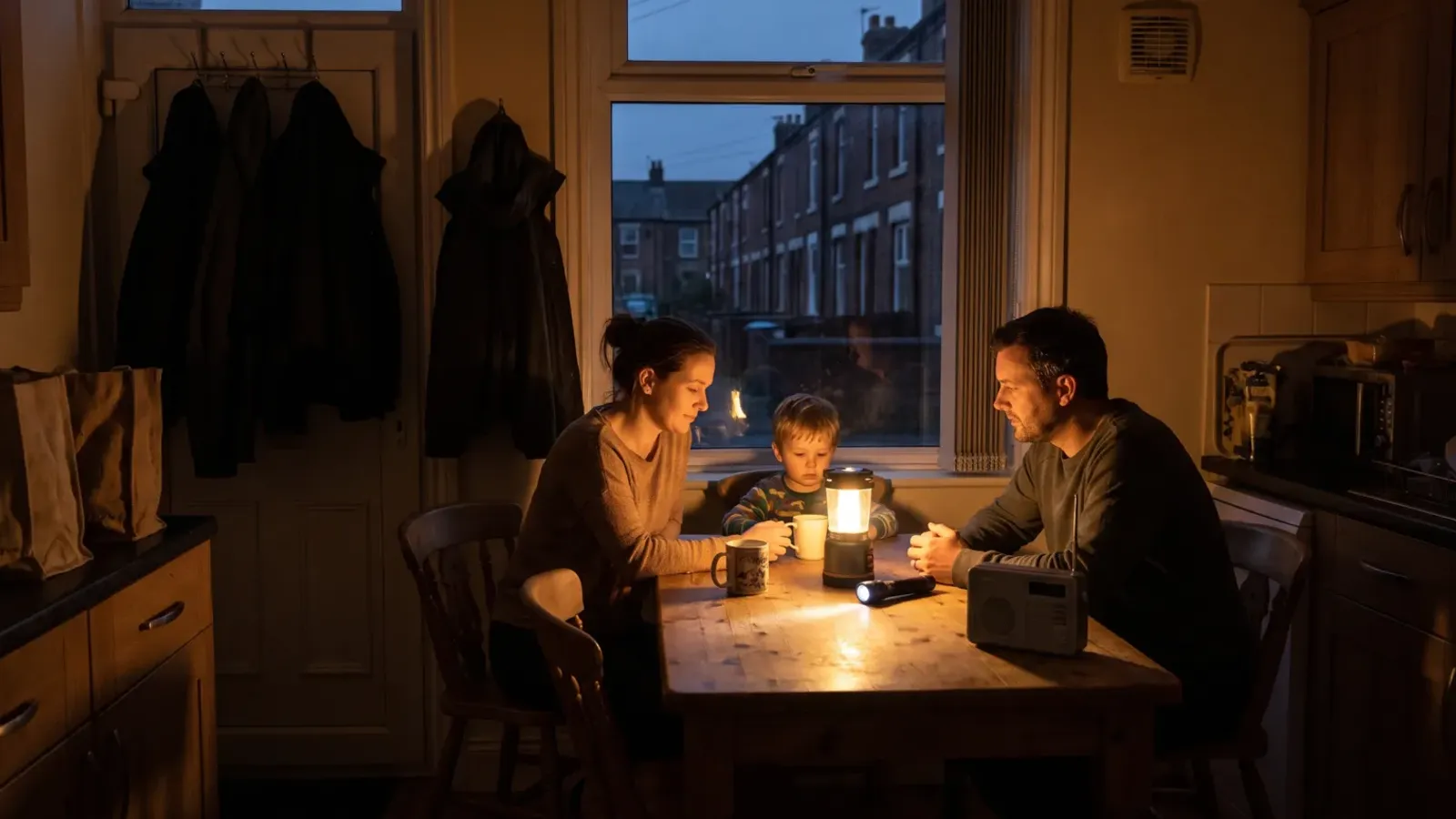
What happened in the Spain and Portugal power cut
At 12:33 Central European Summer Time on Monday 28 April 2025, the power systems of continental Spain and Portugal went down completely. The expert panel of ENTSO-E, the body for Europe's grid operators, calls it "the most severe and unprecedented blackout that had occurred in Europe in the past 20 years". A small area of France near the Spanish border was disrupted briefly. We found no official count of how many people lost power, so we don't give one: it was the whole of both mainlands.
Portugal's grid came back first. Portugal's energy regulator ERSE says the grid operator REN restored the national transmission network at about 23:20 Portuguese time, starting from power stations that can start themselves. The local network company E-Redes announced on the morning of 29 April that every customer was back on. In Spain, the government's analysis committee says 99.95% of demand had been restored by 07:00 on 29 April, and all of Madrid by 00:30. ENTSO-E's final report puts it as restoration "completed in 12 hours in Portugal and 16 hours in Spain".
What caused the Spain blackout
ENTSO-E's expert panel, 49 specialists led by grid engineers from Austria and Hungary, published its final report on 20 March 2026. It says the blackout "is the result of multiple interacting factors": a combination of voltage fluctuations and oscillations led to "widespread generation disconnections in Spain, particularly inverter-based resources, followed by a cascade of overvoltage disconnections", until the Iberian system lost step with the rest of Europe's grid. In the report's summary, the blackout came after "an uncontrolled, rapid rise in system voltage and loss of voltage control". Despite the defence plans working as designed, both systems collapsed "within seconds".
The Spanish government's own committee, which reported on 17 June 2025, reached a similar description: the total loss of power "was caused by an overvoltage problem with multiple causes" and the system "had insufficient voltage control capacity" (our translation). It ruled out a cyberattack. Both reports describe a chain of causes, not a single one, and so does this page.
What stopped working at home and in the street
Card payments and cash machines. Spain's central bank, the Banco de España, found that the lack of both electricity and connectivity stopped most cash machines, and that fewer than 4% have a backup power supply. Using card data, it found card spending from midday to the end of 28 April was 55% lower than on the same Monday three weeks earlier, and 69% lower in high-street retail outside the big chains. It says most small shops lacked backup systems and could not trade at all. In Portugal, the newspaper Observador reported shops taking only notes and coins, and a restaurant whose card terminal still had battery power but could no longer connect over mobile data.
Mobile phones and the internet. Phone masts run on backup batteries in a power cut. In Portugal, Observador reported that some masts stopped quickly because their batteries had run down. Portugal's government, summarising a report by the telecoms regulator ANACOM, says the prolonged power failure caused "a cascade effect" on mobile and fixed networks, and that calls to the 112 emergency number were "heavily restricted" on fixed lines. In Spain, a survey by the state polling institute CIS on 29 and 30 April found 55.5% of people named phones, landline or mobile, not working as one of the two things they missed most. The Banco de España says that in many areas connectivity only came back two hours after the power.
Traffic lights. elDiario.es reported that many of Madrid's traffic lights stopped working, and that mobility officers and national and local police directed traffic by hand. In Portugal, Observador reported police on the streets helping people with traffic because the lights might fail.
Trains and metros. On the evening of the blackout, Spain's prime minister thanked the rail companies and the military emergency unit for helping about 35,000 passengers caught on more than a hundred trains, reported by Público. The Portuguese government says 93 trains stopped, 80 of them on metro systems and 13 on the railway, and Observador reported people trapped inside Lisbon Metro trains. Público reported that the Madrid Metro was still closed late that night.
Lifts. elDiario.es reported fire crews rescuing people trapped in lifts. Portugal's civil protection authority later told MPs that there had been more than 400 incidents of people trapped in lifts, reported by the regional newspaper DNoticias.
Cooking, the fridge and water. In the CIS survey, the thing most people missed was electricity at home for tasks such as cooking and keeping food and medicines cold: 62.1% named it. Of those who said they had lacked something at home, about a third (34.9%) named a way to cook that did not need electricity. In Portugal, Lisbon's water company EPAL told Observador its supply depends on electricity to treat water and pump it through the system, and the head of the national association of municipalities said many blocks of flats need electric pumps to get water to the taps.
What kept working. Radio. In the CIS survey, about half of people (49.6%) already had a battery radio, and 62.1% listened to the radio during the blackout to find out what was happening. Portugal's public broadcaster RTP said that for many people radio "was the only source of information all day". Cash also kept working: the Banco de España says cash "ensures autonomy" because it is the only means of payment that works without a device, electricity or the internet, and the European Central Bank wrote that the blackout turned cash into "the only means of payment for many of those who held it or could access it". Hospitals ran on emergency generators, elDiario.es reported. We found no source saying landlines kept working, so we don't say they did.
What people bought afterwards
Shops ran out within hours. elDiario.es reported that big Madrid building-supplies chains sold out of generators within a few hours of the blackout starting; one worker said they "were sold out by half past two". A day later, a Madrid Decathlon had no camping stoves left. RTP reported that "in many places radios and batteries sold out". The figures below are what retailers, a maker, a survey and two price comparison sites said afterwards.
| What | Change | Who measured it, and what |
|---|---|---|
| Radios, Portugal | Up 4,594%: about 47 times the earlier demand | KuantoKusta, a Portuguese price comparison site: demand on its site on 28 and 29 April against the two days before |
| Power banks, Portugal | Up 1,728%: about 18 times | KuantoKusta, same measure |
| Portable stoves, Portugal | Up 348%: about four and a half times | KuantoKusta, same measure |
| Generators, Spain | Up 639%: about seven times | idealo.es, a price comparison site: searches and interest on its site on 28 April, as reported by trade press |
| Camping gas stoves, Spain | Up 547% | idealo.es, same measure |
| Solar panels, Spain | Up 400% | idealo.es, same measure |
| Portable power stations, Spain | Up 375% | idealo.es, same measure |
| Radios, Spain | Up 205% | idealo.es, same measure |
| Generators and portable cookers, Spain | Sales up 500%: six times | Leroy Merlin, a DIY chain, in a spokesperson's statement to elDiario.es: its sales against the same day a year earlier |
| Generators, Spain | Sales up more than 100%: more than double | Himoinsa, a generator maker: its sales in Spain in the week after the blackout |
| Had considered buying a gas stove, radio or torch, Spain | 56% of adults | Cetelem, a consumer lender: an online survey of 2,200 adults in Spain, 12 to 19 May 2025 |
Portugal figures from KuantoKusta, reported by the news agency Lusa on RTP. Spain search figures from idealo.es as reported by ecommerce-news.es and Marketing4eCommerce; we could not open idealo's own release. Sources are listed at the end of the page.
What these numbers are, and what they are not
Most of these figures are searches or demand on one website, or one company's sales, over a day or two. A rise of several thousand per cent can start from a small number. None of them is a count of sales across a whole country, and idealo did not say what it compared its Monday figures with.
Two counterweights. KuantoKusta said it saw no significant price changes on these products. And International Rental News reported that, according to the equipment rental firm Kiloutou, the overall commercial impact on generator rental and sales was limited by the short duration of the event. People rushed for the cheap things on the day.
What lasted: home batteries
The longer change in Spain was home batteries. APPA Renovables, Spain's renewable energy association, reported on 17 February 2026 that 339 MWh of batteries were installed behind the meter in 2025, 119% more than in 2024, with growth in both homes and businesses. The trade magazine Energías Renovables puts batteries in homes at 158 MWh in 2025, up from 62 MWh in 2024, a rise of 155% (its home and business figures add up to APPA's total). It says the market took off in the second half of the year, spurred by the blackout (our translation), according to all the sources it consulted. That link is the industry's reading; APPA's own release does not mention the blackout.
This was not a boom in solar panels. APPA's same release says new solar for self-consumption fell 15% in 2025, its third year of decline, with a slight rise in homes. We found no sales figures for solar panels in either country. In Cetelem's survey, 72% of people who had panels or were thinking of getting them said their system had no battery or off-grid option.
For Portugal we found no number. The energy retailers' association ACEMEL said a month after the blackout that demand for self-consumption offers with batteries had gone up, reported by Lusa through ECO, without a figure. APREN, Portugal's renewable energy association, said in January 2026 only that battery storage, including in homes and businesses, was "gaining traction", without a figure. We found no figure from DGEG, Portugal's energy directorate.
Do solar panels work in a power cut?
Usually not. In Portugal, the news agency Lusa reported, through ECO, that on the day there were reports of families with grid-connected panels losing power "even in full sun", because inverters shut down for safety, and that the same happened to most home batteries without a backup unit. Catalonia's public broadcaster 3Cat explained that home solar inverters stop working in a blackout for safety reasons, and that the vast majority of installations are built that way.
The UK works the same way. The Electricity Safety, Quality and Continuity Regulations require anyone running a generator connected to the grid, which includes rooftop solar, to have equipment "to prevent danger" to the network, and small systems must be "configured to disconnect" themselves when the network's supply is cut. The Energy Networks Association's standard for small home systems, G98, sets out how. The point is safety: a system that kept feeding a line the network has switched off could put power into cables that engineers are working on.
To keep some power from panels, you need a battery system with a backup mode, called EPS (emergency power supply) or island mode, wired in for it. The manufacturer GivEnergy's installation guide, as one example, says its inverters have this as an option, limits the backup output to between 1.25 kW and 5 kW depending on the setup, and its simplest method is one dedicated backup socket that switches over automatically, into which you plug the things you want to keep running. Island mode needs its own earthing arrangement. The Energy Saving Trust puts a home battery at £1,500 to £10,000, and about £4,600 for a 5 kWh system. Our guide to solar and power cuts explains the options.
Could a blackout like Spain's happen in the UK?
The government's National Risk Register 2026 includes a national power outage. It says: "Great Britain has never experienced a nationwide loss of power and the likelihood is low, however, similar events have occurred internationally", and gives the 2025 Spain and Portugal outage as its example. It rates the likelihood at 1 to 5% over five years, and plans for a worst case in which full, stable power returns after more than seven days.
NESO, which runs Great Britain's electricity system, published its review of the Iberian blackout on 23 September 2025. It says "GB's energy system is well-protected against the sequence of events that led to April's blackout" and that it "has taken action to mitigate many of the risks seen in Iberia", and that it will keep improving, "particularly in voltage management". For this winter, its Winter Outlook says: "We are not forecasting blackouts."
We don't add odds of our own. Two of our fact-checks cover the rest: is a 3-day blackout planned for the UK in 2026? and is there going to be a worldwide blackout?. The register's scenario is explained in our national power outage guide.
What a UK home should already have
Start with the cheap things that sold out first. They are on the government's Be Ready checklist, and most homes have some of them already.
A battery or wind-up radio. Radios topped KuantoKusta's list, and in Spain 62% of people listened to the radio during the blackout. Be Ready says: "Keep a battery or wind-up radio (and spare batteries) at home." Be Ready's checklist specifies an FM radio: see our emergency radio guide.
Torches and spare batteries. Be Ready says: "Keep a battery or wind-up torch (and spare batteries) at home. Torches are safer than candles."
A charged power bank. It's on the Be Ready checklist. It keeps a phone going while there is signal, but in Portugal some masts' batteries ran down and in Spain working phones were among the things people missed most, so a phone is not a substitute for a radio.
Some cash. Be Ready says to keep "a small amount of cash for essential purchases if electronic payments or ATMs are disrupted"; its checklist suggests a mix of coins and notes. Our guide to card machines and cash explains more.
A way to heat food and water without mains power, such as a camping stove, used outdoors only. The NHS says: do not use a barbecue or camping stove indoors or inside a tent. The UK Chief Medical Officers' advice for a national power outage says: "Do not use camping stoves and barbecues indoors as there is a risk of carbon monoxide poisoning, which can kill." Use it outdoors only, as both say. Our guide to cooking without power has the safe ways.
Then the bigger buys, if you want them. A portable power station runs lights, a router or a fridge for a while and has no exhaust; see our power station guides for sizes. Generators are different. The Chief Medical Officers say: "Do not use petrol or diesel generators or other similar fuel driven equipment indoors as the exhaust gases contain carbon monoxide", and to place one "outdoors at least 6 metres or 20 feet away, with the exhaust facing away from windows or doors". On the day after the blackout, the mayor of Taboadela in Galicia said there were signs, which he called speculation while police checked, that three members of one family who died had been poisoned by fumes from a generator, elDiario.es reported. Our emergency kit list covers water and food.
Common questions
What caused the Spain and Portugal blackout?
ENTSO-E's expert panel, in its final report of 20 March 2026, says it resulted from "multiple interacting factors": voltage fluctuations and oscillations led to widespread generator disconnections in Spain, then a cascade of overvoltage disconnections, and the Iberian system collapsed within seconds. The Spanish government's committee described an overvoltage problem with multiple causes and insufficient voltage control, and ruled out a cyberattack.
How long did the Spain blackout last?
It began at 12:33 Spanish time on 28 April 2025. ENTSO-E says the grids were restored in about 12 hours in Portugal and 16 hours in Spain. Spain's government says 99.95% of demand was back by 07:00 on 29 April; in Portugal, E-Redes said every customer was back on by the morning of 29 April.
Do solar panels work in a power cut?
Ordinary grid-connected panels don't: UK rules require them to disconnect when the network's supply is cut, so they can't feed power into lines engineers may be working on. To keep some power, you need a battery with a backup or island mode, installed for it, which usually powers only chosen circuits or a single socket.
Did shops run out in Spain and Portugal?
Yes, within hours. elDiario.es reported generators sold out at big Madrid chains within a few hours, and a Madrid Decathlon had no camping stoves left the next day; RTP reported radios and batteries sold out in many places. KuantoKusta, a Portuguese price comparison site, said demand for radios on its site rose 4,594%, about 47 times, on 28 and 29 April compared with the two days before, with no significant price changes.
Would card payments work in a UK power cut?
Not if the card machine or the shop's connection loses power. In Spain, card spending from midday to the end of the day was 55% lower than on a normal Monday and most cash machines stopped, the Banco de España found. GOV.UK Be Ready advises keeping a small amount of cash for when electronic payments or cash machines are disrupted.
What should I buy first for a power cut?
The cheap things that sold out first: a battery or wind-up radio, torches and spare batteries, and a charged power bank. Add some cash and a way to heat food and water outdoors, such as a camping stove, never used indoors. Most homes have some of these already; a power station or generator is optional.
Sources (44)
- ENTSO-E Expert Panel, Final Report on the Grid Incident in Spain and Portugal on 28 April 2025 (20 March 2026): 12:33 CEST, 'most severe and unprecedented blackout ... in the past 20 years', 'multiple interacting factors', restoration in 12 hours (Portugal) and 16 hours (Spain), read 14 November 2026
- Spanish Ministry for the Ecological Transition, presentation of the report of the committee analysing the 28 April 2025 electricity crisis (17 June 2025): overvoltage with multiple causes, insufficient voltage control capacity, cyberattack ruled out (in Spanish)
- Spanish Government, non-confidential report of the committee for the analysis of the 28 April 2025 electricity crisis (PDF, June 2025): 99.95% of demand restored by 07:00 on 29 April, Madrid by 00:30 (in Spanish)
- ERSE (Portugal's energy regulator), ERSE explica: investigation into the Iberian blackout of 28 April 2025: blackout at 11:33, REN restored the transmission network at about 23:20 (in Portuguese)
- E-Redes, electricity network restored 100% and back to normal (29 April 2025) (in Portuguese)
- Banco de España, Financial Stability Review no. 49 (autumn 2025): the impact of the 28 April 2025 blackout on payment systems in Spain (cash machines, under 4% with backup power, card payments down 55%) (PDF, in Spanish)
- Banco de España blog, How do we pay when everything goes dark? The blackout experience in Spain (27 April 2026) (in Spanish)
- European Central Bank, Economic Bulletin 6/2025, Keep calm and carry cash
- CIS (Spain's state sociological research centre), study 3513, flash survey on the 28 April blackout: 1,752 phone interviews, 29 and 30 April 2025 (PDF, in Spanish)
- Portuguese Government, ANAC, ANACOM and IMT deliver reports and recommendations on the impact of the blackout (10 June 2025): telecoms cascade effect, 112 on fixed networks, 93 trains stopped (in Portuguese)
- Observador, cash-only shops and card terminals without mobile data during the blackout (30 April 2025) (in Portuguese)
- Observador, planes and trains stopped, people taken off the Lisbon Metro, traffic lights off (28 April 2025) (in Portuguese)
- Observador, why water supply was interrupted in parts of Portugal during and after the blackout (29 April 2025) (in Portuguese)
- Observador, ANACOM considers minimum battery times for mobile masts; some masts stopped quickly with flat batteries (24 June 2025) (in Portuguese)
- elDiario.es, live coverage of the blackout: Madrid traffic lights, police directing traffic, lift rescues (28 April 2025) (in Spanish)
- Público (Europa Press), about 35,000 passengers helped on more than a hundred trains (28 April 2025) (in Spanish)
- Público, live coverage: Madrid Metro still closed (28 April 2025) (in Spanish)
- DNoticias, civil protection points to fuel shortages at hospitals during the blackout; more than 400 incidents of people trapped in lifts (January 2026) (in Portuguese)
- RTP, when the lights went out, the radio came on (29 April 2025): radio the only source of information for many, radios and batteries sold out (in Portuguese)
- elDiario.es, emergency generators let hospitals keep essential services running (28 April 2025) (in Spanish)
- RTP / Lusa, KuantoKusta: demand for radios up 4,594% and power banks up 1,728%, portable stoves up 348%, no significant price changes (April 2025) (in Portuguese)
- ecommerce-news.es, idealo.es: demand for generators up 639% and camping gas stoves up 547% (5 May 2025) (in Spanish)
- Marketing4eCommerce, the most searched products after the blackout, idealo.es figures (29 April 2025) (in Spanish)
- elDiario.es, the blackout brings a rush for generators, solar panels and stoves: Leroy Merlin sales up 500% on the same day last year; shops sold out (29 April 2025) (in Spanish)
- Power Progress, Himoinsa: one month after the Iberian Peninsula blackout, sales in Spain up more than 100% in the week after (30 May 2025)
- International Rental News, rental firms and the Iberian grid collapse: Kiloutou reported the commercial impact on generator rental and sales was limited by the short duration of the event (7 May 2025)
- Observatorio Cetelem, impact of the blackout on consumption (PDF, May 2025): 2,200 adults, 12 to 19 May 2025, 56% considered buying gas stoves, radios or torches; 72% of panel owners or planners without battery or off-grid option (in Spanish)
- APPA Renovables, annual self-consumption and storage report 2025, press release (17 February 2026): 339 MWh behind-the-meter storage, up 119%; new self-consumption solar down 15% (PDF, in Spanish)
- Energías Renovables, self-consumption battery installations in homes up 155% in 2025, 62 MWh to 158 MWh (4 June 2026) (in Spanish)
- ECO / Lusa, blackout increases demand for self-consumption solutions, ACEMEL (28 May 2025) (in Portuguese)
- APREN, renewable electricity in Portugal, 2025 analysis (PDF, January 2026) (in Portuguese)
- 3Cat (Catalan public broadcaster), why having solar panels doesn't guarantee power in a blackout (May 2025) (in Catalan)
- The Electricity Safety, Quality and Continuity Regulations 2002, regulation 22, parallel operation (legislation.gov.uk), read 14 November 2026
- Electricity North West, micro-generation and storage connections: what G98 isthe Energy Networks Association's standard for small generation
- GivEnergy, Connect EPS (island mode) installation guide (PDF, revised June 2025)
- Energy Saving Trust, battery storage: costs, read 14 November 2026
- Cabinet Office, National Risk Register 2026 (14 July 2026): national power outage
- NESO, Future-proofing GB's power system: reflections on the April 2025 Iberian event (23 September 2025)
- NESO, Winter Outlook 2026/27: 'We are not forecasting blackouts'
- GOV.UK Be Ready, power cuts: torch, radio, cash, read 14 November 2026
- GOV.UK Be Ready, checklist (PDF, October 2026): FM radio, torch, charged power bank, cash
- NHS, carbon monoxide poisoning: don't use a barbecue or camping stove indoors or inside a tent
- UK Chief Medical Officers, public health advice during a national power outage: camping stoves, barbecues and generators (GOV.UK)
- elDiario.es (Europa Press), three dead in Galicia, suspected poisoning by generator fumes during the blackout (29 April 2025) (in Spanish)
PreparedBritain is independent and not affiliated with HM Government.
The Power Cut Action Card
One page for the kitchen drawer: what to do first, what to have ready, how long food keeps, and how to stay warm without risking carbon monoxide. Free, no catch.
Download it straight away. We'll also send the occasional briefing when something genuinely matters — severe weather, live incidents, real price drops. Nothing else.
Latest from our live data
All stories → News · 15 NovYellow cold-health alert for North East, North West and Yorkshire and The Humber, 15 to 19 Nov
 News · 15 NovCould UK flights be grounded like the US? What failed in 2023, 2025 and 2026, and what to carry
 News · 15 NovUS flights grounded: your rights if your flight to or from America was cancelled or delayed
For the children this Christmas

Keep reading
All power cuts & energy guides →Sangean MMR-99 vs Midland ER300 Pro: a better radio or a bigger power bank?
Two crank-and-solar AM/FM radios that put their batteries to different uses: the IP55 Sangean MMR-99 for listening,…
Roberts SolarDAB 99 vs Philips TAR3500: DAB+ or a longer-running FM radio?
Two IP55 crank-and-solar radios compared: the Roberts SolarDAB 99 for DAB+ and Bluetooth, the Philips TAR3500 for 60…
Philips TAR1609 vs TAR1659: is there any difference?
The Philips TAR1609 and TAR1659 crank radios compared line by line from Philips’ own manuals: what the second model…
