Rise in sales of radios and tinned foods after the call to stock up: what you actually need
Retailers told BBC Newsnight that sales of radios, torches, power banks and tinned food jumped after the government's Be Ready campaign. Iceland says its supplies remain healthy. Here is what the campaign actually asks for, where most homes really are, and which radio is worth buying.
Retailers told BBC Newsnight that sales jumped after the government's Be Ready campaign launched on 22 October: Iceland saw tinned products up 40% over the weekend, Robert Dyas radios up 160% on the week before, and Maplin radios up 92%, torches up 284% and power banks up 106%. Iceland says its supplies remain healthy. The campaign asks for enough to manage for three days, built up over time, and the item most homes are missing is a radio that works without mains power: only 23% of adults have one, according to the government's own 2026 survey.
By Tom Calder · Updated 27 October 2026 · Sourced to BBC Newsnight's retailer figures (27 October 2026), the government's Be Ready campaign and checklist, the Cabinet Office's 2026 preparedness survey, and our own radio and food guides, all read on 27 October 2026
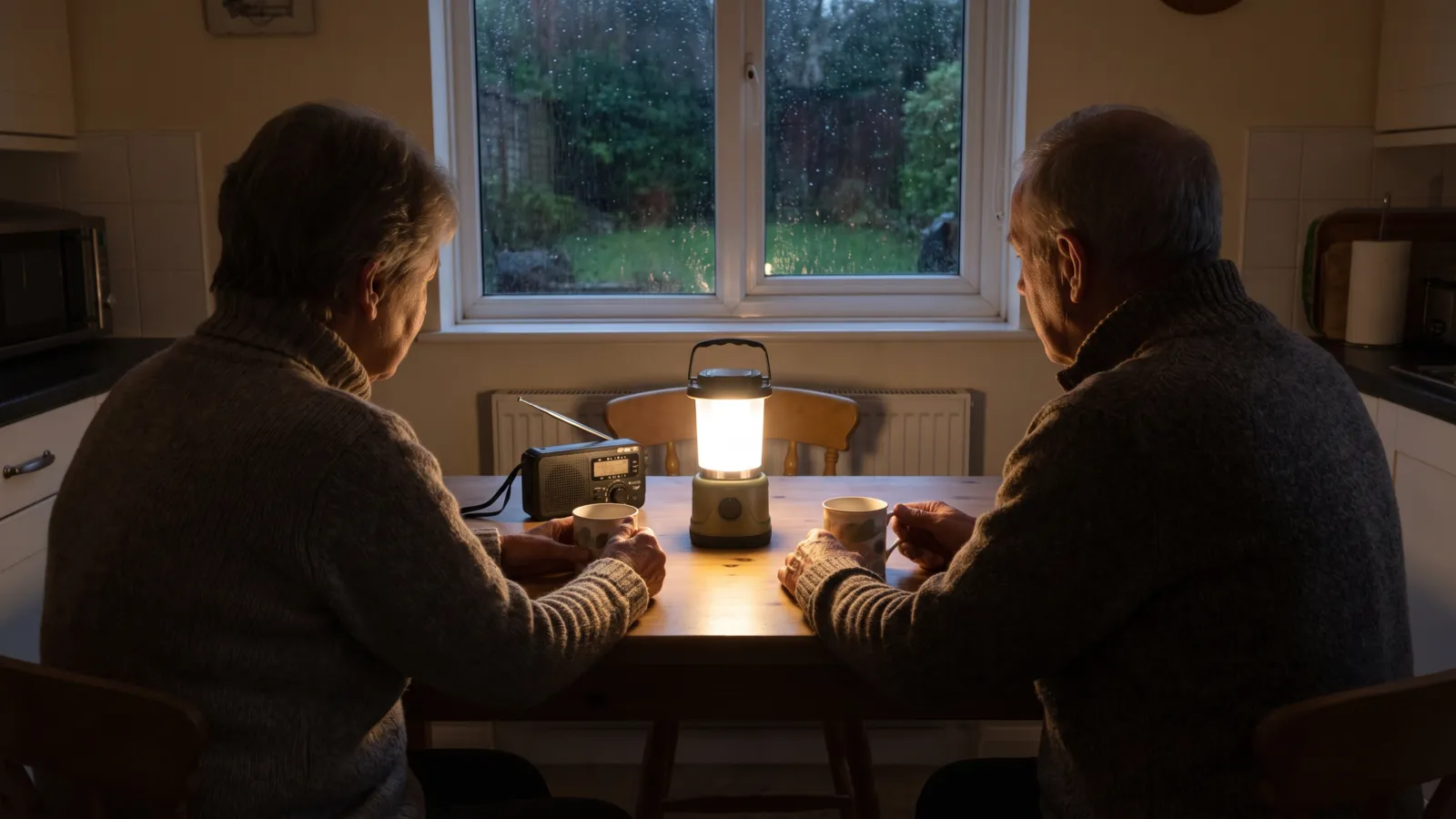
What the shops reported
BBC Newsnight gathered sales figures from retailers after the government's Be Ready campaign launched on 22 October. Iceland said it saw a 40% increase in sales of tinned products over the weekend, with strong sales of bottled water too. Robert Dyas reported radio sales up 160% compared with the week before.
Maplin said that, since the announcement and compared with the same period last month, radio sales were up 92%, torches up 284% and power banks up 106%. Two small specialist shops told the programme their orders had risen tenfold and by 650%, most of them for wind-up radios.
Iceland also said its supplies of these products remain healthy. Nothing here suggests a shortage, and there is no reason to buy more than your household needs.
What the government actually asked for
Be Ready asks households to keep enough at home to manage for three days of disruption, such as a storm, a power cut or a water outage. Its checklist covers 3 litres of drinking water per person per day, food that needs no fridge or cooking, a torch and spare batteries, warm layers, a battery or wind-up FM radio, a charged power bank, some cash, and medicines and baby or pet supplies where you need them.
It is a list to build up a few items at a time, not a shopping trip to do this week. Our explainer of the checklist goes through it item by item.
Home Alerts members
The full picture, for your home
Each week, what's happening across Britain set against your own address: your water company, your power network, fuel for your car and the gaps in your kit. Free for your own home. We're inviting the first 100 on the list now, and opening to everyone later in October.
Join the list →Britain's figures from our live trackers, 27 October.
Where most homes really are
The Cabinet Office's own 2026 preparedness survey, published as official statistics in August, asked 10,791 UK adults what they had at home. 60% said they had three days of food that needs no cooking. About half had a power bank (54%) or a battery, solar or wind-up torch (53%).
Two gaps stand out. Only 23% had a battery, solar or wind-up FM radio. And once their bottled water was counted against their household size at 3 litres a person a day, only 4% had three days' worth.
If you're buying a radio, get one that works here
FM is the band that matters: it carries BBC local radio, the station with practical local information when something goes wrong in your area. DAB works too, but it uses more battery for the same listening, so a cheap set flattens its cells faster. An FM-only radio is perfectly good for this job.
Two things to ignore. Long wave closed in June 2026, so a long-wave band is no use. And many wind-up radios sold here are American designs that advertise NOAA weather channels: those are US frequencies and receive nothing in Britain. Judge a radio on FM reception, how it takes power (batteries, a crank, solar or USB), and whether the crank feels sturdy.
Tins: buy what you already eat
The best emergency food is food you would eat anyway, bought a few extra tins at a time and used in date order, so nothing goes to waste. Pick things you can eat cold, and keep a tin opener that works by hand.
Water is the bigger gap for most homes: the Be Ready checklist asks for 3 litres a person a day, so a household of three needs 27 litres for three days.
Common questions
Are radios and tinned food selling out in the UK?
Retailers told BBC Newsnight that sales rose sharply after the Be Ready campaign launched on 22 October, with radio sales up 160% at Robert Dyas and tinned products up 40% at Iceland over the weekend. Iceland said its supplies remain healthy, and nothing reported suggests a national shortage.
What does the government's Be Ready campaign ask people to keep?
Enough to manage for three days at home: 3 litres of water per person per day, food that needs no fridge or cooking, a torch, warm layers, a battery or wind-up FM radio, a charged power bank, some cash, and any medicines, baby or pet supplies you need. It can be built up a few items at a time.
Which radio works in a UK power cut?
Any battery or wind-up radio with FM, which carries BBC local radio. DAB also works but drains batteries faster. Ignore long wave (closed in June 2026) and NOAA weather bands, which are American and receive nothing in the UK.
How much water should I keep?
The Be Ready checklist asks for 3 litres a person a day, so three days for one person is 9 litres and for a household of three is 27 litres.
Sources (7)
- BBC News (Newsnight), Rise in sales of radios and tinned foods, say retailers, after call to stock up (27 October 2026)
- Cabinet Office, Households encouraged to take small, simple steps to stay prepared in an emergency (22 October 2026)
- GOV.UK Be Ready, Be ready for emergencies (the Be Ready checklist)
- Cabinet Office, UK Public Survey of Risk Perception, Resilience and Preparedness: 2026 headline findings (official statistics, 19 August 2026)
- PreparedBritain, Which radio actually works in a UK power cut?
- PreparedBritain, Be Ready: the government's new emergency checklist, explained
- PreparedBritain, Only 4 in 100 adults have three days of bottled water
PreparedBritain is independent and not affiliated with HM Government.
See our checks first on Google. Add PreparedBritain as a preferred source and Google will show our stories to you more often in Top Stories.

The Emergency Kit Checklist
The GOV.UK Prepare essentials on one printable page — tick them off as you go and keep it with the kit. Free, no catch.
Download it straight away. We'll also send the occasional briefing when something genuinely matters — severe weather, live incidents, real price drops. Nothing else.
Latest from our live data
All stories → News · 26 OctHighland homes hit by fresh power cuts: 125 faults since Saturday, 47 still with homes off
 News · 24 OctPower cuts hit more than seven times a normal day as Storm Austen crossed: what our data shows
 News · 24 OctSome rail lines set to close as Scotland braces itself for Storm Boelo: what shuts and when
Keep reading
All planning & the national picture guides →The clocks go back on Sunday: what changes at home, and the £1,000 dog-coat fine that isn't
The clocks go back one hour at 2am on Sunday 25 October. Here is what to change at home, the driving rule that…
Be Ready: the government's new emergency checklist asks for three days of supplies. What's new
The government has launched Be Ready, a three-year campaign asking households to be ready for three days of…
‘Unprecedented’ summer of wildfires sparks Welsh fire resilience summit: what satellites show
Wales' First Minister holds a wildfire summit on 22 October after a summer that saw four major incidents declared in…