
Is stockpiling illegal in the UK? What the rules say about buying extra food and water
We found no law limiting the food and water you keep at home, and the government's Be Ready campaign asks for three days of it, built up gradually. The limits are elsewhere: petrol storage, shop limits and prescriptions.
We found no law against it for the food and water the government asks you to keep. Its Be Ready campaign, launched on 22 October, asks households that can to have three days of non-perishable food and bottled water at home, and says you don't need to do it all at once. We found no law in the official record that limits how much food or water you can keep for your own household. There are limits elsewhere. In England, Scotland and Wales you can store up to 30 litres of petrol at home without telling your local Petroleum Enforcement Authority. Shops can set purchase limits: in 2020 the competition regulator said it would not act against rationing where needed to protect consumers, and the government briefly let supermarkets coordinate purchase limits. For prescriptions, the advice is to order ahead, not extra. The Security Minister told MPs the campaign is not a response to any specific or imminent threat.
By Tom Calder · Updated 12 November 2026 · Sourced to GOV.UK Be Ready, the Cabinet Office's 22 October 2026 release, Hansard for 27 October 2026, the HSE and the Petroleum (Consolidation) Regulations 2014, the 2020 Defra release, groceries order and CMA taskforce update, and the NHS Specialist Pharmacy Service, all read on 12 November 2026
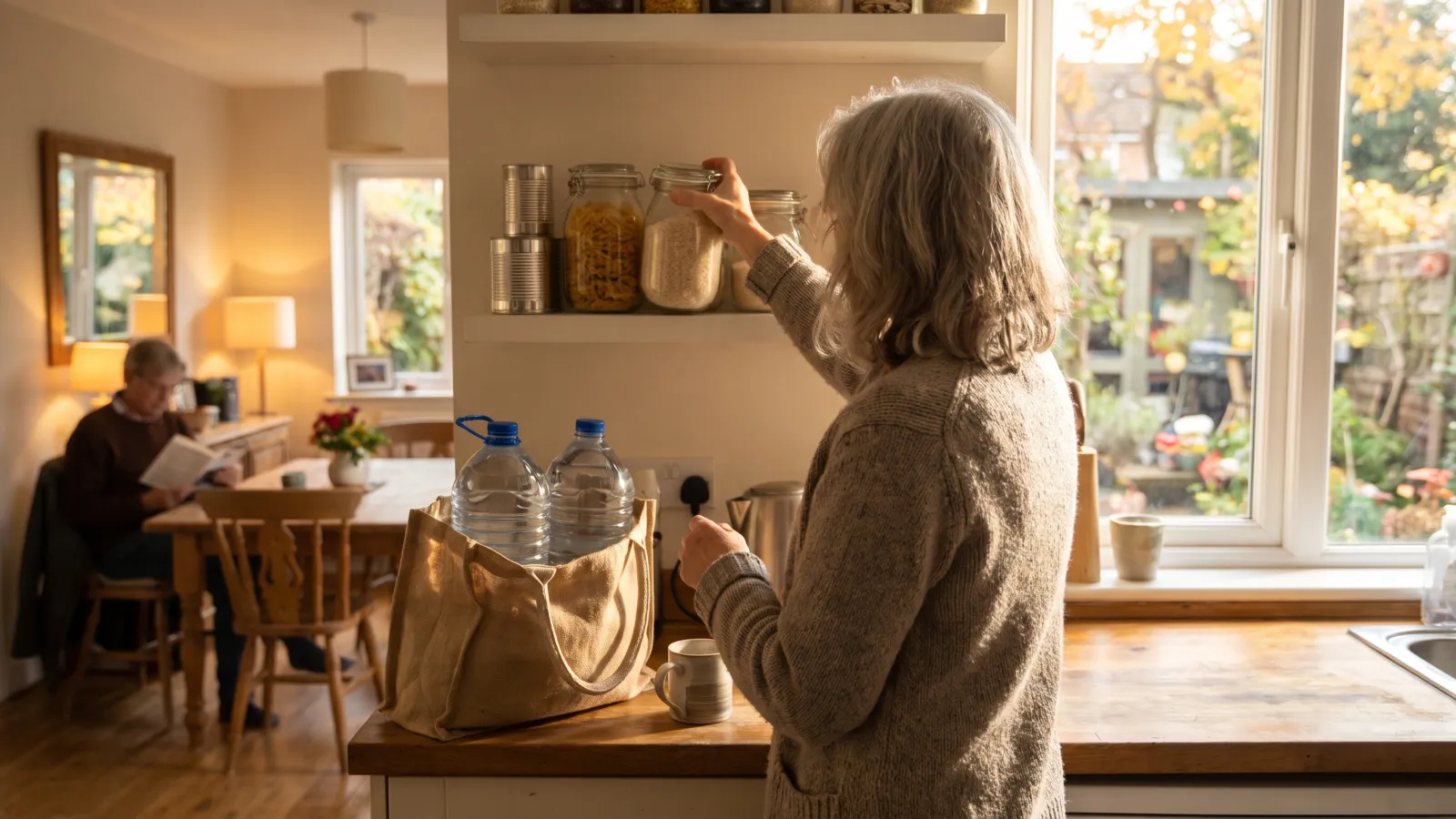
Is stockpiling illegal in the UK?
The question is being searched as more households stock up after the government's Be Ready campaign; our story on the rise in sales of radios and tinned food covers what shops and shopper data showed. The plain answer from the official record: the government is asking households to keep supplies at home, not telling them to stop.
We read the campaign, what the Security Minister told the Commons, the safety regulator's rules on storing fuel, and what happened in shops in 2020. We found no law that limits how much food or bottled water you can keep for your own household. Nothing we read describes buying it as an offence.
What the government asks you to keep
Be Ready says: "Being ready for 3 days helps you manage while support reaches those most in need." Its checklist asks for bottled water at "3 litres per person per day for drinking", with more for cooking and washing, and non-perishable food for three days, adding: "It's best to buy food you'd usually eat." The Cabinet Office's launch release on 22 October asks households to "keep a small supply of non-perishable food and bottled water at home".
It is not asking for a big shop. "You don't need to do it all at once," the campaign says; "Pick up missing items when you can during your regular shopping trips to help spread the cost." On 27 October Dan Jarvis, the Security Minister, told MPs there was no "requirement for households to assemble all these items in one go", suggesting "adding one item per week to the weekly shop", and said: "we are not launching this campaign because of any specific or imminent threat." The checklist, item by item and how much food to store go further.
Where the law does set a limit at home: petrol
The clearest legal limit on keeping supplies at home is for petrol. The HSE says: "You can store up to 30 litres of petrol at home or at non-workplace premises without informing your local Petroleum Enforcement Authority (PEA)." Above 30 litres, and up to a maximum of 275 litres, you should notify the PEA in writing and follow the storage rules, including that petrol is not kept in your living accommodation.
The containers matter too. Under the Petroleum (Consolidation) Regulations 2014, which cover England, Scotland and Wales, a portable petrol container must be "no greater than 10 litres if made of plastic" and "no greater than 20 litres if made of metal". Our fuel shortages guide explains why filling up as normal works better than storing fuel.
Home Alerts members
The full picture, for your home
Each week, what's happening across Britain set against your own address: your water company, your power network, fuel for your car and the gaps in your kit. Free for your own home. Sign up in a minute.
Start free →Britain's figures from our live trackers, 13 November.
What shops can limit
Shops can set purchase limits, and in 2020 they did. On 19 March 2020 the Competition and Markets Authority said it had "no intention of taking competition law enforcement action against cooperation between businesses or rationing of products to the extent that this is necessary to protect consumers". The same day the government said it was relaxing competition law "to allow supermarkets to work together to feed the nation", and urged people "to shop considerately".
A short-lived order from 27 March 2020 allowed supermarkets "coordination on limiting purchases by consumers of particular groceries"; it was revoked on 8 October 2020. All of this was about what retailers could do; none of it put a rule on shoppers. On prices, the CMA said in April 2020 it was concerned that a small minority were "charging excessive prices", had written to 187 firms, and would act "where there is evidence that competition or consumer protection law has been broken".
Medicines are different
Be Ready's checklist includes essential medication and medical supplies, and its advice is to plan ahead rather than order extra: "It's important to request prescriptions up to 5 working days before you need your medicine." During a medicines shortage, the NHS Specialist Pharmacy Service's leaflet for patients says: "Avoid stockpiling and ordering more than you need until your next prescription."
If you run out, there are proper routes: our guide to getting an emergency supply covers them, and our medicine shortages guide explains what to do when a medicine is hard to find.
What to do
Work towards the three days, a few items at a time, from food you already eat. Store water as the checklist says; our guide to storing emergency water covers bottles and rotation. Check dates every six months, as Be Ready suggests, and if you end up with more than you need, the campaign says "you could consider donating these to others who might not have the means to prepare their own households."
Common questions
Is stockpiling illegal in the UK?
We found no law that limits how much food or bottled water you can keep for your own household. The government's Be Ready campaign asks households that can to keep three days of non-perishable food and water, built up gradually. There are limits elsewhere: petrol storage at home, shops' own purchase limits, and prescriptions.
How much food and water does the government say to keep?
Enough for three days. Be Ready's checklist asks for bottled water at 3 litres per person per day for drinking, more for cooking and washing, and non-perishable food for three days, ideally food you'd usually eat.
Can shops limit how much I buy?
Shops do set purchase limits. In March 2020 the CMA said it would not take competition law action against rationing where needed to protect consumers, and the government briefly let supermarkets coordinate purchase limits on particular groceries. That order was revoked in October 2020.
How much petrol can I keep at home?
In England, Scotland and Wales, up to 30 litres without telling your local Petroleum Enforcement Authority, in suitable containers: no more than 10 litres each if plastic, 20 litres if metal. Between 30 and 275 litres you should notify the authority in writing. Never store it in your living accommodation.
Should I stock up on prescription medicines?
Order as normal and in good time. Be Ready's checklist includes essential medication, and it advises requesting prescriptions up to 5 working days before you need your medicine. During a shortage, the NHS Specialist Pharmacy Service's patient leaflet says to avoid stockpiling and ordering more than you need until your next prescription.
Sources (10)
- GOV.UK Be Ready, Be ready for emergencies (the Be Ready checklist: 3 days, 3 litres per person per day, build up gradually, prescriptions 5 working days ahead, donating extra items), read 12 November 2026
- Cabinet Office, Households encouraged to take small, simple steps to stay prepared in an emergency (22 October 2026), read 12 November 2026
- Hansard, House of Commons, Strengthening Community Resilience (27 October 2026): statement and answers by Dan Jarvis, Security Minister, read 12 November 2026
- HSE, If you store petrol at home, or at a club/association or similar premises (30 litres without informing the PEA; up to 275 litres with written notification; not in living accommodation), read 12 November 2026
- The Petroleum (Consolidation) Regulations 2014, Schedule 3 (portable petrol container sizes; extent England, Wales and Scotland), read 12 November 2026
- Defra and BEIS, Supermarkets to join forces to feed the nation (19 March 2020), read 12 November 2026
- The Competition Act 1998 (Groceries) (Coronavirus) (Public Policy Exclusion) Order 2020, SI 2020/369, article 3 (made 27 March 2020; revoked 8 October 2020 by SI 2020/933), read 12 November 2026
- CMA, Protecting consumers during the coronavirus (COVID-19) pandemic: update on the work of the CMA's Taskforce (24 April 2020), read 12 November 2026
- CMA, CMA publishes update on COVID-19 taskforce (24 April 2020: letters to 187 firms), read 12 November 2026
- NHS Specialist Pharmacy Service, Medicines shortages leaflets and posters (24 November 2025), read 12 November 2026
PreparedBritain is independent and not affiliated with HM Government.
See our checks first on Google. Add PreparedBritain as a preferred source and Google will show our stories to you more often in Top Stories.

The Emergency Kit Checklist
The GOV.UK Prepare essentials on one printable page — tick them off as you go and keep it with the kit. Free, no catch.
Download it straight away. We'll also send the occasional briefing when something genuinely matters — severe weather, live incidents, real price drops. Nothing else.
Latest from our live data
All stories →
Keep reading
All planning & the national picture guides →Santa trackers 2026: NORAD, Google and a time for every UK town
There are three Santa trackers to know about: NORAD Tracks Santa, Google’s Santa Tracker and ours for the UK. When…
Last posting dates for Christmas 2026: Royal Mail, Parcelforce, Evri, DHL, DPD, Yodel and InPost
The last recommended posting dates for Christmas 2026, from each carrier’s own page: Royal Mail 2nd Class by Friday…
Will there be power cuts in the UK due to the Iran war? What the grid operator's notices show
None of the bodies we checked has said the Iran war will cause power cuts in Britain. NESO expects electricity…