Fog forecast for central and eastern England tonight: the fog-light rules and what to carry
The Met Office forecasts fog developing across central and eastern parts of England tonight, slow to lift on Friday. There is no formal fog warning. Here is what the Highway Code says about fog lights, what 'dense' fog means, and what to keep in the car.
The Met Office forecast issued at 4am on Thursday 29 October says fog will develop across central and eastern parts of England tonight, and that areas of mist and fog will be slow to lift and clear on Friday. There was no formal Met Office fog warning in force when we checked on Thursday morning. The Highway Code says you must use headlights when you cannot see for more than about 100 metres, you may also use fog lights then, and you must switch fog lights off when visibility improves. A torch, warm clothes, a charged phone, food and a drink are the core of a car kit for a slow or stopped journey.
By Tom Calder · Updated 29 October 2026 · Sourced to the Met Office forecast and travel advice, and the Highway Code on GOV.UK, read on 29 October 2026
What the Met Office forecast says
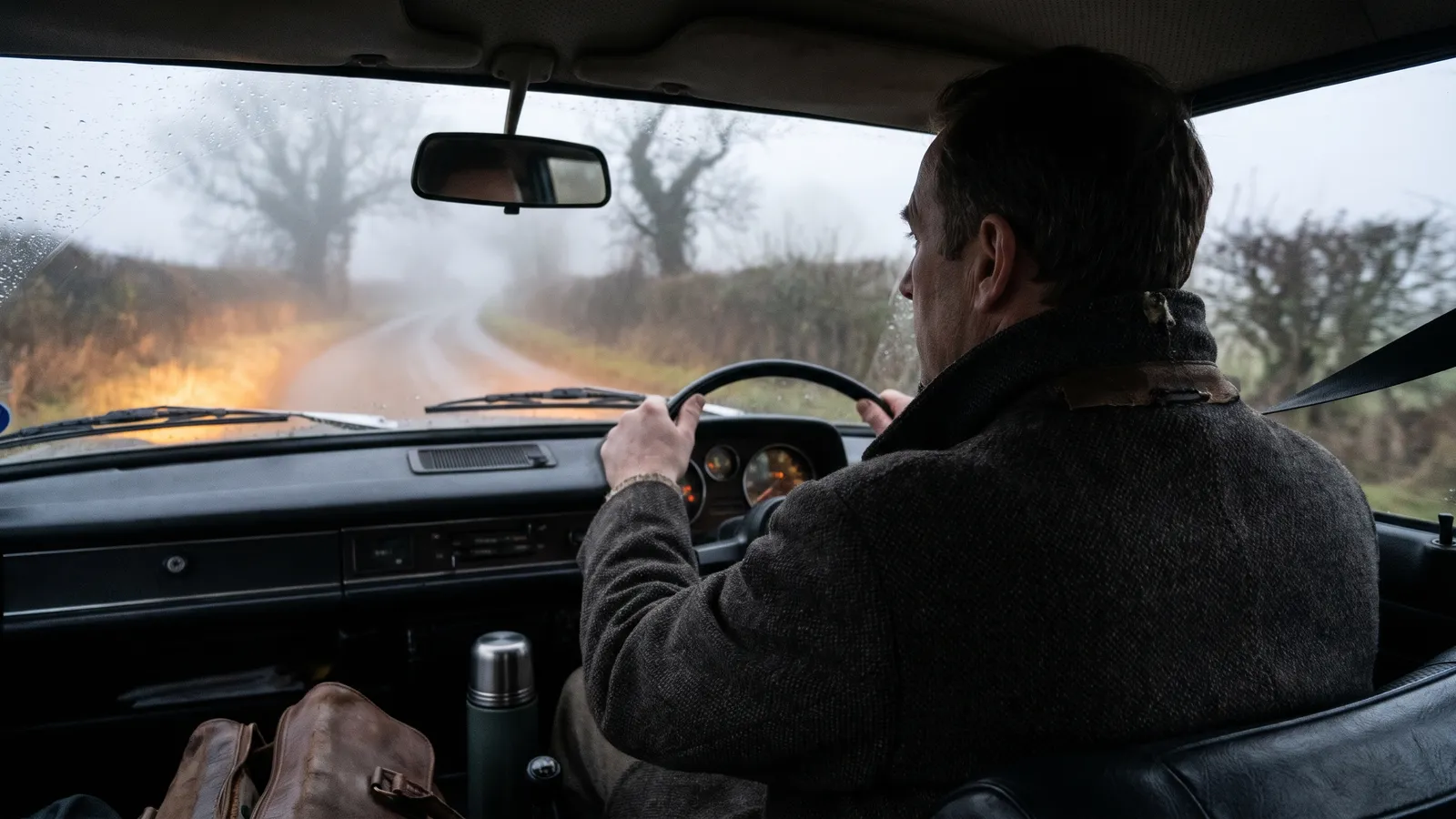
The Met Office's UK forecast, issued at 4am on Thursday 29 October, says Thursday will be mainly dry “after any morning low cloud and patchy fog clears”. For tonight it says: “Fog developing across central and eastern parts of England.” For Friday morning: “Areas of mist and fog slow to lift and clear.” The forecast does not give visibility figures or clearing times.
Fog may not be a one-night event. The Met Office's outlook for Saturday to Monday mentions “overnight fog patches”, and its outlook for 2 to 11 November says high pressure is set to dominate, with some places likely to see fog that “once formed, could be slow to clear or possibly linger all day”.
There was no formal Met Office weather warning for fog when we checked on Thursday morning: the Met Office's UK warnings feed had no warnings in it. Forecasts and warnings change, so check again before you set off. Our weather warnings tracker shows any that are in force.
What “dense” fog means: three Met Office answers
This week's headlines describe the fog as “dense”. The word does not have one fixed meaning, even on the Met Office's own pages.
Its page on fog says fog is “a reduction in visibility to less than 1000 metres”, that in forecasts for the public it “generally refers to visibility less than 180 m”, and that “dense fog is when the visibility falls below 100 metres”. Its advice page for travelling in fog says “warnings of dense fog are issued when visibility is expected to fall below 200 metres”. A third page, on how fog affects travel, uses 200 metres for “thick fog” and keeps “dense fog” for visibility below 50 metres, where “severe disruption to road transport occurs”.
For drivers, the figure that matters is the one in the Highway Code: about 100 metres, as the next section explains.
The fog-light rules
Highway Code rule 226 says you must use headlights when visibility is seriously reduced, “generally when you cannot see for more than 100 metres (328 feet)”. You may also use front or rear fog lights then, but you must switch them off when visibility improves.
Rule 236 says you must not use front or rear fog lights unless visibility is seriously reduced, “as they dazzle other road users and can obscure your brake lights”. Both rules are backed by law, the Road Vehicles Lighting Regulations (regulations 25 and 27). So fog lights are for thick fog, not for mist or a murky evening, and they go off again when the fog thins.
The Met Office's fog advice, produced with National Highways, says to drive with dipped headlights, because full beam reflects off the fog “causing a 'white wall' effect”.
Home Alerts members
The full picture, for your home
Each week, what's happening across Britain set against your own address: your water company, your power network, fuel for your car and the gaps in your kit. Free for your own home. Sign up in a minute.
Start free →Britain's figures from our live trackers, 29 October.
Driving in fog: what the Highway Code says
Rule 234 says to check your mirrors and slow down before you enter fog. If a ‘Fog’ sign is showing but the road looks clear, expect a bank of fog or drifting patches ahead: “even if it seems to be clearing, you can suddenly find yourself in thick fog”.
Rule 235 says you should keep a safe distance from the vehicle in front, because rear lights can give a false sense of security, and be able to stop well within the distance you can see clearly, especially on motorways and dual carriageways. It also says to use your wipers and demisters, watch for drivers without headlights on, not speed up to get away from someone too close behind, and at a junction with limited visibility, stop in the right place and listen for traffic.
The Met Office adds two points: fog “can give the illusion of moving in slow motion”, so keep an eye on your speed, and watch out for freezing fog, which “can quickly form a layer of ice”. Its first piece of advice is to avoid travel if possible.
What to carry in the car
Fog makes for slow journeys, and a breakdown in the dark is harder to deal with. Highway Code rule 228, written for icy and snowy weather, lists an emergency kit: de-icer and an ice scraper, a torch, warm clothing and boots, a first aid kit, jump leads and a shovel, with a warm drink and emergency food in case you get stuck or break down.
The Met Office's winter car kit page, written with the RAC, adds an in-car phone charger, a paper road atlas for diversions, warm clothes and blankets, high-visibility clothing in case you need to leave the car in the dark, an empty fuel can, a flask of hot drink, warning triangles and sunglasses for low winter sun. It says a large torch with spare batteries, or a wind-up torch, is essential, because “a phone light won’t really give you visibility”.
Our car emergency kit checklist goes through each item, including where warning triangles must not be used and what to do if you break down on a motorway.
Before you set off
The Met Office says to check before you set off that your lights, especially your fog lights, are working properly. It also says fog can be very localised, so it may not be there when you leave home. Check your route's forecast for the time you'll be driving, not just the time you leave, and allow extra time on Friday morning if you are in central or eastern England.
The Met Office says fog in late autumn and winter usually forms under clear skies and light winds, and its outlook for next week says overnight frost is likely where skies are clear and winds light. Our guide to defrosting your car and the law covers clearing the windscreen properly.
Common questions
Is there a Met Office fog warning?
Not when we checked on Thursday morning, 29 October. The Met Office forecast says fog will develop across central and eastern parts of England on Thursday night and be slow to clear on Friday. Check the Met Office again before you travel.
When should I use fog lights?
Only when visibility is seriously reduced. The Highway Code says that is generally when you cannot see for more than 100 metres (328 feet). You must use headlights then, you may add fog lights, and you must switch fog lights off when visibility improves.
Can I use fog lights in light mist?
No. Highway Code rule 236 says you must not use front or rear fog lights unless visibility is seriously reduced, because they dazzle other road users and can hide your brake lights.
Should I use full beam in fog?
No. The Met Office advises dipped headlights, because full beam reflects off the fog and causes a 'white wall' effect.
What should I keep in the car for fog and winter journeys?
The Highway Code's winter kit is de-icer and a scraper, a torch, warm clothing and boots, a first aid kit, jump leads, a shovel, a warm drink and emergency food. The Met Office's winter car kit page adds a phone charger, a paper road atlas, high-visibility clothing, blankets, an empty fuel can, warning triangles and sunglasses.
Sources (7)
- Met Office — UK forecastissued 04:00 UTC, Thursday 29 October 2026: fog developing across central and eastern England tonight
- Met Office — UK weather warnings feed (no warnings in force, read 29 October 2026)
- Met Office — Fogdefinitions: under 1,000 m; under 180 m in public forecasts; dense fog under 100 m
- Met Office — Advice for travelling in fogwith National Highways; dense fog warnings below 200 m
- Met Office — How fog affects travelthick fog 200 m, dense fog 50 m; check lights before setting off
- Met Office — Prepare a winter kit for your car (with the RAC)
- GOV.UK — The Highway Code, rules 226 to 237adverse weather: fog lights, driving in fog, winter kit
PreparedBritain is independent and not affiliated with HM Government.
See our checks first on Google. Add PreparedBritain as a preferred source and Google will show our stories to you more often in Top Stories.

The Emergency Kit Checklist
The GOV.UK Prepare essentials on one printable page — tick them off as you go and keep it with the kit. Free, no catch.
Download it straight away. We'll also send the occasional briefing when something genuinely matters — severe weather, live incidents, real price drops. Nothing else.
Latest from our live data
All stories →

Keep reading
All planning & the national picture guides →Rise in sales of radios and tinned foods after the call to stock up: what you actually need
Retailers told BBC Newsnight that sales of radios, torches, power banks and tinned food jumped after the…
The clocks go back on Sunday: what changes at home, and the £1,000 dog-coat fine that isn't
The clocks go back one hour at 2am on Sunday 25 October. Here is what to change at home, the driving rule that…
Be Ready: the government's new emergency checklist asks for three days of supplies. What's new
The government has launched Be Ready, a three-year campaign asking households to be ready for three days of…