
Should you stockpile for two weeks, not three days? What the government actually says
A Daily Mail headline told Brits to forget three days and stockpile for two weeks. The two weeks is one academic's view; the government's Be Ready advice is three days. What each means for one home's cupboard and budget.
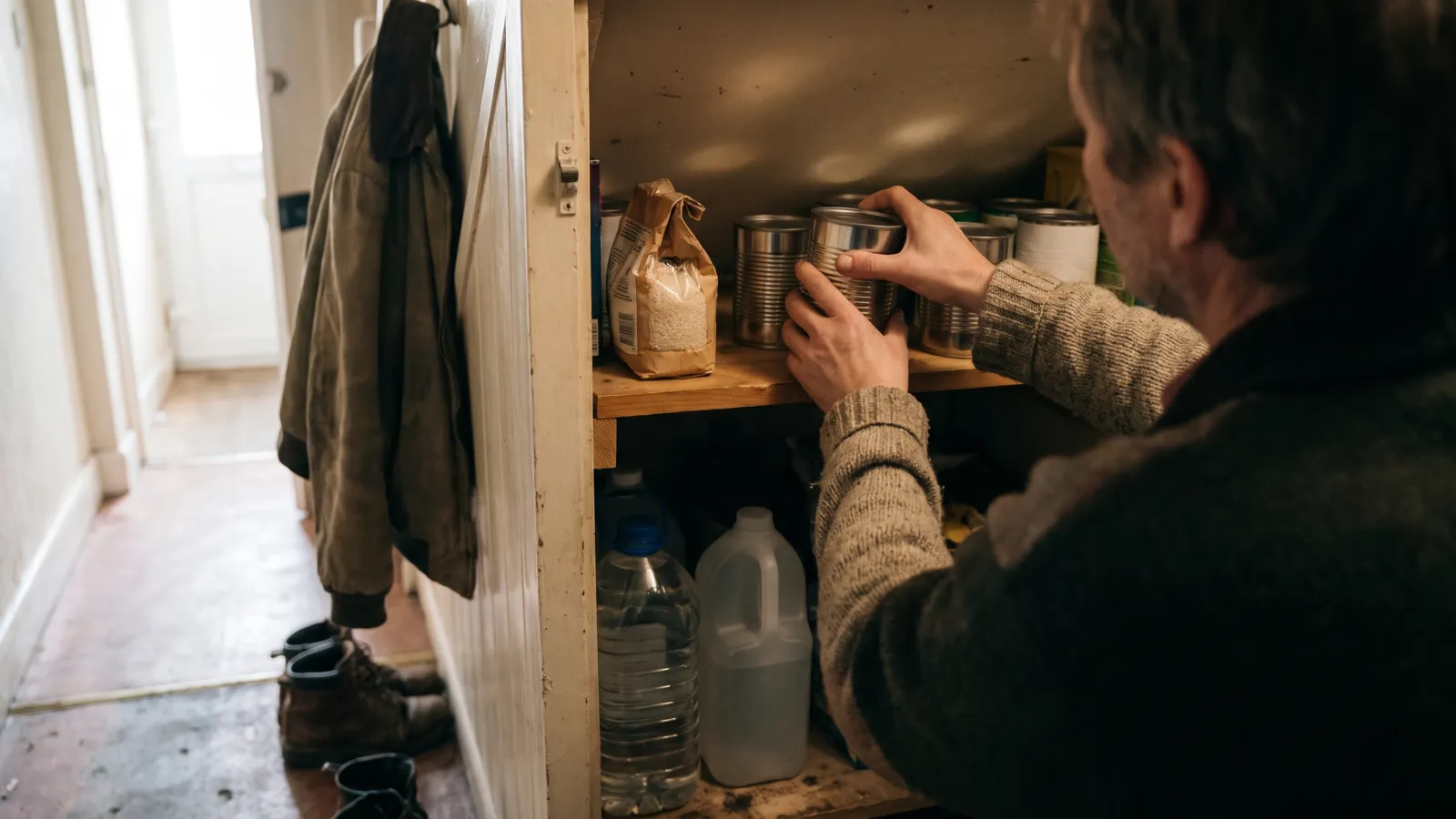
No, the government has not changed its advice: its Be Ready campaign asks households to be ready for three days, and nothing on its page asks for two weeks. The two-week figure comes from one expert, Professor Ilan Kelman of University College London, quoted by the Daily Mail on 31 October, who said two weeks is "much better than three days" for "those who can afford it". He pointed to advice from the American Red Cross, the New South Wales government and Washington State, not from the UK. For one home the difference is size: at Be Ready's 3 litres of drinking water per person per day, three days is 9 litres each and two weeks is 42. Two weeks is more than four times the cupboard space and the cost. Be Ready says to build up gradually during your normal shopping. Three days is the official starting point; going further is a choice, not an instruction.
By Tom Calder · Updated 12 November 2026 · Sourced to GOV.UK Be Ready, the Cabinet Office's 22 October 2026 release, the British Red Cross and the Daily Mail article of 31 October 2026, all read on 12 November 2026
Should you stockpile for two weeks, not three days?
The question comes from a Daily Mail headline of 31 October: "Forget three days! Scientist tells Brits to stockpile enough for two WEEKS". The short answer from the official record is that the UK advice is still three days. The government's Be Ready campaign says: "Being ready for 3 days helps you manage while support reaches those most in need." We found no figure longer than three days on its page when we read it on 12 November.
Two weeks is not wrong or forbidden. It is a bigger target than the government sets, put forward by one academic, and he says himself that it is for those who can afford it. Our story on whether stockpiling is illegal covers the rules on keeping supplies at home.
What the expert actually said
The Daily Mail quotes Professor Ilan Kelman, "a disaster and climate expert at University College London": "Stockpiling at least two weeks of supplies, for those who can afford it, is much better than three days in order to get through many more types of crises, including helping those around us." His reason, in his words: "Many scenarios exist with electricity, water and transport routes unavailable for longer than 72 hours."
The 14-day figure is not British advice. The Mail says he "points to advice issued by the American Red Cross, the government of New South Wales and the Washington State Emergency Management Division", which all advocate supplies "to last for 14 days". The same article quotes him on cost: "The real crisis is that most households in this country cannot afford to stockpile." The article has no shop links, and its food list is ordinary: canned meat, fish, fruit and vegetables, pasta, rice, cereal, crackers, nuts and long-life milk.
What the government asks for
Be Ready, launched by the Cabinet Office on 22 October, asks for "Bottled water for 3 days", at "3 litres per person per day for drinking", adding that "More would be needed for other tasks such as cooking and washing", and "Non-perishable food for 3 days": "It's best to buy food you'd usually eat." The rest of the checklist is hygiene products, a torch, blankets and warm clothing, a radio, a power bank, cash and cards, copies of documents, a written list of phone numbers, first aid, medication, and supplies for babies and pets. Our story on the checklist goes through it item by item.
Three days is not a UK oddity. The Cabinet Office says the three-day advice "is also used by France, Ireland and The Netherlands", and the British Red Cross asks UK households to "prepare your household for 72 hours".
Home Alerts members
The full picture, for your home
Each week, what's happening across Britain set against your own address: your water company, your power network, fuel for your car and the gaps in your kit. Free for your own home. Sign up in a minute.
Start free →Britain's figures from our live trackers, 13 November.
What two weeks means for one home's cupboard
Water is the part that grows fastest. By our sums from Be Ready's 3 litres a day, three days is 9 litres of drinking water per person and two weeks is 42. For a couple, that is 18 litres against 84. On the Mail's own measure of one gallon (3.8 litres) per person per day, a couple's two weeks is "28 gallons (approximately 106 litres)". Either way it is several large packs of bottles, and it needs somewhere cool and dark to live.
Food scales the same way: two weeks is more than four times the three days, so roughly four to five times the tins and packets, and the cost and shelf space that go with them. How much food to store works out one week and two weeks per person, and storing emergency water covers bottles and rotation.
What it means for your budget
Be Ready does not ask for a big shop. "You don't need to do it all at once," it says, suggesting "picking up an extra item or two when you can" and to "Pick up missing items when you can during your regular shopping trips to help spread the cost." The Cabinet Office says the steps "are designed to be as low-cost as possible", and Be Ready adds that "There are lots of suggestions here that won't cost anything".
The sensible order is three days first, from food you already eat, and only then more if you have the money and the space. Food you rotate into normal meals is not wasted; Be Ready suggests a reminder "every six months to check expiry dates".
Common questions
Is the "Forget three days! Expert tells Brits to stockpile for two weeks - here's what you should be buying" headline right?
Only as one expert's view. The Daily Mail quotes Professor Ilan Kelman of UCL saying two weeks is much better than three days for those who can afford it, citing American and Australian advice. The UK government's Be Ready advice is still three days.
How many days of supplies does the UK government recommend?
Three. Be Ready asks households to be ready for 3 days, with bottled water at 3 litres per person per day for drinking and non-perishable food for 3 days, built up gradually.
How much water is two weeks for a couple?
At Be Ready's 3 litres of drinking water per person per day, two weeks for two people is 84 litres, against 18 litres for three days. On the US gallon-a-day measure the Mail used, it is about 106 litres.
Who recommends two weeks of supplies?
The Daily Mail says the American Red Cross, the New South Wales government in Australia and the Washington State Emergency Management Division advise supplies for 14 days. No UK government body we read gives that figure.
Is it worth going beyond three days?
It is a choice, not an instruction. Get three days in place first from food you already eat. If you have the money and space, more is fine, built up through your normal shop and rotated so nothing expires.
Sources (4)
- GOV.UK Be Ready, Be ready for emergencies (3 days, 3 litres per person per day, non-perishable food for 3 days, build up gradually, check expiry every six months), read 12 November 2026
- Cabinet Office, Households encouraged to take small, simple steps to stay prepared in an emergency (22 October 2026), read 12 November 2026
- British Red Cross, Prepare for emergencies (prepare your household for 72 hours), read 12 November 2026
- Daily Mail, Forget three days! Scientist tells Brits to stockpile enough for two WEEKS (31 October 2026), the article checked, read 12 November 2026
PreparedBritain is independent and not affiliated with HM Government.
See our checks first on Google. Add PreparedBritain as a preferred source and Google will show our stories to you more often in Top Stories.

The Emergency Kit Checklist
The GOV.UK Prepare essentials on one printable page — tick them off as you go and keep it with the kit. Free, no catch.
Download it straight away. We'll also send the occasional briefing when something genuinely matters — severe weather, live incidents, real price drops. Nothing else.
Latest from our live data
All stories →
Keep reading
All planning & the national picture guides →The Santa tracker is live: see what time he reaches your town
Our Santa tracker went live on 12 November 2026. Put in a postcode and it shows the time Santa is due in your town…
Is stockpiling illegal in the UK? What the rules say about buying extra food and water
We found no law limiting the food and water you keep at home, and the government's Be Ready campaign asks for three…
Santa trackers 2026: NORAD, Google and a time for every UK town
There are three Santa trackers to know about: NORAD Tracks Santa, Google’s Santa Tracker and ours for the UK. When…