Bird flu housing order in England from 13 November: is it safe to eat eggs and chicken?
Yes: the Food Standards Agency says properly cooked poultry and poultry products, including eggs, are safe to eat, and that bird flu is a very low food safety risk. Defra's housing order covers the whole of England from 00:01 on 13 November 2026. Scotland has a prevention zone with biosecurity rules; the Scottish Government's pages didn't mention housing when we checked.
Yes. The Food Standards Agency says properly cooked poultry and poultry products, including eggs, are safe to eat, and that bird flu poses a very low food safety risk for UK consumers. The UK Health Security Agency says the risk to the general public's health is very low. The housing order is real but narrower than the headline. Defra announced on 11 November 2026 that from 00:01 on Friday 13 November, keepers across England must house poultry and captive birds if they keep 50 or more birds or sell or give away eggs, poultry products or live birds. Scotland declared a Scotland-wide prevention zone from noon on 10 November, with biosecurity rules; the Scottish Government's pages didn't mention housing when we checked on 11 November. Nothing changes in your kitchen: the FSA's advice is still to cook poultry all the way through.
By Tom Calder · Updated 11 November 2026 · Sourced to Defra's housing order announcement (GOV.UK, 11 November 2026), GOV.UK's bird flu latest situation page for England, the Scottish Government's prevention zone declaration of 10 November 2026, Food Standards Agency advice on GOV.UK, GOV.UK's egg marketing guidance, and the Welsh Government and DAERA restriction pages, all read on 11 November 2026
Is it safe to eat eggs and chicken during the bird flu housing order?
The Food Standards Agency's answer hasn't changed. Its advice on GOV.UK says: “Properly cooked poultry, game birds and other poultry products are safe to eat.” It adds that bird flu “poses a very low food safety risk for UK consumers, and does not change our advice on consumption of poultry products, including eggs and game birds.”
Defra's own announcement of the housing order, published on 11 November 2026, carries the same line: “The FSA says properly cooked poultry and poultry products, including eggs, are safe to eat.” On health more widely, GOV.UK says the UK Health Security Agency advises that bird flu “is primarily a disease of birds and the risk to the general public's health is very low.”
The housing order is about protecting flocks from infection. It isn't a food warning, and Defra's announcement doesn't ask shoppers to do anything.
What the housing order covers in England
Defra announced on 11 November 2026 that the UK Chief Veterinary Officer has ordered a mandatory poultry housing order “to cover the whole of England from 00:01 on Friday 13th November 2026”. It gives the reason as the increased risk and the “escalating number of confirmations” of bird flu in kept birds, and findings in wild birds.
The order doesn't cover every bird keeper. In Defra's words, keepers must house all poultry and captive birds “if they keep 50 or more birds (except in specific circumstances e.g. some zoo birds) or if they sell or give eggs, poultry products and live birds away.” So someone with a few backyard hens who sells or gives away even some of the eggs is covered.
On top of housing, an England-wide Avian Influenza Prevention Zone came into force on 11 November. Defra says it applies to all keepers, “whether they have pet birds, commercial flocks or just a few birds in a backyard flock”. Its rules include record keeping, disinfecting footwear and equipment, keeping feed and water away from wild birds, and reporting changes in egg production.
GOV.UK's latest situation page lists recent cases in commercial poultry, including near Garstang in Lancashire and Pocklington in the East Riding of Yorkshire on 7 November and near Dersingham in Norfolk on 9 November.
Scotland, Wales and Northern Ireland
The headline going round says birds must be kept inside in England and Scotland. The housing order Defra announced covers England. The Scottish Ministers declared the whole of Scotland an Avian Influenza Prevention Zone, taking effect “from 12pm (noon) on 10 November 2026”. GOV.UK says it is a legal requirement for all bird keepers in England and Scotland “to follow strict biosecurity”.
The Scottish declaration and the Scottish Government's outbreaks page, both last updated on 10 November, didn't mention a housing order when we read them on 11 November. That's what those pages say on that date, not a promise about what happens next: rules can change quickly in a bird flu season, so Scottish keepers should check gov.scot.
In Wales, the Welsh Government's current restrictions page, last updated on 3 July 2026, said the all-Wales prevention zone had been revoked and listed no current disease control zones when we read it on 11 November. In Northern Ireland, DAERA's latest situation page says housing measures were lifted on 5 May 2026 and its prevention zone on 15 May; its newest entry, of 20 October, urges keepers to strengthen biosecurity.
Home Alerts members
The full picture, for your home
Each week, what's happening across Britain set against your own address: your water company, your power network, fuel for your car and the gaps in your kit. Free for your own home. Sign up in a minute.
Start free →Britain's figures from our live trackers, 13 November.
Eggs and chicken in your kitchen
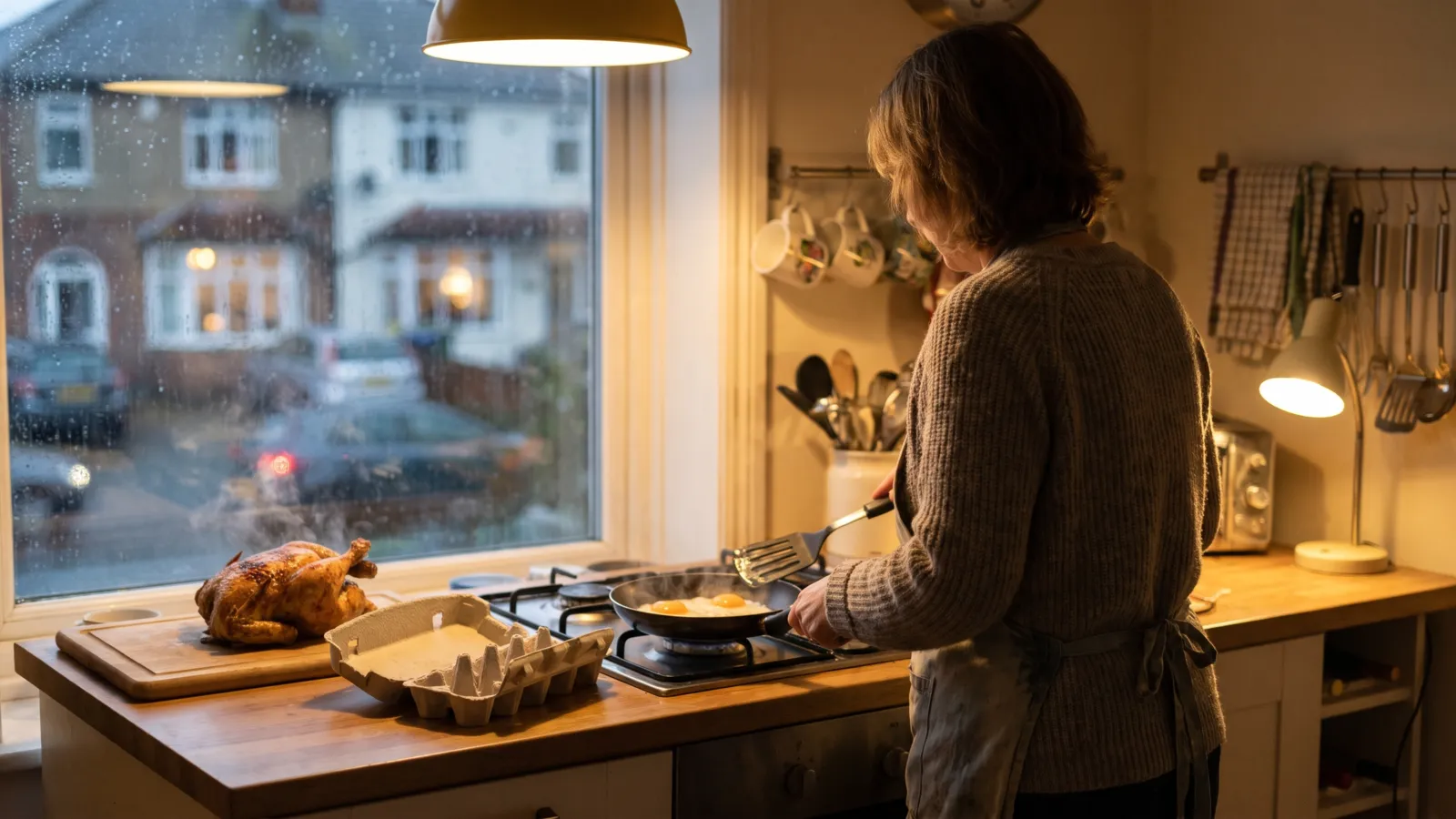
The FSA's usual cooking advice is what applies. Poultry needs to be cooked all the way through, it says, and you can check with a clean food thermometer. If you don't have one, cut into the thickest part, “make sure there is no pink, fleshy meat, as this is a sign it is undercooked” and check the meat is “steaming hot all the way through”. In a whole bird, the FSA says the thickest part is the leg between the drumstick and the breast. Our Christmas dinner guide has the FSA's cooking temperatures.
For eggs, the FSA says that its advice “remains valid during outbreaks of Avian Influenza”, and that bird flu “does not change our advice on consumption of eggs”. That includes its advice on raw or runny eggs: it says young children, pregnant people, older people and people with some health conditions can eat raw or lightly cooked hen eggs if they have a British Lion mark or come from the Laid in Britain scheme. It says that doesn't apply to people who are severely immunocompromised and on medically supervised diets.
Free range eggs and Christmas turkeys
From 13 November, hens covered by the order in England must be kept indoors. GOV.UK's egg marketing guidance says that where birds must be housed, producers “can label your eggs as free range for 16 weeks from the date that the birds were housed.” For anything longer, it tells producers to contact their APHA egg marketing inspector.
On supply, Defra's announcement says: “We do not currently anticipate any impact overall on the availability of Christmas turkeys or other seasonal poultry for consumers.” It says the UK produces around 8 million turkeys a year. We found no official statement about eggs on shop shelves. Our Christmas shortages check has more on the turkey season.
If you keep birds, or find a dead one
If you keep hens, ducks or geese, even a few, the prevention zone rules apply to you in England and Scotland. If you keep 50 or more, or sell or give away eggs, poultry products or birds, the housing order applies in England from 00:01 on 13 November. GOV.UK says suspected bird flu in poultry or captive birds must be reported immediately to the Animal and Plant Health Agency: in England on 03000 200 301.
For wild birds, GOV.UK's advice is “Do not touch dead wild birds”. You can report them online on GOV.UK or by phone on 03459 33 55 77. Not every bird reported will be collected.
Common questions
Is it safe to eat chicken and eggs during bird flu?
The Food Standards Agency says properly cooked poultry and poultry products, including eggs, are safe to eat, and that bird flu poses a very low food safety risk for UK consumers. It says bird flu does not change its advice on eating poultry or eggs. Cook chicken all the way through.
Do I have to keep my backyard chickens inside?
In England, from 00:01 on 13 November 2026, if you keep 50 or more birds, or if you sell or give away eggs, poultry products or live birds. Every keeper in England, however few birds, must follow the prevention zone's biosecurity rules, in force since 11 November. Scotland has a prevention zone with biosecurity rules from 10 November.
Is there a bird flu housing order in Scotland?
The Scottish Government declared the whole of Scotland an Avian Influenza Prevention Zone from noon on 10 November 2026, with biosecurity rules for all keepers. Its declaration and outbreaks page didn't mention housing when we read them on 11 November. Rules can change quickly, so keepers in Scotland should check gov.scot.
Are free range eggs still free range?
GOV.UK's egg marketing guidance says that where birds must be housed, eggs can still be labelled free range for 16 weeks from the date the birds were housed. For longer housing, it tells producers to contact their APHA egg marketing inspector.
Will there be a turkey shortage at Christmas?
Defra's announcement of 11 November says it does not currently anticipate any impact overall on the availability of Christmas turkeys or other seasonal poultry for consumers. It says the UK produces around 8 million turkeys a year.
Sources (11)
- GOV.UK — National Housing Order declared to protect birds from Avian Influenza (Defra, 11 November 2026)
- GOV.UK — Bird flu (avian influenza): latest situation in EnglandDefra and APHA, updated 11 November 2026
- Scottish Government — Avian Influenza Prevention Zone: declaration (10 November 2026)
- Scottish Government — Avian influenza (bird flu) outbreaks (updated 10 November 2026)
- GOV.UK — Cooking your food (Food Standards Agency)
- GOV.UK — Home food fact checker: eggs (Food Standards Agency)
- GOV.UK — Egg marketing standards: free range status in areas with housing measures
- GOV.UK — Bird flu (avian influenza): how to spot and report it in poultry or other captive birds
- GOV.UK — Report dead wild birds
- Welsh Government — Avian influenza (bird flu): current restrictions (updated 3 July 2026)
- DAERA — Avian influenza: latest situation (Northern Ireland)
PreparedBritain is independent and not affiliated with HM Government.
See our checks first on Google. Add PreparedBritain as a preferred source and Google will show our stories to you more often in Top Stories.

The Emergency Kit Checklist
The GOV.UK Prepare essentials on one printable page — tick them off as you go and keep it with the kit. Free, no catch.
Download it straight away. We'll also send the occasional briefing when something genuinely matters — severe weather, live incidents, real price drops. Nothing else.
Latest from our live data
All stories →
Keep reading
All food & growing guides →Home freeze dryers in the UK: cost, running cost, and are they worth it?
What a home freeze dryer does and doesn't do, what one costs in the UK to buy and to run, how big and loud it is,…
Survival seeds in the UK: are seed vaults worth it?
What survival seed kits and ‘seed vaults’ are, heirloom and open-pollinated seed versus F1, how long seeds really…
UK inflation picks up more than expected to 3.5%: food held at 1.3%, wholesale veg up a third
UK inflation rose to 3.5% in September from 3.1%, with motor fuels the biggest push. Food inflation did not move:…