Storm Austen won't end the drought: England's reservoirs are 54% full and need months of rain
Storm Austen brings wind warnings and 20-30mm of rain in many places on Friday. It will help soils and rivers, but England's reservoirs are 54% full, about 21% below normal for the time of year, and the government says 120% of typical rainfall over seven months from mid-September is needed for all areas to be out of drought. The Environment Agency's own numbers show why one wet spell does little, which areas are in drought, and what the Met Office outlook says.
Storm Austen arrives late Thursday into Friday with an amber wind warning for Cornwall, Devon, the Isles of Scilly and Plymouth and yellow wind warnings across south-west England, Hampshire, the Isle of Wight, Sussex and Kent, south and mid Wales, and Herefordshire. The Met Office expects 20-30mm of rain in many places on Friday, more over high ground in the west and further north, with further wind and rain likely into next week. It will not end England's drought on its own. In the Environment Agency's latest weekly report, England's reservoirs were 54% full in the week ending 13 October, around 21% below the long-term average for the time of year; they were 82.9% in early July. That week was wetter across much of England, and river flows rose at most sites, yet overall storage stayed at 54%. On 16 September the Environment Agency, Defra and the water minister said 120% of typical rainfall over the following seven months is needed for all areas to be out of drought. Ten water companies have hosepipe bans in force. The Met Office's October to December outlook gives double the normal chance of a wet period overall.
By Tom Calder · Updated 22 October 2026 · Sourced to the Environment Agency's weekly report Dry weather and drought in England, 9 to 15 October 2026 (the newest on 22 October), the government's 16 September 2026 drought announcement, the Met Office's Storm Austen release, warnings and three-month outlook, UKCEH's COSMOS-UK soil moisture network and the European Drought Observatory, all read on 22 October 2026, and to our own drought and hosepipe-ban trackers
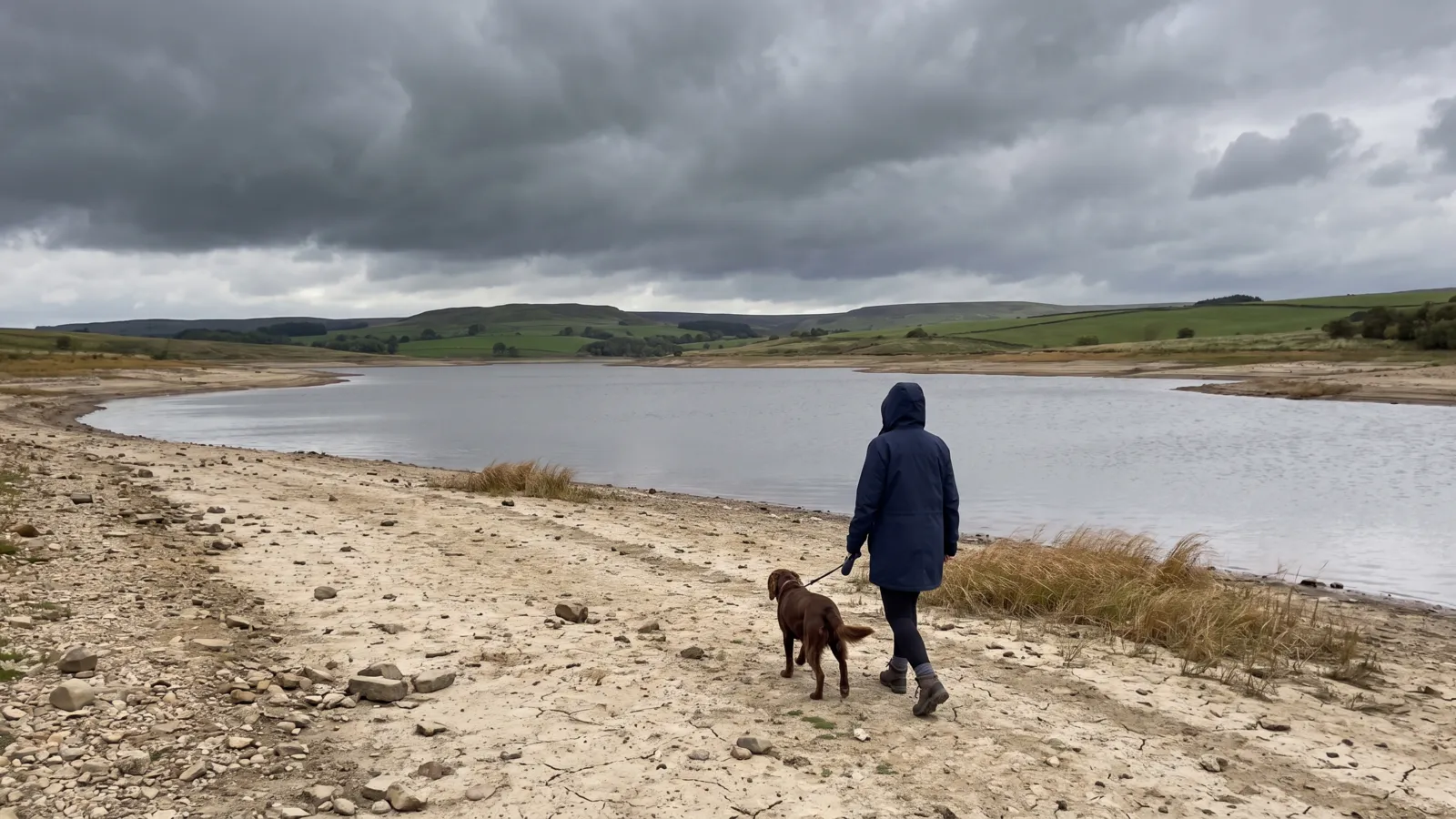
What Friday brings
The Met Office named Storm Austen on Tuesday, the first named storm of the season. Its warnings, read on Thursday morning, are for wind. An amber warning covers Cornwall, Devon, the Isles of Scilly and Plymouth from 3am to 10am on Friday. Yellow wind warnings run from midnight to 2pm on Friday across south-west England, Hampshire, the Isle of Wight, Sussex and Kent, south and mid Wales, and Herefordshire. The Met Office says gusts of over 70mph are possible on the most exposed coasts, with 50-60mph more widely in the yellow area. Our wind warning story has the detail and what to do.
On rain, the Met Office says: "Rain is an additional hazard, with 20-30mm in many places and higher totals possible over higher ground in the west and further north on Friday." It adds that further periods of wind and rain are likely through the weekend and into the start of next week, with the heaviest rain more likely in western areas. The only rain warnings in force are in Scotland, from 6am on Friday to 3am on Saturday. There is no rain warning for England.
Where England's water stands
The Environment Agency's weekly report for 9 to 15 October, the newest published on 22 October, opens: "The drought situation in England has continued to worsen, despite some rainfall across parts of the country."
National reservoir storage in England was 54% of capacity in the week ending 13 October, around 21% below the long-term average for the time of year. Eighteen reservoir groups were under half full, and 11 reservoirs or groups were classed as exceptionally low, including Ardingly, Wimbleball, Colliford, Chew Valley, Hanningfield, Grafham Water and Rutland Water.
In the Environment Agency's weekly figures, which our drought tracker records, England's reservoirs were 82.9% full in the week ending 7 July. They have fallen almost every week since.
A wetter week, and storage stayed at 54%
The clearest sign of how little one wet spell does is in the same report. The Environment Agency says: "It has been a wetter week across much of England, particularly in the north-west." Rainfall that week ranged from 10mm in central and south-east England to 33mm in the north-west.
Yet over two-thirds of reservoirs still recorded a fall in storage in the week ending 13 October. Ten, mainly in northern England and Wales, rose. "Overall, England storage remains at 54%," the agency says.
The Environment Agency notes that October as a whole remains much drier than normal: England as a whole had received 26% of its long-term average October rainfall by 15 October, from 18% in south-east and south-west England to 41% in the north-west. The agency's verdict: "Further significant rainfall is needed to return to normal water resource conditions for many water companies."
Home Alerts members
The full picture, for your home
Each week, what's happening across Britain set against your own address: your water company, your power network, fuel for your car and the gaps in your kit. Free for your own home. Opening in October; the first 100 on the list get in first.
Join the list →Britain's figures from our live trackers, 22 October.
What it would take: 120% of normal rain for seven months
On 16 September a press release from the Environment Agency, Defra and water minister Emma Hardy, issued after a National Drought Group meeting, said: "New research has shown we need 120% of typical rainfall over the next seven months for all areas to be considered out of drought."
That is a season's worth of wetter-than-normal weather, not a storm. Even a very wet Friday is one day out of roughly 210. Our guide to the hosepipe bans this winter goes through what each water company has said about lifting its ban.
Rain shows up in rivers first
Rain does real good, just not to reservoirs first. As the Environment Agency's chief executive said on 16 September: "A few weeks of rain cannot reverse the deficit we face from the very dry spring and summer."
In the wetter week to 15 October, river flows rose at most of the Environment Agency's reporting sites, though most were still below normal for the time of year. Groundwater levels were still in their usual seasonal decline at most sites.
Soils are still well short too. In the UK Centre for Ecology & Hydrology's COSMOS-UK network, 26 of the 28 English sites we could classify were drier than normal for the time of year in the seven days to 20 October (the newest data is provisional). Sites in Northern Ireland, Scotland and Wales were mostly normal. On farmland, the European Drought Observatory's indicator had 45 of the 47 English points we read in drought warning or alert for 21 to 30 September. You can follow the rain as it falls on our rainfall tracker.
Bans and drought status today
Ten water companies have temporary use bans (hosepipe bans) in force, and the Environment Agency reported no changes in the latest week: Affinity Water (Central and East regions), Anglian Water (excluding Hartlepool), Bristol Water, Cambridge Water, Essex & Suffolk Water, Southern Water (Hampshire and the Isle of Wight), South East Water, South West Water (excluding Bournemouth), Thames Water and Wessex Water. Our hosepipe ban tracker lists each one.
Since the government's declaration on 15 October, parts of four Environment Agency areas have been in severe drought: Wessex; Devon, Cornwall and the Isles of Scilly; Solent and South Downs; and Kent and South London. The agency lists ten areas in drought: East Anglia, Hertfordshire and North London, Thames, Devon, Cornwall and the Isles of Scilly, the West Midlands, Kent and South London, Solent and South Downs, the East Midlands, Lincolnshire and Northamptonshire, and Yorkshire, which moved into drought on 9 October.
Not everywhere is in drought. The Northeast, Cumbria and Lancashire, and Greater Manchester, Merseyside and Cheshire are in prolonged dry weather, the stage before drought.
The outlook is the Met Office's, not ours
The Met Office's three-month outlook for October to December, issued on 28 September, says: "There is double the normal chance of this period being wet overall." A wetter-than-normal season is what the 120% figure needs, but an outlook gives chances, not a promise. The next outlook is due on 26 October, and the Environment Agency's next weekly report covers 16 to 22 October, before Storm Austen's rain.
Common questions
Will Storm Austen end the drought?
Not on its own. England's reservoirs were 54% full in the week ending 13 October, around 21% below normal for the time of year, and the government said on 16 September that 120% of typical rainfall over the next seven months is needed for all areas to be out of drought. The Met Office expects 20-30mm of rain in many places on Friday.
Will the hosepipe ban be lifted after the storm?
No company has said so. Ten water companies have bans in force, and the Environment Agency reported no changes to them in its latest weekly report. Our hosepipe ban guide sets out what each company has said about lifting its ban.
Is there a rain warning for Storm Austen?
On Thursday morning the Met Office's rain warnings were for parts of Scotland only, from 6am Friday to 3am Saturday. In England and Wales the warnings are for wind, with an amber warning for Cornwall, Devon, the Isles of Scilly and Plymouth from 3am to 10am Friday.
Why doesn't heavy rain fill reservoirs straight away?
The Environment Agency's figures show the lag. In the wetter week to 15 October, river flows rose at most of its sites, but over two-thirds of reservoirs still fell and England's storage stayed at 54%.
Is all of England in drought?
No. The Environment Agency lists ten areas in drought, and parts of four areas, including Wessex, in severe drought. The Northeast, Cumbria and Lancashire, and Greater Manchester, Merseyside and Cheshire are in prolonged dry weather.
Sources (8)
- Environment Agency — Dry weather and drought in England: 9 to 15 October 2026published 16 October 2026; newest on 22 October
- GOV.UK — Government, Environment Agency and water companies step up efforts to prevent England remaining in drought by next spring (16 September 2026)
- Met Office — Storm Austen named (10:45, 20 October 2026)
- Met Office — UK weather warnings (read 22 October 2026)
- Met Office — UK 3-Month Outlook, October to December 2026issued 28 September 2026; next issue 26 October 2026
- UK Centre for Ecology & Hydrology — COSMOS-UK soil moisturedaily data to 20 October 2026, provisional
- European Drought Observatory, Copernicus — Combined Drought Indicator, 21 to 30 September 2026
- PreparedBritain — drought and hosepipe-ban trackers
PreparedBritain is independent and not affiliated with HM Government.
See our checks first on Google. Add PreparedBritain as a preferred source and Google will show our stories to you more often in Top Stories.

The Emergency Kit Checklist
The GOV.UK Prepare essentials on one printable page — tick them off as you go and keep it with the kit. Free, no catch.
Download it straight away. We'll also send the occasional briefing when something genuinely matters — severe weather, live incidents, real price drops. Nothing else.
Latest from our live data
All stories → News · 22 Oct‘Unprecedented’ summer of wildfires sparks Welsh fire resilience summit: what satellites show
 News · 21 OctOnly 4 in 100 adults have three days of bottled water at home, the government's survey shows
 News · 21 OctUK inflation picks up more than expected to 3.5%: food held at 1.3%, wholesale veg up a third
Keep reading
All planning & the national picture guides →Only 4 in 100 adults have three days of bottled water at home, the government's survey shows
The government's own 2026 preparedness survey of 10,791 UK adults asked people to count the litres of bottled…
Renogy vs Jackery vs EcoFlow vs BLUETTI solar panels: price per watt, and the plug catch
Nine portable solar panels compared on price per watt, with what a watt is actually worth in a British December…
No planning permission needed for cross-pavement EV chargers: what changes in England
From 21 October 2026, a cable channel under the pavement for charging a car parked on the street no longer needs…