Supercapacitor vs Lithium Jump Starters: Where Does the ANCEL Super Starter Fit?
How ANCEL's installed supercapacitor Super Starter units compare with portable lithium jump packs, what ANCEL says each model is for, and where a lithium pack is the better buy.
By Tom Calder · Updated 22 October 2026
A flat battery, and what a starting aid can and cannot do
Most flat batteries have an ordinary cause. Short runs put less back into the battery than the start took out, a dashcam or alarm draws a little all night, the battery is simply old, or the alternator is not charging properly. Our guide to jump-starting a car covers the first steps and when not to try. The lasting fix for a car that keeps going flat is a battery and charging-system test at a garage, which takes minutes.
A starting aid of any kind sits on top of that. It gets the engine running when the battery is low; it does not repair a worn battery, a charging fault or a parasitic drain. ANCEL says the same in its own technical reference for the Super Starter range. That is the right frame for what follows: a fair look at two kinds of starting aid, and at where ANCEL's installed units fit.
What the ANCEL Super Starter is
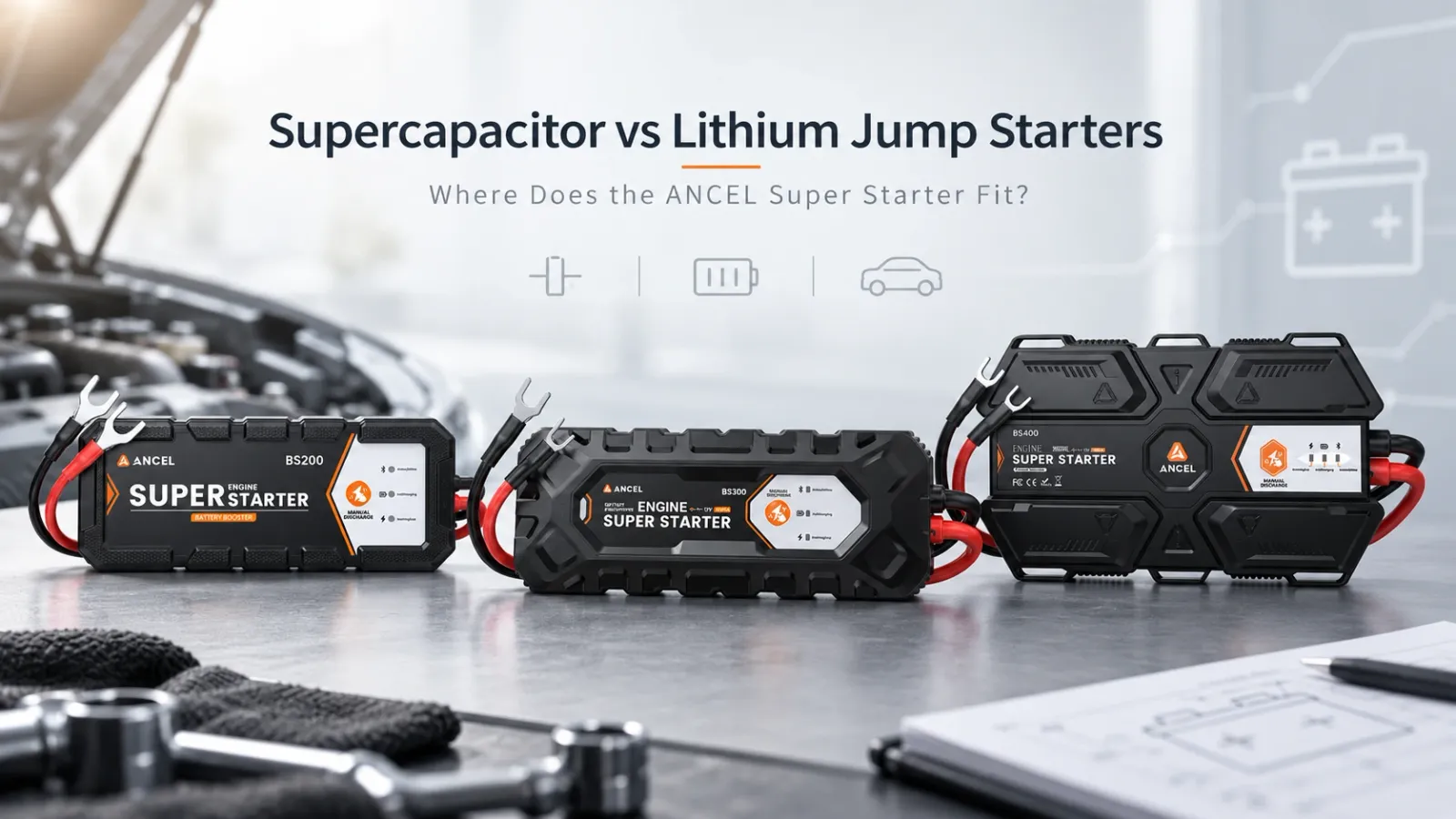
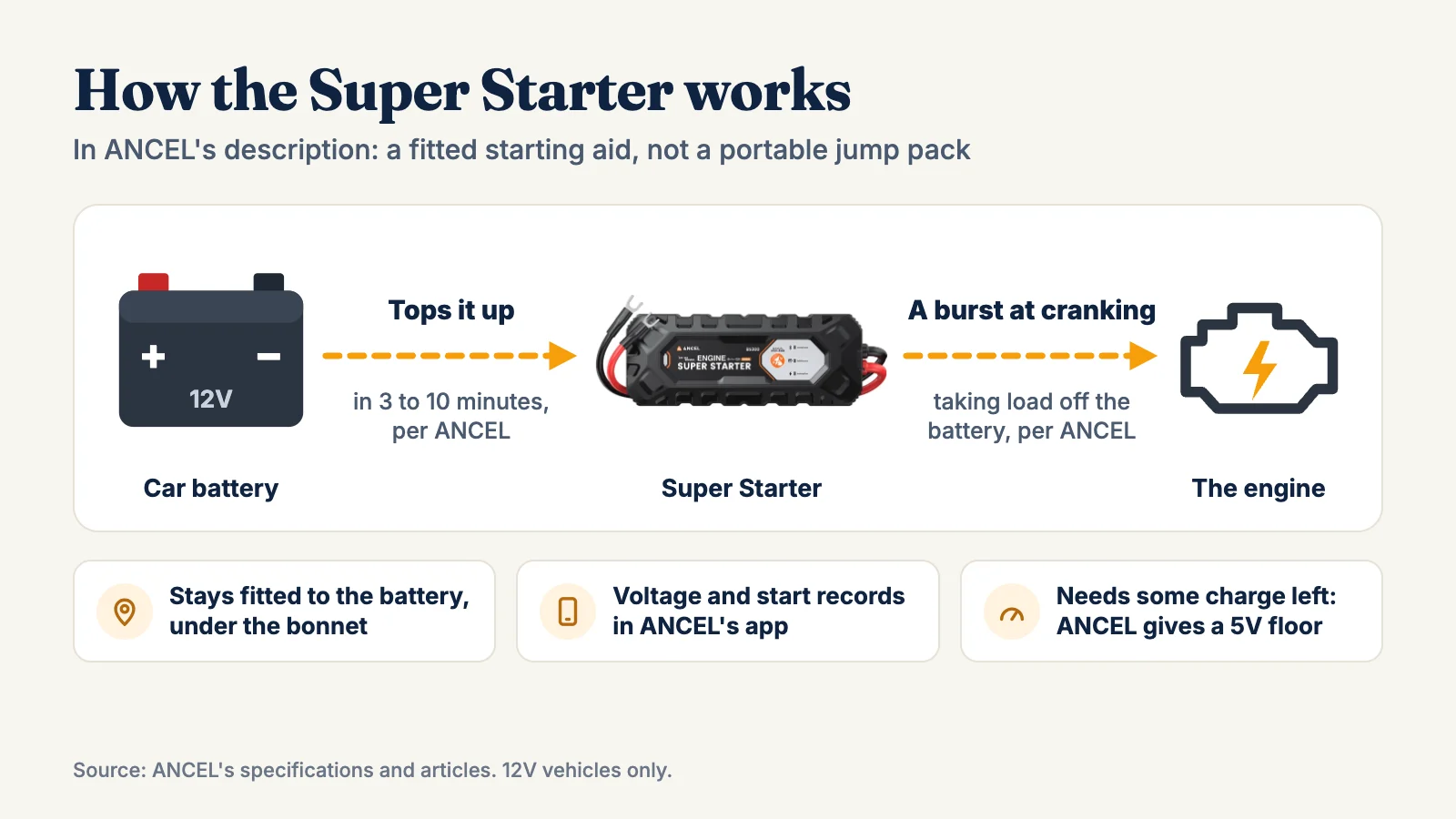
The ANCEL BS200, BS300 and BS400 are not portable jump packs. In ANCEL's description they are supercapacitor starting-assist units designed to be fitted to the car's battery terminals under the bonnet and left there. ANCEL says the unit stores a short burst of energy drawn from the car's own battery and releases it during cranking, so the battery is asked for less at the moment of starting. ANCEL describes this as sharing the instantaneous starting load with the battery, reducing the high current the battery has to supply each time the engine starts, which it says is most relevant to drivers who make frequent short trips, start the car several times a day or simply want extra starting support. ANCEL's specifications give a recharge from the vehicle battery in 3 to 10 minutes, or from a USB-C supply (5V/2A) in 3 to 40 minutes; its BS200 safety guide gives slightly longer ranges.
All three share the same core specification, and every figure here is ANCEL's: a lithium-free supercapacitor store, 12V vehicle systems only, an operating range of 5 to 20V, an IP65 rating, an operating temperature of -40°C to 80°C, Bluetooth 5.3 to the Super Starter app for voltage, status and start records, a standby draw ANCEL puts at 3mA, and a one-year warranty. ANCEL rates the units for 500,000-plus cycles.
Two points of ANCEL's own candour are worth repeating. Its comparison article says most supercapacitor starters need some residual voltage in the battery to begin charging. Its article on testing the BS200 says the unit is not a traditional jump starter designed for dead batteries, but is built for when the car still starts and the consistency of that start begins to change. Both shape the advice below.
Supercapacitor versus lithium: the independent picture
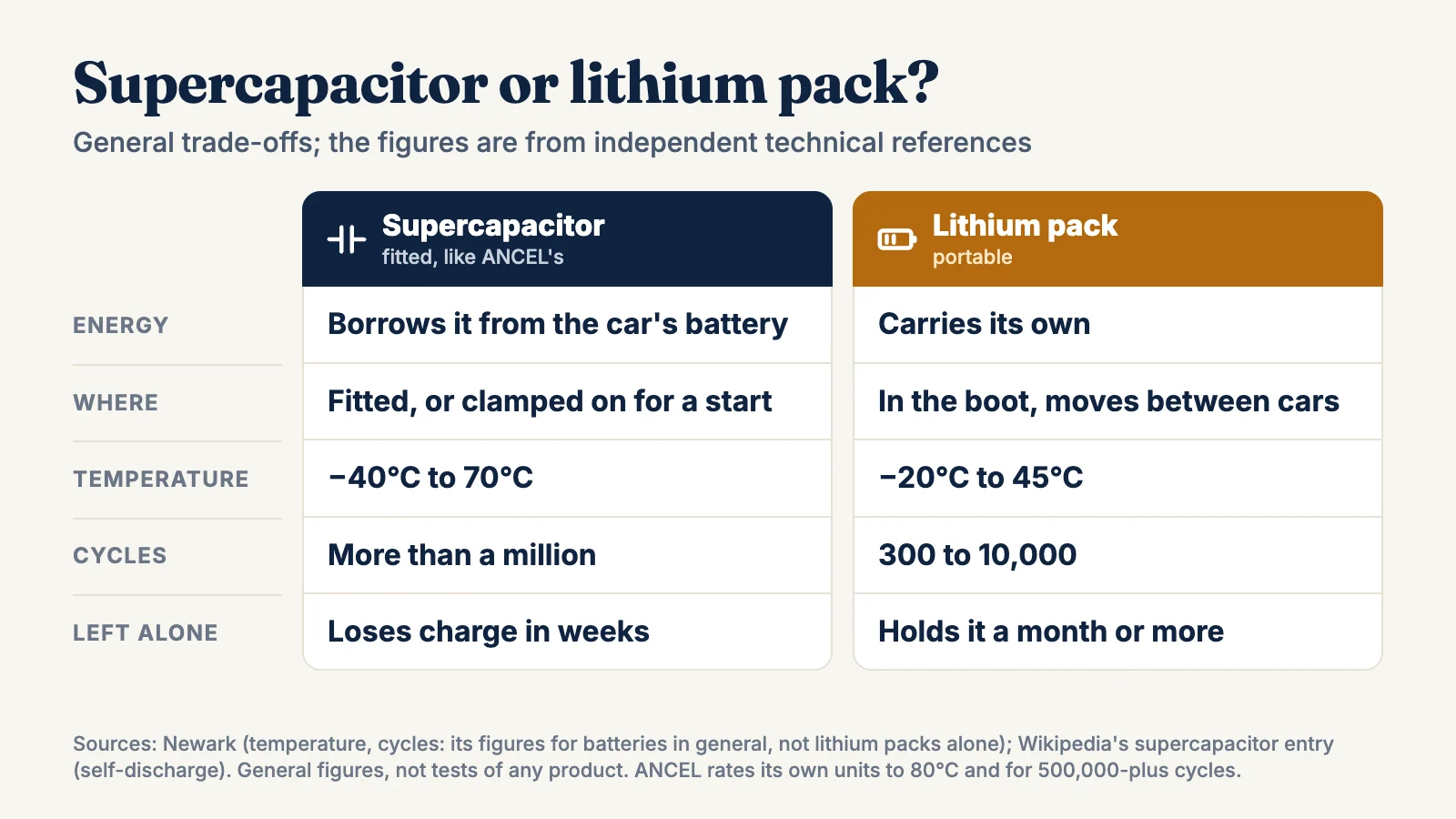
A supercapacitor stores energy in an electric field rather than through a chemical reaction, and independent technical references put the trade-offs plainly. Newark's comparison of supercapacitors and batteries gives supercapacitors an energy density of 1 to 10 watt-hours per litre against 100 to 650 for batteries, so a capacitor holds far less energy for its size. In return it releases that energy in seconds to minutes, tolerates a wider temperature range (Newark gives -40°C to 70°C against -20°C to 45°C for batteries) and survives more than a million cycles against 300 to 10,000. ANCEL's 80°C rating is ANCEL's own figure.
Supercapacitors also lose charge faster when left alone: the comparison table in Wikipedia's supercapacitor entry lists self-discharge in weeks for double-layer capacitors against a month or more for lithium-ion cells. That is why a capacitor unit cannot be left in a glovebox for months the way a lithium pack can, and why ANCEL's design keeps the unit on the battery to top itself up. It is a genuine engineering reason for a fitted design.
A lithium jump pack carries its own energy, so it works without help from the car's battery and can move between cars. Its weaknesses are the mirror image: it needs topping up every three to six months and after every use, it works within a narrower temperature range (the battery figures above), and most makers cap charging at around 40 to 45°C, which a car cabin in summer sun can pass. Our best jump starters guide covers those limits, and our lithium battery fire safety guide puts the fire risk in proportion: real if a pack is damaged or overheated, rare in practice.
Where a portable lithium pack is the better choice
If you only need an occasional emergency start and have no need for battery monitoring, a portable jump starter may be the more practical choice, and ANCEL's own documents say as much. A portable pack is also the better buy if you want one tool for several vehicles: your car, a van, a relative's car. ANCEL's technical reference gives "flexible emergency backup shared across cars" as the portable pack's best fit, its survey report says a conventional portable jump starter may suit that need better than permanent installation, and its BS400 article names drivers who want one starter to move between vehicles as outside the unit's main use.
That is not to say the Super Starter can only work fitted. ANCEL says the BS series can also give a one-off emergency start with its supplied red and black clamps, so it does not have to stay installed. Its main design advantage is long-term installation, giving ongoing starting support to one vehicle, and ANCEL says the longer it is fitted, the more battery data it collects, which can make the battery monitoring in its app more accurate. It can be moved between vehicles, though each move means disconnecting and reconnecting it, which is less convenient than a portable pack for frequent swaps. The two are designed around different needs and priorities rather than one doing something the other cannot.
A pack is also the safer bet when a battery is close to dead. A lithium pack brings its own energy; ANCEL's unit relies on residual voltage in the battery, with a specified operating floor of 5V, and ANCEL's BS200 article says a start below 5V needs pre-charging. If your battery is in the boot or under a seat, or has a monitoring sensor on the negative terminal, a pack used at the car's jump points avoids the question; ANCEL's reference says to confirm connection points and compatibility for such cars first. A pack also suits anyone who would rather not modify the car.
If the car is seldom used and parked near a mains socket, ANCEL's own survey report says a compatible charger or maintainer may better address the lack of charging, with starting support an extra safeguard rather than a substitute. If you want a torch, a USB power bank or a tyre inflator in the same box, only a lithium pack offers them: ANCEL's BS200 article says the unit has none. On cost, ANCEL's own BS400 article says a basic portable jump starter costs a fraction of the BS400's price.
BS200, BS300 and BS400: what ANCEL says each is for
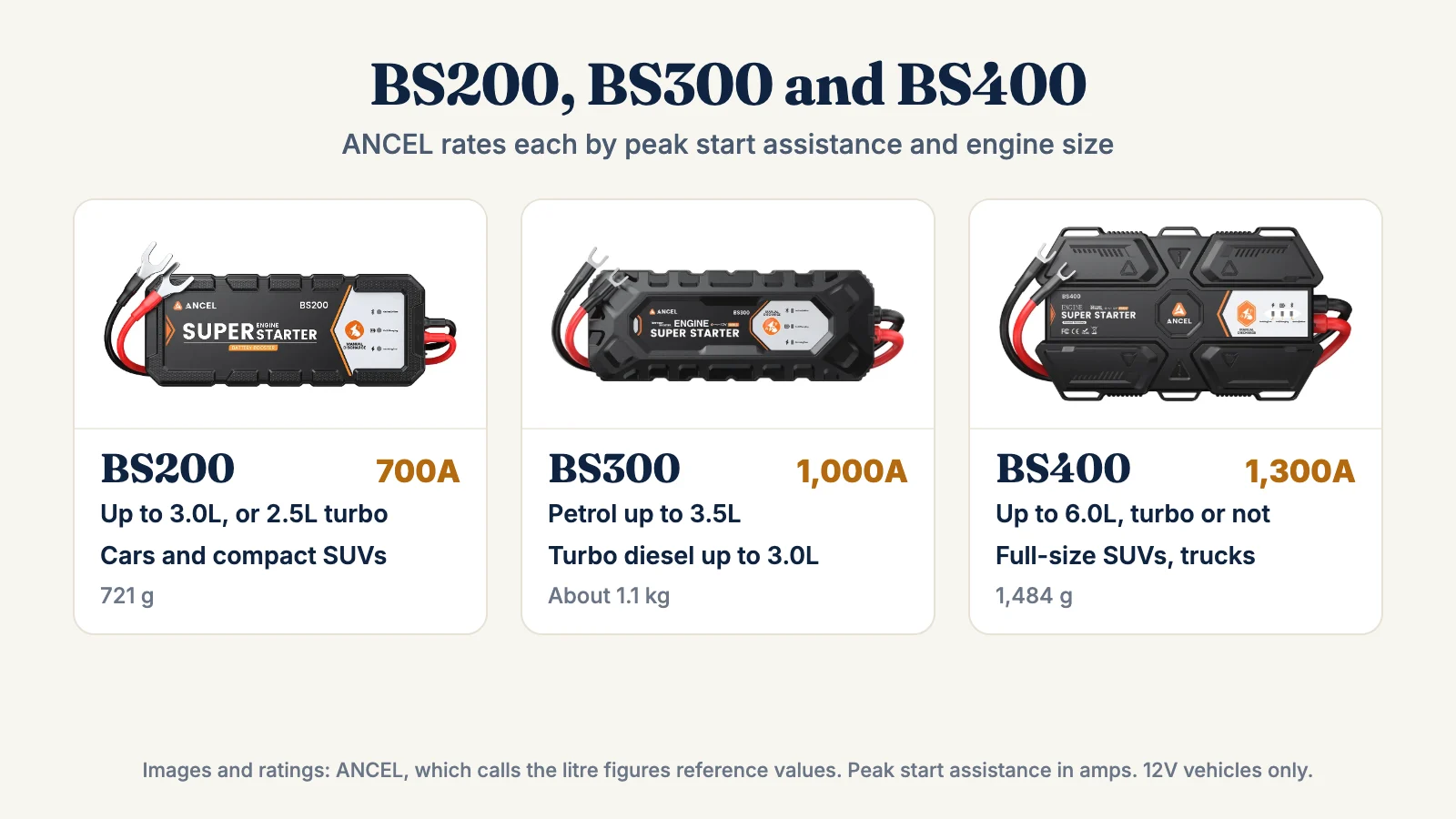
ANCEL rates the three by peak start assistance and engine size, and both figures are ANCEL's. The BS200 (700A) is for engines up to 3.0 litres naturally aspirated or 2.5 litres turbocharged, petrol or diesel; ANCEL lists cars and compact SUVs, with motorcycles and ATVs on the product page. The BS300 (1,000A) is for petrol engines up to 3.5 litres and turbo diesels up to 3.0 litres. The BS400 (1,300A) is for engines up to 6.0 litres, naturally aspirated or turbocharged, which ANCEL aims at full-size SUVs, trucks and larger vehicles.
Typical UK family cars run 1.0 to 2.0-litre petrol or 1.5 to 2.0-litre diesel engines, so on ANCEL's own engine ratings the BS200 covers the ordinary household car, and the BS300 and BS400 are for larger diesels, vans, 4x4s and pickups. Size and weight, per ANCEL: the BS200 is 23.4 × 9.4 × 5.0 cm and 721 g; the BS300 about 26 × 10 × 5.5 cm and about 1.1 kg (our conversion of ANCEL's imperial figures); the BS400 27.3 × 16.5 × 5.5 cm and 1,484 g.
ANCEL adds a rule worth knowing: it calls the litre figures reference values rather than absolute criteria. What matters is whether the engine's cranking-current requirement is within the model's peak rating, and ANCEL does not publish that requirement per vehicle, so check with ANCEL or your garage before choosing. Peak amps are a manufacturer's figure and are not comparable between brands, which is why this guide does not rank the three on amps. Vehicles with 24V systems are outside the range, per ANCEL.
What ANCEL's customer survey says, and what it cannot tell you
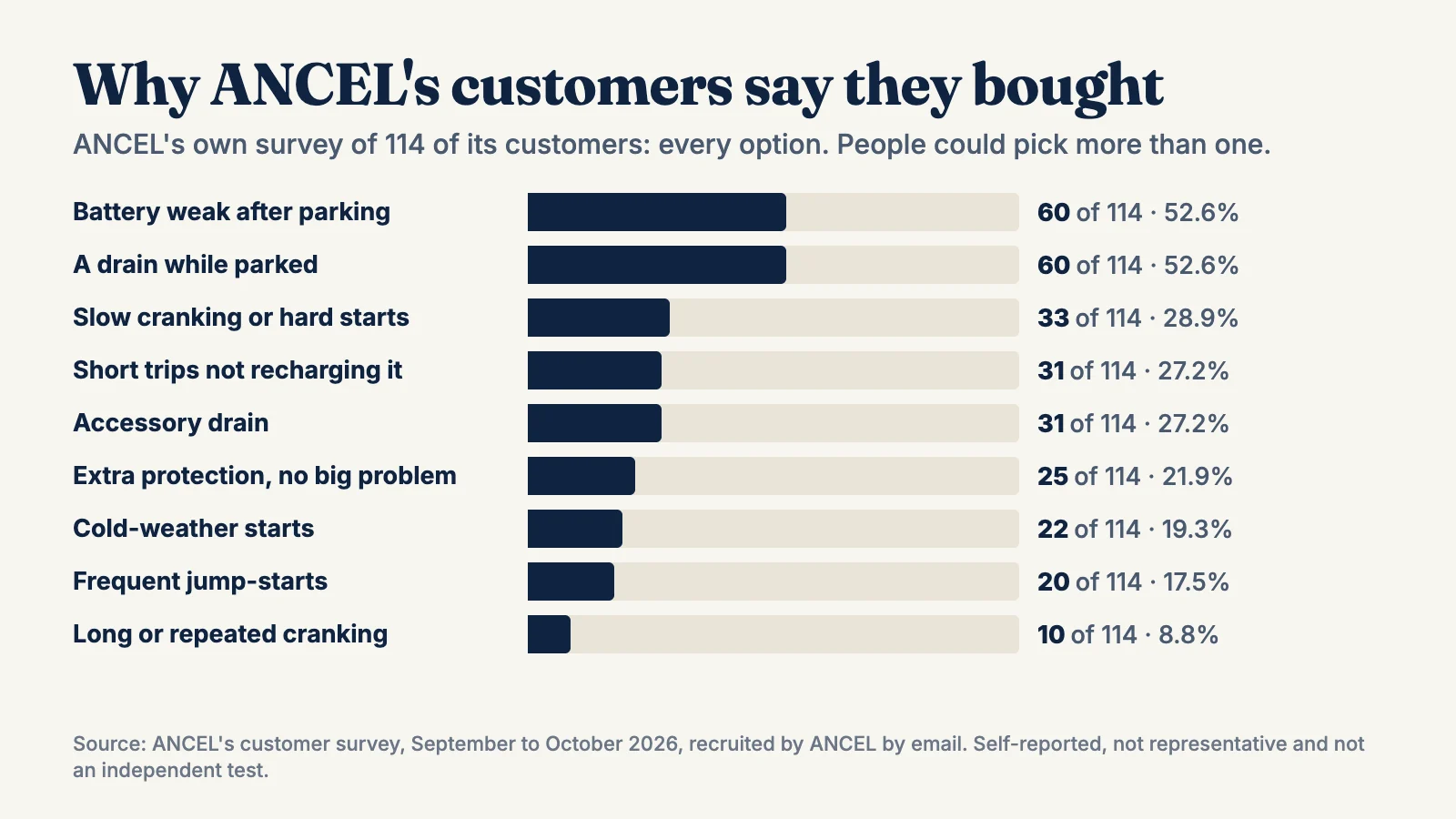
ANCEL supplied a survey of 114 of its existing Super Starter customers, recruited by the brand by email in September and October 2026. Respondents chose to take part, so the results are self-reported and not representative, and nothing was independently tested: this is ANCEL's own research, not an independent test. The most useful numbers are the ones about why people bought.
ANCEL frames the day-to-day difference like this. A portable jump starter has to have its charge checked now and then, be fetched when it is needed and have its clamps connected before use. The BS series is designed to stay fitted and, in suitable conditions, tops its own store back up from the vehicle, so there is no separate charging routine; battery voltage and start records can be checked in its app.
In ANCEL's survey (self-reported, brand-recruited, not representative), 60 of the 114 (52.6%) said their battery went weak after parking and 60 (52.6%) reported a drain while parked; 33 (28.9%) slow cranking; 31 (27.2%) short trips not recharging the battery; 22 (19.3%) cold-weather difficulty. ANCEL says the survey cannot distinguish a deteriorating battery from an abnormal drain or a charging fault. 88 of the 114 (77.2%) said they used the unit on a daily-driven vehicle. 90 of the 114 reported fitting the unit and a real starting test; ANCEL says this does not establish verified performance for everyone.
Asked to pick the single most valuable benefit they had experienced, 55 of the 114 (48.2%) chose a reduced risk of the vehicle failing to start; 13 (11.4%) being able to leave the unit connected long term; 12 (10.5%) less reliance on traditional jump starters; 12 (10.5%) faster or stronger starts; 9 (7.9%) battery and device status monitoring; and 5 (4.4%) less hassle from removing, charging or replacing batteries. By ANCEL's count, 80 respondents (70.2%) chose a benefit tied to having the unit permanently installed: the first three on that list.
One respondent described the switch. After a car failed to start at a car wash, they bought a portable lithium jump starter, but said: “I had to lift the bonnet and attach the battery pack, which was very inconvenient.” After fitting the Super Starter: “I no longer need to worry about the car not starting as the BS series product is fitted all the time.” It is one customer's account, supplied by ANCEL.
The same self-reported survey records ANCEL's own limitations. 28 of the 114 named fit, wiring, size or installation as a top improvement; 19 named connection or state-of-charge information; 16 named starting performance or reliability. One respondent reported a difficult or unsuccessful Force Start below roughly 6 to 7 volts, which ANCEL calls an anecdote, not a universal threshold. Only 14 BS300 owners responded, so ANCEL itself warns against comparing models from this sample.
Fitting one, and where the limits are
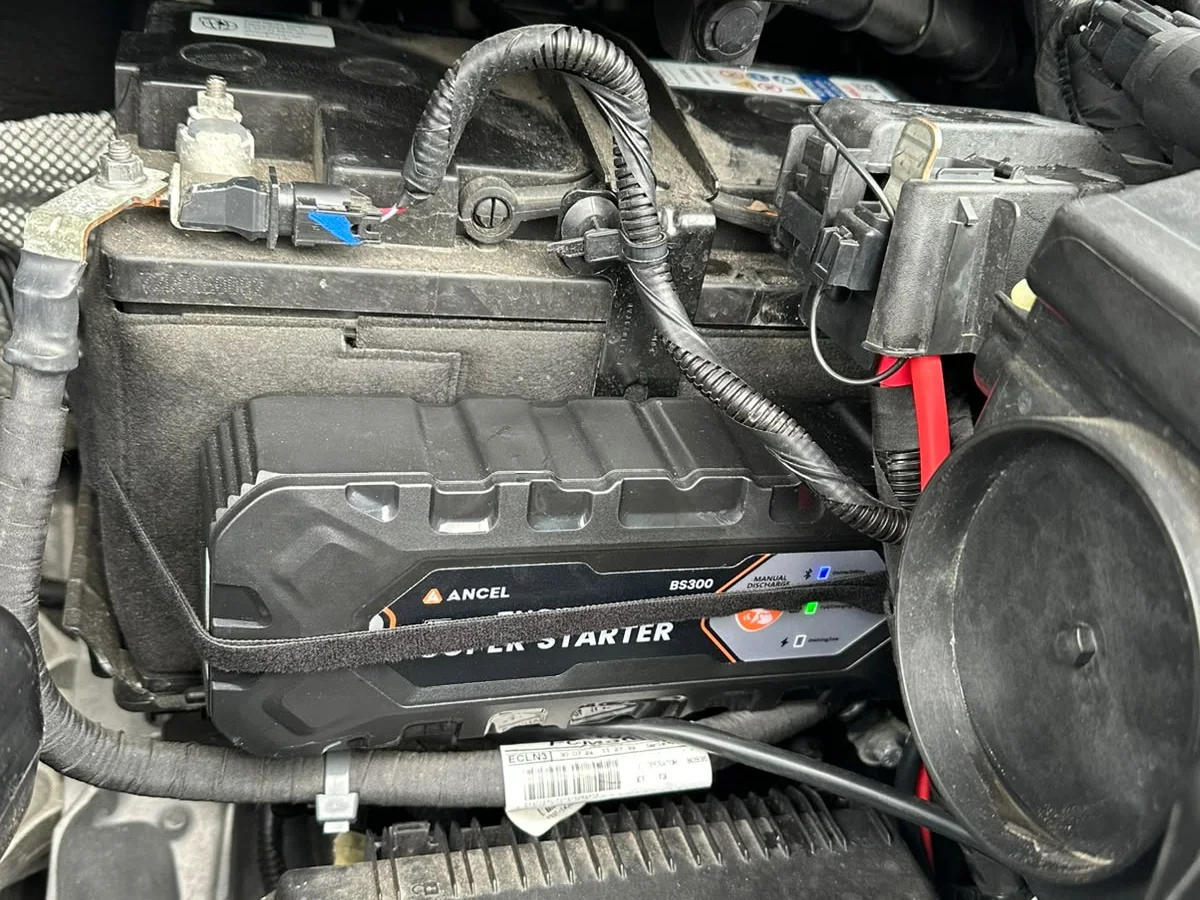
The units are fitted to the car's battery terminals and stay there. Work with the engine off. ANCEL's method, in outline: the red lead to the positive (+) post and the black lead to the negative (-) post using the supplied U-shaped terminals; clamp screws tightened firmly, because ANCEL says loose clamps can cause sparks or poor performance; the unit secured under the bonnet in a heat-safe spot; and the indicator lights checked to confirm the set-up before a normal start. Pairing is through the Super Starter app. Follow the printed manual, not this summary.
ANCEL's safety lines, carried over without softening: keep spanners and other metal tools away from the car body while connecting, because ANCEL says a tool touching both a clamp and the chassis can cause a short circuit or scalding; never reverse the connections, since ANCEL says that, despite reverse-polarity protection, reversing stops the unit working and may damage the clamps over time; inspect for a cracked casing, rusted clamps or damaged cables before fitting; keep the unit away from direct sunlight, exhaust heat and moisture, because ANCEL says IP65 covers dust and light rain, not submersion; and disconnect it if the car will be unused for more than six months.
A car battery also gives off an explosive hydrogen-oxygen mixture while charging and for a time afterwards, and the HSE notes many battery explosions happen as connections are made or broken. Keep flames and phones away, empty your pockets of metal, and never work on a cracked, leaking or swollen battery; our jump-starting guide sets this out with its sources. ANCEL says the BS series is designed for everyday vehicle owners, who can fit it themselves by following the official instructions without any battery-maintenance experience. Keep to the essentials every time: engine off, red to positive and black to negative, connections tight and secure, and nothing that could short across the terminals. If you would rather not do it yourself, a garage or auto-electrician can fit it in a short visit.
ANCEL's stated limits: 12V systems only; 24V vehicles not supported; pure electric vehicles not supported; hybrids only where the 12V system cranks the engine; no battery below 5V or one that is physically damaged; and a cranking requirement within the model's peak rating. ANCEL says the units work with AGM, EFB, GEL, standard lead-acid and lithium starter batteries; lithium support came with a recent product update, so an older printed guide may not list it. For boot-mounted batteries or battery sensors, ANCEL's reference says to confirm guidance and connection points first; ask ANCEL and check your handbook. If the car is leased, or your insurance has conditions on modifications, check those terms too.
Buying one
All three models are sold on ANCEL's UK store: the BS200, BS300 and BS400. The BS200 is also on Amazon UK; the BS300 and BS400 are only on ANCEL's store. ANCEL says prices on its UK store are converted from US dollars and confirmed at checkout, and that delivery is US$9.99, also converted at checkout. ANCEL says it normally ships UK orders from its UK warehouse, arriving in 1 to 3 business days. If UK stock is unavailable, or in other exceptional circumstances, it contacts the customer first and ships from Shenzhen only once they confirm; those orders take 7 to 14 days and may incur customs charges, which ANCEL estimates at around £30. Each unit carries a one-year warranty, per ANCEL's product pages.
Where it fits in a household car plan
ANCEL describes several kinds of driver the Super Starter is designed for, and they need not all apply at once: everyday drivers who want an extra layer of starting support; drivers who make frequent short trips or sometimes notice a sluggish start; owners of cars that are used infrequently and may struggle to start after being parked for a long time; drivers who have trouble starting in cold weather; anyone who would rather not jump-start by hand or keep a separate jump starter charged; owners who want to monitor battery voltage and start records; and owners of older or second-hand cars, whose battery condition and electrical history may be less certain, particularly if starts have been slow or difficult. For those cars, ANCEL says, the unit adds current while the engine cranks, easing the instantaneous load on the battery and giving an extra layer of starting support. In every case, ANCEL says, vehicle compatibility, battery condition and correct installation come first.
Whichever starting aid suits you, the basics stay the same: if a battery keeps going flat or the engine is slow to start, have the battery and charging system tested at a garage, because a starting aid supports a tired battery but does not fix one; a charger or maintainer keeps a car that sits charged; and breakdown cover is worth having regardless. Our winter preparation guide covers the cold-start season, when all of this matters most.
Common questions
Does the ANCEL Super Starter charge or repair my battery?
No: it supports the start rather than charging the battery. ANCEL says the BS series stores energy in its internal supercapacitors and supplies extra current while the engine starts, and, in suitable conditions, tops its own store back up from the vehicle's electrical system, which is not the same as charging the car's battery. ANCEL's technical reference is clear that the units do not repair a weak battery, a charging fault or a parasitic drain. A charger or maintainer does a different job, keeping the battery itself charged, so the two can work alongside each other. If a battery is deteriorating or keeps going flat, have the cause diagnosed at a garage.
Does it work on a completely flat battery?
ANCEL says most supercapacitor starters need some residual voltage in the battery to begin charging. It specifies a 5V operating floor, and its BS200 article says a start below 5V needs pre-charging. If the battery is close to dead, a lithium jump pack that brings its own energy is the safer choice, or ask ANCEL in writing what its units do below 5V.
Can I fit it to a hybrid or electric car?
Per ANCEL, pure electric vehicles are not supported, and hybrids only where the 12V system cranks the engine. Vehicles with 24V systems are also outside the range. Confirm your exact model with ANCEL before buying, and check your handbook for the recommended connection points.
Will it drain my battery when the car is parked?
ANCEL puts the standby draw at 3mA. Our arithmetic, not ANCEL's: 3mA over 30 days is roughly 2.2 amp-hours, small against a car battery's tens of amp-hours but not nothing. ANCEL says the unit can stay fitted on a car parked for up to six months and should be disconnected beyond that.
Is a supercapacitor starter better than a lithium jump pack?
Neither is better in every case. An installed supercapacitor unit needs no charging routine and the technology tolerates a wide temperature range, but it is designed to stay on one car (ANCEL says it can be moved, or used for a one-off start with its supplied clamps) and needs residual battery voltage. A lithium pack moves between cars, works on a flatter battery and often adds a torch or power bank, but needs topping up every few months and dislikes heat and cold. Our jump starters guide compares the packs.
Can I fit it myself?
Yes. ANCEL says the BS series is designed for everyday vehicle owners to fit themselves by following its official instructions, with no battery-maintenance experience needed. Keep to the safety essentials: engine off, red to positive and black to negative, clamps tight and secure, and metal tools kept clear of the car body so nothing can short. If you would rather not, a garage or auto-electrician can fit it in a short visit.
Sources (13)
- Newark — Supercapacitors vs. batteries: evaluating energy storage solutionsenergy density, power density, cycle life and temperature range figures
- Wikipedia — Supercapacitor (comparison table: self-discharge and cell characteristics)
- HSE — Using electric storage batteries safely (INDG139)
- ANCEL (advertiser) — BS200 Super Starter product page, specification as of 13 Oct 2026
- ANCEL (advertiser) — BS300 Super Starter product page, specification as of 13 Oct 2026
- ANCEL (advertiser) — BS400 Super Starter product page, specification as of 13 Oct 2026
- ANCEL (advertiser) — How to use the ANCEL Super Starter BS200 safelyconnection, safety and battery-type guidance
- ANCEL (advertiser) — ANCEL BS400: a different approach to jump startinginstallation note; who it is not for; cost
- ANCEL (advertiser) — Testing the ANCEL BS200 on a Toyota Corolla"not a traditional jump starter designed for dead batteries"
- ANCEL (advertiser) — Is the ANCEL BS200 Super Starter worth it?voltage requirements; no torch, power bank or compressor
- ANCEL (advertiser) — Why heat-resistant, maintenance-free jump starters actually matter (residual-voltage statement)
- ANCEL (advertiser) — Technical Reference, BS200/BS300/BS400, supplied by ANCEL to PreparedBritain (not published)
- ANCEL (advertiser) — BS Series customer survey of 114 brand-recruited existing customers, analysis dated 6 Oct 2026, supplied by ANCELnot published; self-reported, not an independent test
PreparedBritain is independent and not affiliated with HM Government.
The Emergency Kit Checklist
The GOV.UK Prepare essentials on one printable page — tick them off as you go and keep it with the kit. Free, no catch.
Download it straight away. We'll also send the occasional briefing when something genuinely matters — severe weather, live incidents, real price drops. Nothing else.
Latest from our live data
All stories → News · 22 Oct‘Unprecedented’ summer of wildfires sparks Welsh fire resilience summit: what satellites show
 News · 22 OctStorm Austen won't end the drought: England's reservoirs are 54% full and need months of rain
 News · 21 OctOnly 4 in 100 adults have three days of bottled water at home, the government's survey shows
Keep reading
All planning & the national picture guides →Only 4 in 100 adults have three days of bottled water at home, the government's survey shows
The government's own 2026 preparedness survey of 10,791 UK adults asked people to count the litres of bottled…
Renogy vs Jackery vs EcoFlow vs BLUETTI solar panels: price per watt, and the plug catch
Nine portable solar panels compared on price per watt, with what a watt is actually worth in a British December…
No planning permission needed for cross-pavement EV chargers: what changes in England
From 21 October 2026, a cable channel under the pavement for charging a car parked on the street no longer needs…
