Filtered water without power or plumbing: the Weeplow Earth 8.5L gravity filter, and what its lab reports show
How the Weeplow Earth 8.5L gravity filter keeps drinking water flowing in a power cut or supply interruption, and what its independent lab reports show.
By Tom Calder · Updated 11 October 2026
Drinking water that does not depend on the mains
The kitchen tap does most of the work, but there are moments worth planning for: a power cut, a burst main or a planned supply interruption, a private borehole or spring supply, a campervan, a week of camping, or off-grid living. In each case the useful thing is a way to produce drinking water that relies on nothing but gravity.
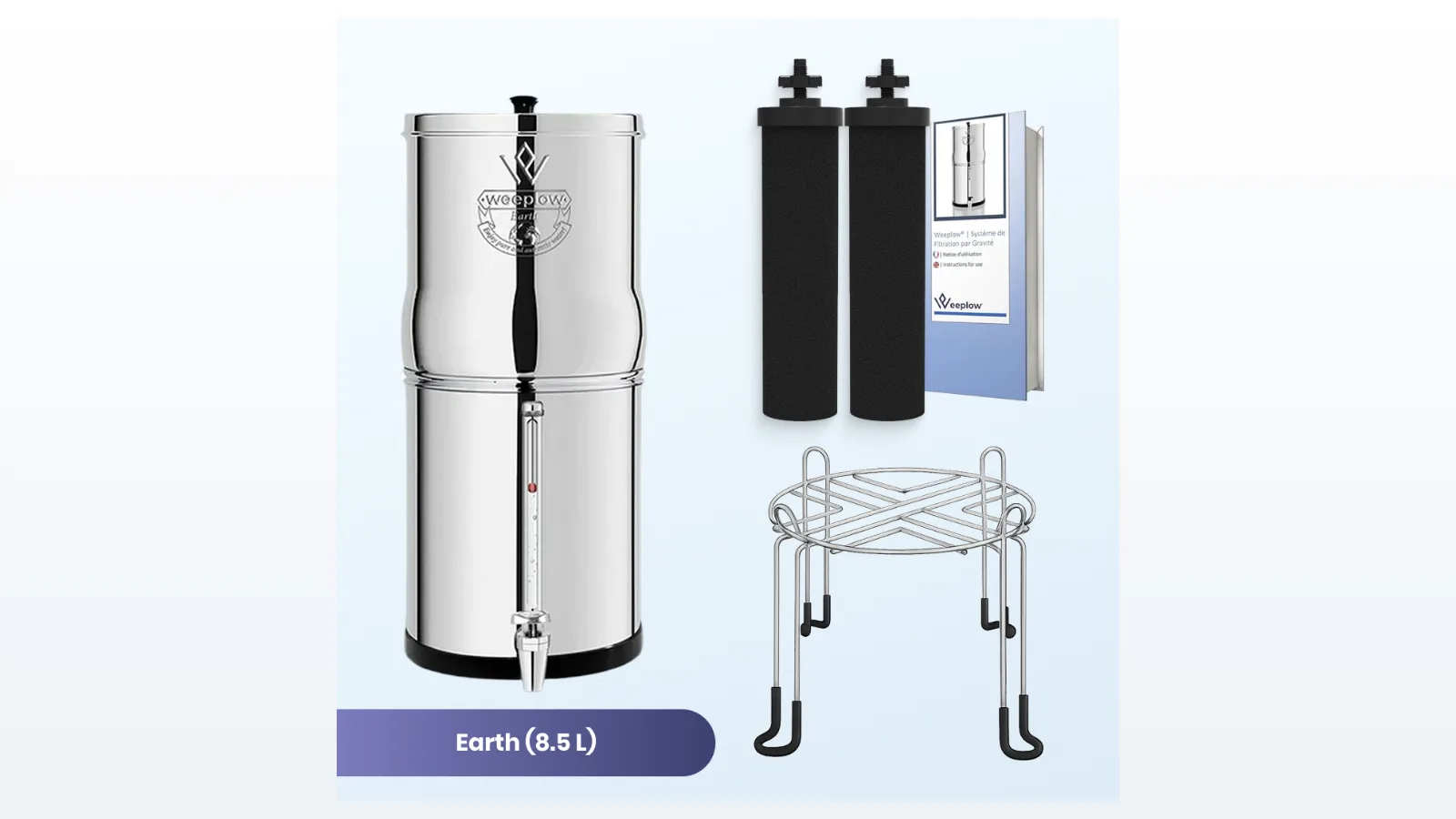
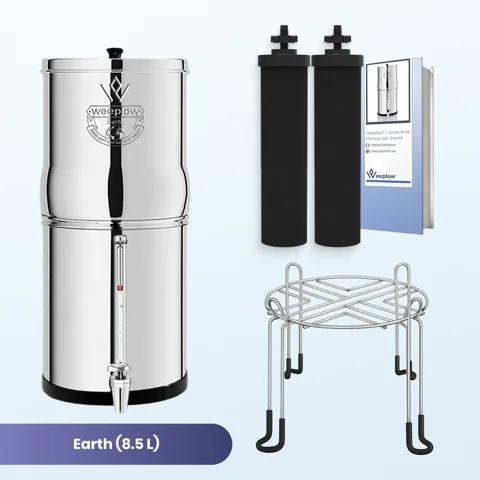
The Weeplow Earth 8.5L is built for exactly that: a well-built stainless steel gravity system from Weeplow, a European brand, sized for three to five people, whose O'Pure 2 elements pair activated carbon with a 0.02-micron hollow-fibre membrane, a step beyond carbon-only filters. SGS testing reports a 99.9999% reduction of the MS2 test virus, and the published reports cover bacteria, PFAS, pesticides and heavy metals too.
Weeplow describes its range simply: stainless steel gravity water filters that combine activated carbon with a 0.02-micron hollow-fibre ultrafiltration membrane, need no power or plumbing, come with a 10-year warranty on the steel body, and use filters that last up to 22,000 litres per pair. The Weeplow Earth 8.5L is the middle size of three.
How it works when the power is off
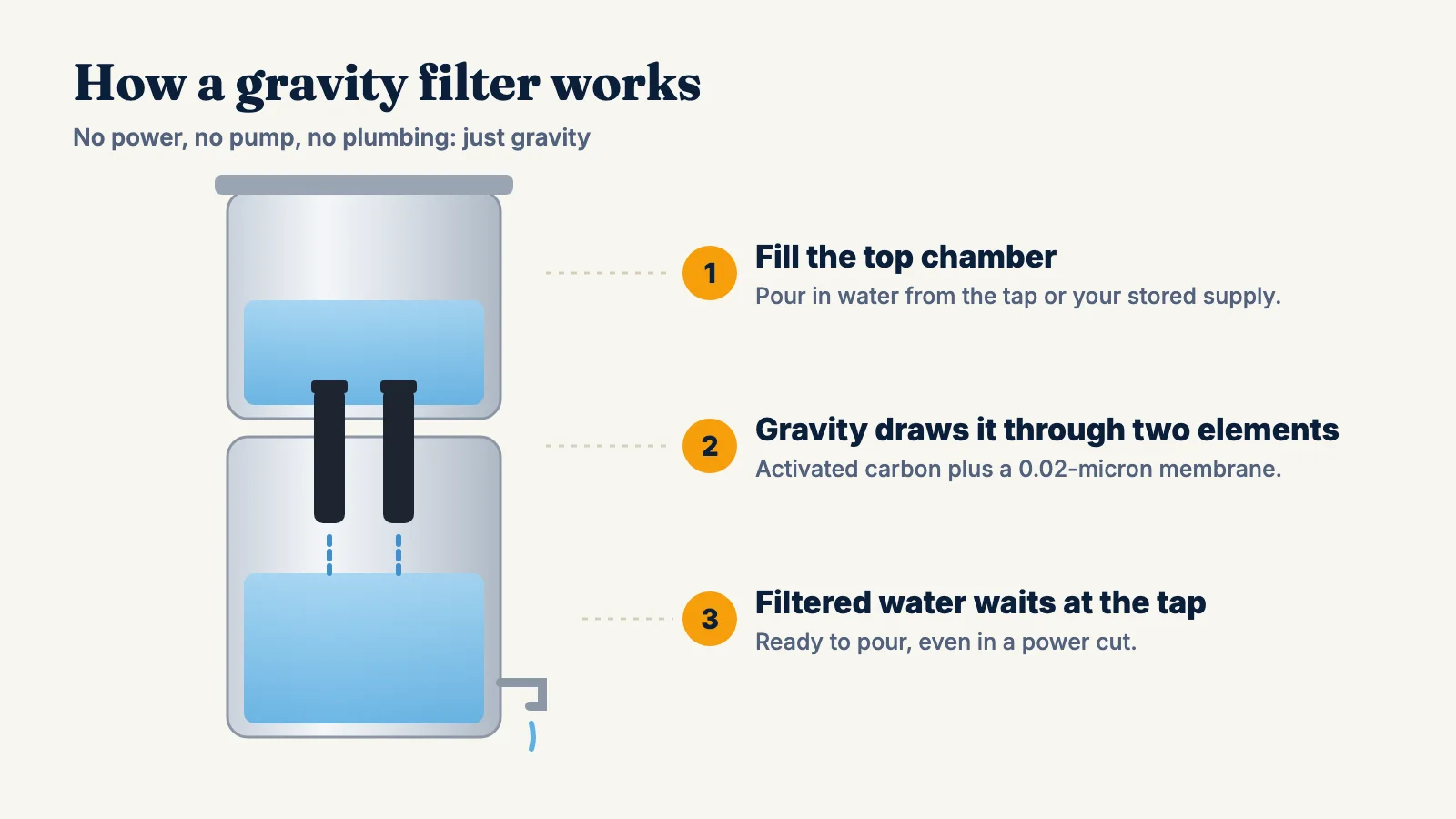
Water goes into the top chamber, gravity draws it down through the two O'Pure 2 elements, and it collects in the lower chamber behind a stainless steel tap. With no pump, no electricity and no connection to the mains, it keeps working whatever the power or the supply is doing, and whatever has already filtered through sits ready to pour.
What is inside the O'Pure 2 elements
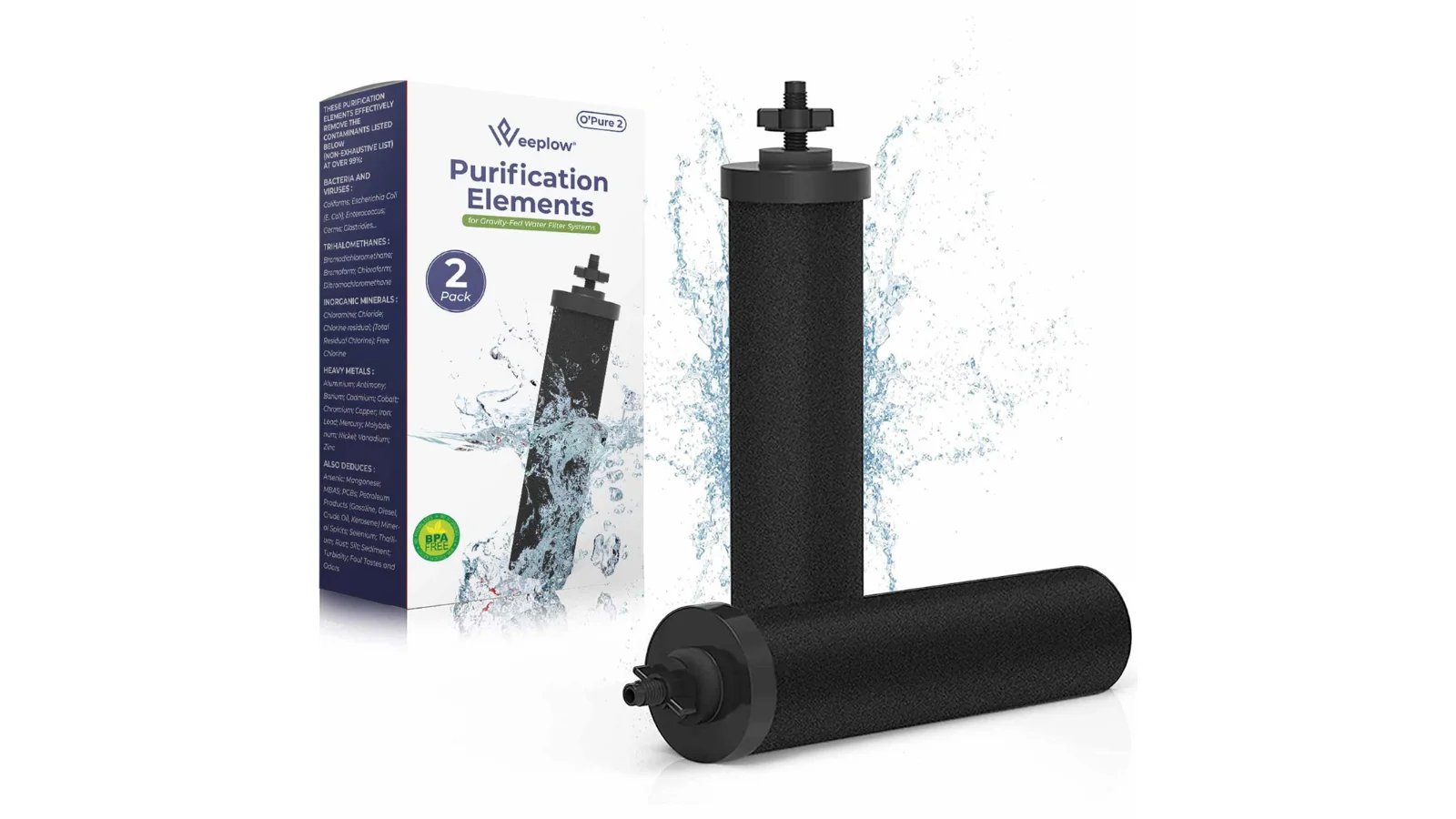
Each O'Pure 2 element combines coconut-shell activated carbon with a hollow-fibre ultrafiltration membrane rated at 0.02 microns. Weeplow says the membrane is designed to block bacteria, viruses, cysts and microplastics, while the carbon handles chlorine, taste, chemicals and heavy metals. The membrane is a physical barrier, holding back particles that carbon alone does not.
Weeplow lists coliforms, E. coli, lead, iron, mercury, chlorine, chloramines, bisphenol A, pharmaceutical residues, petroleum contaminants, pesticides and heavy metals among the substances the O'Pure 2 reduces. Two elements come fitted, and they are the only part you replace.
What the lab reports show
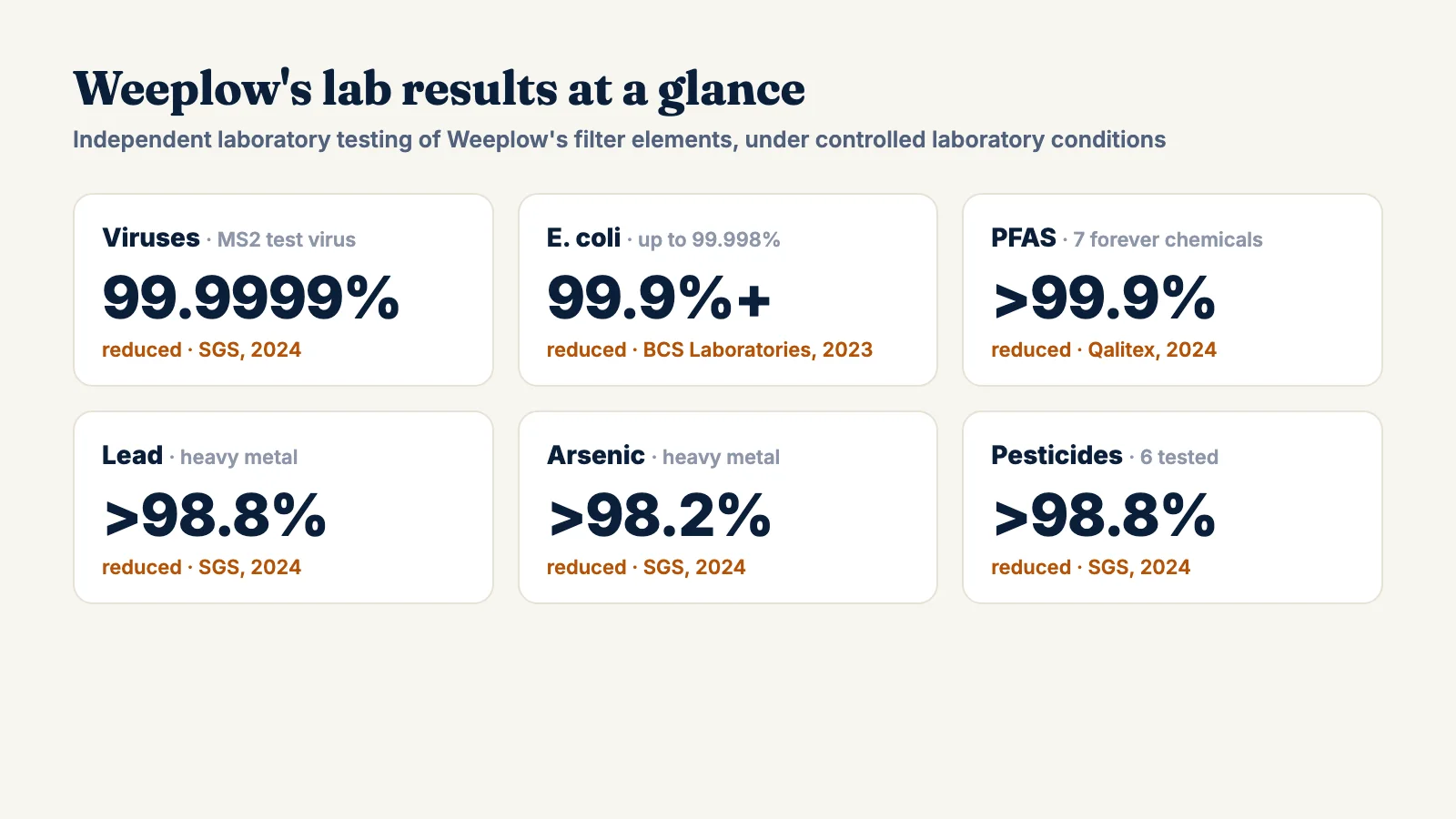
Weeplow has had the elements tested by several independent laboratories rather than one, and publishes the full reports alongside an explanation of its filtration technology. The results below were recorded under controlled laboratory conditions.
Viruses and bacteria. In SGS testing, the O'Pure 2 reduced the MS2 test virus by 99.9999%. Weeplow's filters reduced E. coli by between 99.9% and 99.998% across 300 litres in testing by BCS Laboratories, Florida.
Heavy metals. Tested by SGS to NSF/ANSI 53 and 42 test protocols, the O'Pure 2 reduced lead by more than 98.8%, arsenic by more than 98.2%, cadmium by more than 99.6%, mercury by more than 98.8% and copper by more than 99.9%.
Pesticides and PFAS. In SGS testing, six pesticides including chlorpyrifos were each reduced by more than 98.8%, and dimethoate by more than 99.9%. Qalitex found seven PFAS, the so-called forever chemicals, including PFOA and PFOS, reduced by more than 99.9%. All five reports are linked below.
Why it fits a prepared household
Mains-independent. No power, pump or water pressure is needed, so it keeps producing filtered water in a power cut or supply interruption, and stores it on the worktop.
Microbiological protection including viruses. The 0.02-micron membrane targets bacteria and viruses, as the SGS and BCS results above show, which matters for private or borehole supplies, camping, campervans and off-grid use.
Transparent, multi-lab testing. Full reports from SGS, Qalitex and BCS Laboratories are published openly, so anyone can read the figures above in full.
Built to last. Food-grade AISI 304 stainless steel, polished to a mirror finish, with a stainless steel tap and a 10-year warranty on the chambers, stand and tap; long-life filters keep running costs low.
Less plastic, less carrying. Weeplow's aim is to help households move away from bottled water to a cleaner, cheaper and less wasteful alternative. It estimates one system can replace up to 544 kg of plastic bottle waste over its lifetime, with no multipacks to carry home.
Easy UK buying. Weeplow says its UK store ships from within the UK with free shipping and returns, delivery in around 48 hours and seven-day customer support. The brand reports more than 100,000 customers and an average rating of 4.74 out of 5.
Living with it
Weeplow rates the flow at up to 3.8 litres an hour with both elements fitted. Kept topped up, that is around 90 litres over a day, many times the 2.5 to 3 litres per person per day of drinking water that GOV.UK Prepare quotes, so regular top-ups keep a family going all day.
Setting up takes a few minutes: prime the two elements, run a fill or two through, and it is ready. A quick scrub every couple of months keeps the flow at its best.
The Earth is 22 cm across, 50 cm tall (66 cm on the optional stand) and weighs 4.2 kg. Weeplow rates a pair of O'Pure 2 elements at up to 22,000 litres, typically one to two years, which it says works out at less than a penny a litre of filtered water.
Replacement O'Pure 2 elements are sold in pairs, and optional O'Pure 2B elements add extra fluoride and arsenic reduction, in Weeplow's description. Accessories include stainless steel stands, a water-level indicator with tap, and a maintenance and descaler kit. As of 11 October 2026 the Earth is £129.99 on Weeplow's UK store without the stand, or £159.99 with the 15 cm stand and water-level indicator.
Who it suits
This is for households that want one countertop filter covering everyday drinking water and supply resilience, including protection against viruses as well as bacteria. It is a natural fit for homes on a borehole or spring supply (have the supply tested by your council), for campervans, boats and holiday lets, and for anyone who wants to stop buying bottled water.
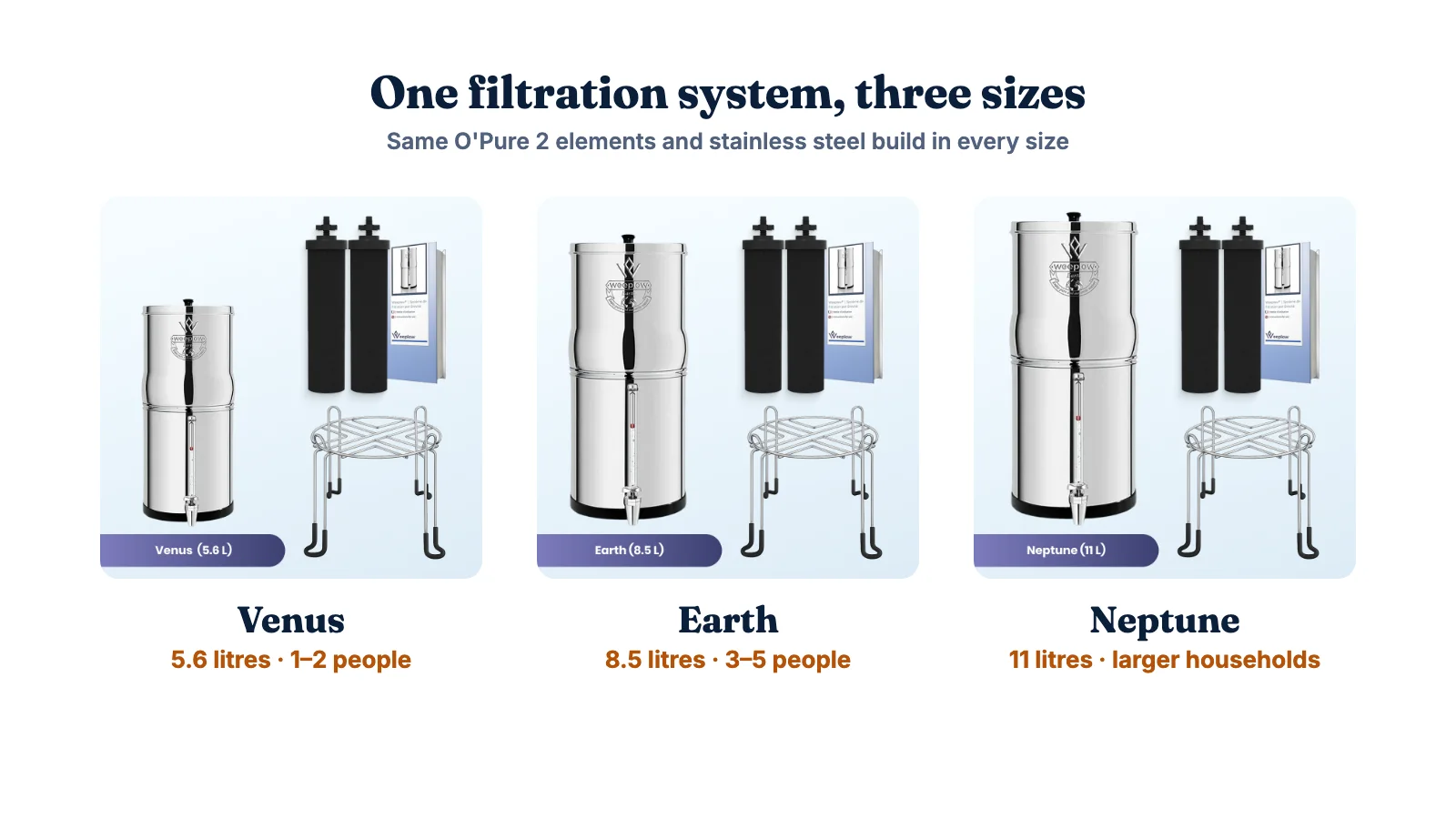
The range comes in three sizes with the same filtration and build. The Venus at 5.6 litres suits one or two people or a compact kitchen, the Earth at 8.5 litres suits three to five, and the Neptune at 11 litres suits larger households or higher daily use.
Where it fits in a household water plan
A filter works best alongside stored water: our storage guide covers how much to keep, and a gravity filter is the natural second layer, keeping stored water fresh-tasting and adding a physical barrier. During a boil water notice, follow your water company's instructions (our guide explains what to do).
Common questions
Does the Weeplow Earth remove viruses?
Yes. Its O'Pure 2 elements add a 0.02-micron ultrafiltration membrane designed to block viruses as well as bacteria, and in SGS testing they reduced the MS2 test virus by 99.9999%. The full report is linked below.
Does it work in a power cut?
Yes. The Earth runs on gravity alone, with no power, pump or plumbing, and whatever has already filtered through sits ready in the lower chamber.
How long do the O'Pure 2 elements last?
Weeplow rates a pair at up to 22,000 litres, typically one to two years for most households. Replacement elements are sold in pairs, and the price of a pair is on Weeplow's UK store.
Sources (6)
- SGS report XMF24-0006475-01 (Aug 2024) — O'Pure 2, MS2 virus reduction
- SGS report XMF24-0002261-01 (June 2024) — O'Pure 2, heavy metals, NSF/ANSI 53 and 42 protocols
- SGS report XMF24-000026-01 (Feb 2024) — O'Pure 2, pesticides
- Qalitex report 9145253 (Aug 2024) — O'Pure 2, PFAS
- BCS Laboratories (Feb 2023) — Weeplow filters, E. coli
- Weeplow UK store — Earth 8.5L product page (price and specification as of 11 Oct 2026)
PreparedBritain is independent and not affiliated with HM Government.
The Emergency Water Checklist
One page: how much to store per person, the cheapest ways to store it properly, how to make uncertain water safe, and what changes in a hosepipe ban. Free, no catch.
Download it straight away. We'll also send the occasional briefing when something genuinely matters — severe weather, live incidents, real price drops. Nothing else.
Latest from our live data
All stories →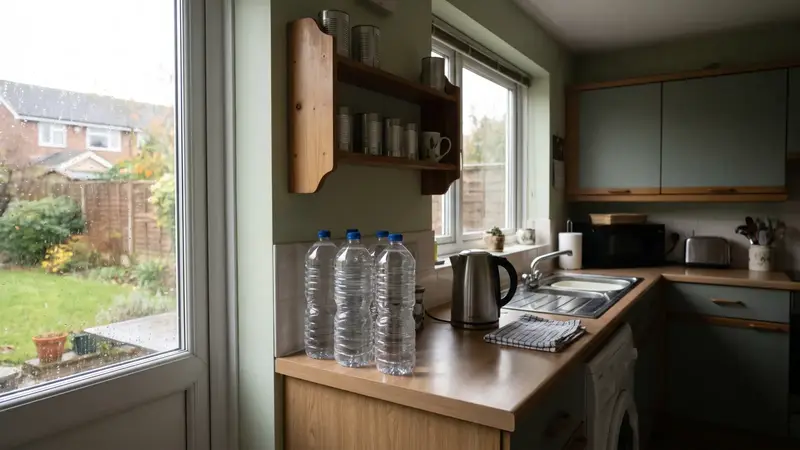 News · 21 OctOnly 4 in 100 adults have three days of bottled water at home, the government's survey shows
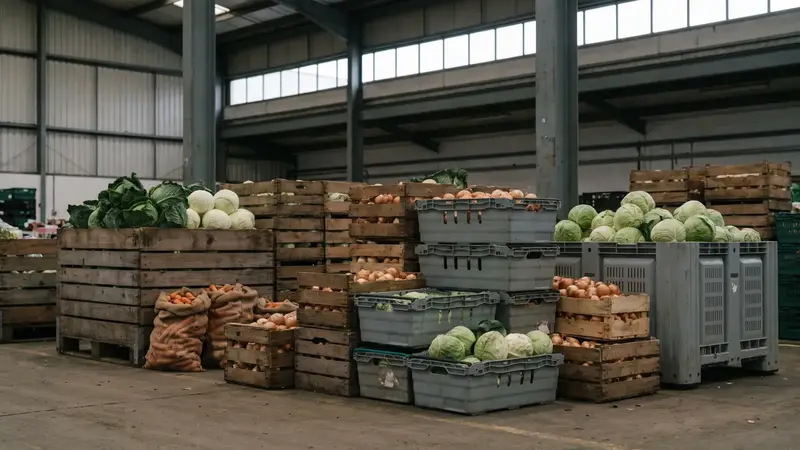 News · 21 OctFood inflation held at 1.3%. Wholesale cabbage and cauliflower are up a third. Both are true
 News · 21 OctAldi recall: shoppers warned of hairdryer electric shock or fire risk. How to check yours
Keep reading
All water guides →No water coming out of your taps? What to do, your rights and compensation
No water from your taps? How to check if it's your pipe or the mains, fill up fast, find bottled water stations, and…
How to purify water in an emergency: safe UK methods
The ways to make water safe in an emergency — boiling, tablets and filters — what each actually removes, what none…
Is UK tap water safe to drink?
A calm, sourced answer: UK mains tap water is among the safest in the world. What the regulation says, why taste…
