
Cooking indoors in a power cut: what to use instead of a camping stove (2026)
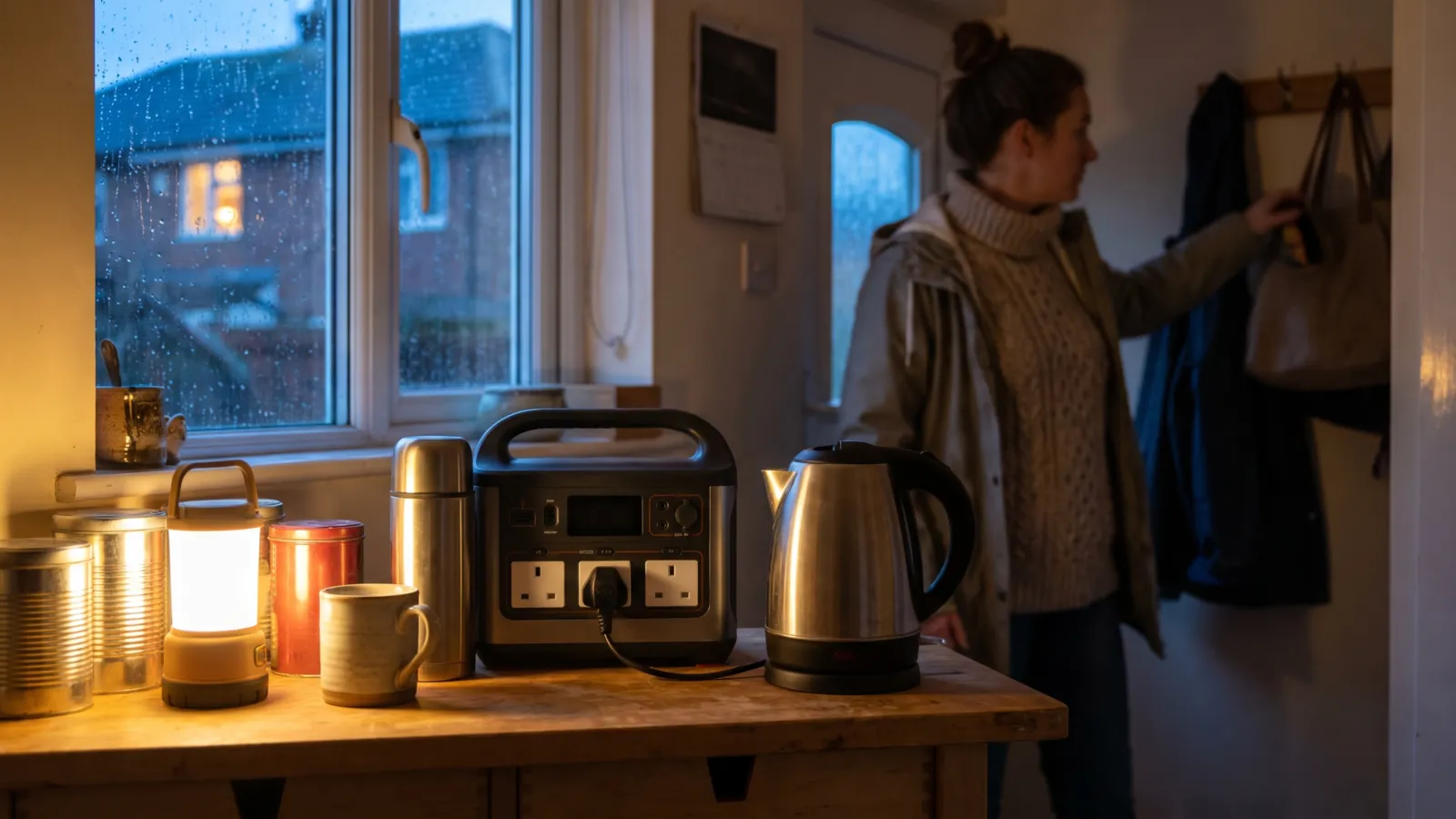
We found no portable gas or camping stove whose maker says it can be used indoors in a home, and the NHS says “do not use a barbecue or camping stove indoors or inside a tent”, so this page is about what you can cook on indoors instead. If your gas is still on, a fitted gas hob may keep working and can usually be lit with a match. For electric cooking, the power stations below are three whose makers’ own pages, among those we read, mention indoor use in words, compared on battery size and output, with the sums for a kettle, a slow cooker, a microwave and a hob. And for most short cuts, food that needs no cooking and a flask filled beforehand cost far less.
By Tom Calder · Updated 15 November 2026 · 3 products, all price-tracked
All 3 compared
| Power station | Capacity | Output | Weight | Price |
|---|---|---|---|---|
 2,042 Wh · 2,200 W · 17.5 kg Whole-home backup during power cuts, and off-grid trips | 2,042 Wh | 2,200 W | 17.5 kg | £726 at Amazon as of 15 Nov 2026, 12:07 GMT · DetailsProduct prices and availability are accurate as of the date/time indicated and are subject to change. Any price and availability information displayed on Amazon.co.uk at the time of purchase will apply to the purchase of this product. |
Our verdictOur verdictResearched Update, 11 November 2026: Jackery now sells the 2027 edition of this model on pre-order and estimates dispatch in early December. Jackery lists the new edition at 2,048Wh and 18.5kg with three AC outlets and a 10ms switchover, so the figures in this write-up are for the earlier edition, which has sold out. A genuine step up on the outgoing 2000 Plus — noticeably lighter for the same 2kWh capacity, with a LiFePO4 cell rated for thousands of cycles. It isn't cheap, but it's built to still be working a decade from now. Its 2200W inverter briefly surges to 4400W for motor start-ups, and the LiFePO4 cells are rated for years of weekly cycling. Best for Whole-home backup during power cuts, and off-grid trips Good
Worth knowing
Who shouldn't buy it: Don't buy it if you want to scale capacity over time — the 2000 Plus it replaces took add-on battery packs up to 12kWh; this model doesn't, so buy for the capacity you'll actually need. Read the full review → | ||||
 4,096 Wh · 4,000 W · 51.5 kg Several days of whole-home essentials and heavy kitchen appliances at once, if you can handle a wheeled 51.5kg unit. | 4,096 Wh | 4,000 W | 51.5 kg | £2,799 at EcoFlow Checked 15 NovIn stockCheck price → |
Our verdictOur verdictResearched The DELTA Pro 3 is the top of EcoFlow's portable range: 4,096Wh, 4,000W output rising to 6,000W with X-Boost, 2,600W of solar input and expansion to 12kWh. EcoFlow rates the LiFePO4 pack at 4,000 cycles to 80%. It is a wheeled suitcase-style unit, 51.5kg without extra batteries, built for people who want to run a fridge, freezer and kitchen appliances together. Next to the DELTA 3 Max Plus it offers twice the capacity and a third more output at more than twice the weight; most households will be well served by the smaller unit. Best for Several days of whole-home essentials and heavy kitchen appliances at once, if you can handle a wheeled 51.5kg unit. Good
Worth knowing
Who shouldn't buy it: You only need a fridge, router and phones covered: a 1kWh unit does that for a fraction of the cost and weight. Whole-house backup that needs to switch automatically also needs an electrician and a proper changeover, not just this unit. Read the full review → | ||||
Sold out right now (1)
The shop says these are sold out today. We check stock every hour, and each one moves back up the list when it returns.
| Power station | Capacity | Output | Weight | Price |
|---|---|---|---|---|
 1,024 Wh · 1,800 W · 12.5 kg Households that want the fridge, router and phones covered for a long power cut and may add a second battery later — the expandable 1kWh choice. | 1,024 Wh | 1,800 W | 12.5 kg | £699 at EcoFlow Checked 15 NovOut of stockCheck price → |
Our verdictOur verdictResearched This is the DELTA 3 Classic with the door left open. Same 1,024Wh LiFePO4 pack, which EcoFlow rates at 4,000 cycles to 80% (it quotes the Classic only as a 10-year life), same 1,800W output, but with an extra-battery port that takes it to 5kWh, dual solar inputs up to 1,000W, 140W USB-C ports and a 56-minute mains recharge. For a home that wants to start with one unit and grow into whole-fridge, whole-day backup, it is the better buy than the Classic; for a home that will never expand, the Classic does the same job for less. EcoFlow's UK store listed it as available to order rather than in stock when we checked; Amazon had it in stock at the same price. Best for Households that want the fridge, router and phones covered for a long power cut and may add a second battery later — the expandable 1kWh choice. Good
Worth knowing
Who shouldn't buy it: You know you'll never add a battery or solar panels — the DELTA 3 Classic is the same power station without the ports you won't use. And if a fridge isn't on your list, a 300Wh unit or a big power bank covers phones, lights and the router for a fraction of the price. Read the full review → | ||||
ⓘ As an Amazon Associate, PreparedBritain earns from qualifying purchases. We may earn a commission when you buy, or a fee when you request a quote, through our links. When two products are close, commission can decide which one we pick. A clearly better product always wins. Amazon prices come from Amazon's own product data and show the date and time they were retrieved. Prices at other retailers are checked by us, less often. Prices and stock can change at any time, so always check the retailer's price before you buy.
Before you buy
Start with what the makers and the NHS say, because it decides everything else.
The NHS says “do not use a barbecue or camping stove indoors or inside a tent”, and London Fire Brigade says “It’s never safe to use any type of outdoor cooking equipment like a BBQ or camping stove indoors.” The UK Chief Medical Officers’ power-cut food advice says: “Never use camping stoves or barbecues indoors as there is a very high risk of carbon monoxide poisoning, which can kill.” The stove manuals we read agree: Campingaz says its Camp’Bistro DLX “should only be used outside premises”, Cadac’s Carri Chef 40 instructions say “FOR OUTDOOR USE ONLY!” and Eureka’s SPRK+ manual says “Never use this appliance in an enclosed space such as a camper, tent, car or home.” The only manual we found that allows indoor use at all, Iwatani’s US manual for its ZA-3HP, allows it only “in a restaurant with a properly equipped ventilation hood”, and says it “may not be used indoors in tents, campers, apartments or other confined areas.” Writing about tents and other enclosed shelters, Cheshire Fire and Rescue Service says “Opening tent flaps, doors, or windows is insufficient to prevent build-up of CO concentrations from these devices.” So a camping stove cooks outside, and the food comes in.
A fitted gas hob is the first thing to try if the gas is still on.
The Food Standards Agency says “Electric/induction cookers will not work during a power cut, but gas cookers may continue to function.” Citizens Advice says “You can use a gas hob but the spark to light the gas might not work without electricity” and to “Use long safety matches or a gas lighter to light your hob safely.” It adds that a gas oven “probably won’t work without electricity - this is a safety feature on most modern gas ovens.” Your hob’s manual says how to light it by hand: Miele’s, for example, says “the gas can be ignited with a match” and to keep the control knob pressed in for a further 8 to 10 seconds after it lights. If you smell gas, don’t light anything: call the National Gas Emergency Service on 0800 111 999. Any home with a gas hob should have an audible carbon monoxide alarm; the NHS advises one “for each room of your home containing appliances that burn gas, oil, coal or wood”.
Electric cooking from a battery means nothing burns, so there is no fuel exhaust.
The catch is watts. Every appliance has a rating, and a power station can only run it if the appliance’s rating is within the station’s rated AC output. A full-size UK kettle is 2.2kW to 3kW (Morphy Richards’ Essentials 980560 is 2,200W; Russell Hobbs’ Buckingham is 3kW), Morphy Richards rates its Portable Single Induction Hob at 2kW, and Panasonic’s 800W microwave, the NN-E28JMM, draws up to 1,250W from the socket. Lower-wattage appliances go much further: Swan rates its 0.5-litre travel kettle at up to 600W, and Morphy Richards lists its 1.5-litre slow cooker at 0.11kW (110W).
Here are the sums, worked out the way the rest of our power station pages do them
Battery capacity × 90% usable × 85% inverter efficiency ÷ (the appliance’s watts + about 10W the unit uses itself). A 1,024Wh unit such as the EcoFlow DELTA 3 Plus gives about 783Wh at the socket. That runs a 600W travel kettle for about 1 hour 17 minutes of heating in total, a 110W slow cooker for about 6½ hours, a 1,250W microwave for about 37 minutes of cooking, or a hob held at the DELTA 3 Plus’s full 1,800W rating for about 26 minutes. By our own physics sum, heating a litre of water from 15°C to boiling takes about 100Wh before the kettle loses any heat, so a full charge boils fewer than eight litres. The Jackery Explorer 2000 v2 (2,042Wh, 2,200W rated, on our figures for the earlier edition) runs a 2,200W kettle at its rating for about 42 minutes in total, with nothing else plugged in. The EcoFlow DELTA Pro 3 (4,096Wh, 4,000W) runs a 3kW kettle for about an hour, or a 2kW induction hob for about 1½ hours. Real use varies: thermostats and induction hobs cycle on and off, and cold batteries give less.
Boost modes are not extra power for cooking.
EcoFlow says its X-Boost mode on the DELTA 3 Plus gives “2400W (3600W surge)” for some appliances, but it does not say a kettle or hob will heat as fast as on the mains. BLUETTI, describing the same kind of mode on its Elite 100 V2, says “its actual output power is still 1,800W”. Treat the rated output as the most a heating appliance gets, turn a hob down where you can, and use a low-wattage kettle rather than a 3kW one.
A power station is still a large lithium battery, so treat it with care in a kitchen.
EcoFlow’s safety instructions for the DELTA 3 Classic say “Keep the product away from fumes, smoke, steam, and dust” and “Do not get the product wet or immerse it in any liquid”, and Jackery’s manual for the Explorer 1000 Plus v2 says “To ensure proper air circulation, keep the product vents uncovered.” Stand it on a flat, dry surface away from the hob and the kettle’s spout, and charge and store it as its own manual says.
Food that needs no cooking is the cheapest answer of all.
The government’s Be Ready checklist lists “Food with a long shelf life that doesn’t need refrigeration or cooking e.g. tinned meat, fish or vegetables, dried fruit and nuts.” The UK Chief Medical Officers add that “Some food that you would usually cook can be safely eaten uncooked”, naming “tinned vegetables, tinned fish, beans, pasta, dried cereals such as oats, and pre-cooked rice and grains in pouches that don’t need refrigeration.” The Food Standards Agency says “Some foods such as tinned foods will be safe to eat without heating through.”
For something warm without a flame, fill a flask while you still have power.
Thermos says its food flask keeps oatmeal (porridge) warm “for up to 8 hours”, so a pan of porridge, soup or pasta cooked before a forecast cut, or boiling water for tea and instant meals, carries you into the evening. Self-heating meal packs are another option, with care: Manchester Fire and Rescue Service says “Flameless self-heating food pads do not emit carbon monoxide (CO) because they do not involve combustion”, but also to “Use in a well-ventilated area (avoid small, enclosed space), ideally outdoors”, that a carbon monoxide alarm may go off “due to gases or vapours released”, and that the heating pack “can reach up to 150°C”. Keep children and pets away from them and follow the pack’s own instructions.
We have not used these power stations, the appliances or the stoves named on this page: it is researched, not used. A power station is listed here only if its maker’s own UK product page mentions indoor use in words; the EcoFlow DELTA 3 Series page says “Perfect for indoors, outdoors, or on the go”, Jackery’s Explorer 2000 v2 page (read on the page now selling the 2027 edition) says “perfect for indoor use without disruption” about its quiet charging mode, and EcoFlow’s DELTA Pro 3 page says “The device is suitable for use in well-ventilated indoor environments or sheltered outdoor environments” (in a note about the main unit’s IP20 rating against rain and dust). Other power stations may be just as usable indoors; we left out those whose makers’ pages we read did not say so. Appliance watts come from the makers’ pages, and the runtimes are our own sums using the method above. Prices and stock are re-checked on a schedule where we can track them automatically. When two products are close, commission can decide which one we pick; a clearly better product always wins. Read our full methodology →
Related kit comparisons
Guides that go with this
Can a camping or butane stove be used indoors in a UK power cut? What the NHS, fire services and the makers’ m…
Safe ways to get hot food in a power cut: the one rule (never burn fuel indoors), a what-to-use decision guide…
The NHS symptoms of carbon monoxide poisoning, the two tells that separate it from flu, the six sources in you…
Plain watt-hour arithmetic for UK homes — fridge-freezer, combi boiler, CPAP, router — three sizing tiers, and…
The free number to save today, what to have ready, food safety, staying warm safely, and the compensation you …
Common questions
Is there an emergency stove I can use indoors in the UK?
Not a portable gas or camping stove that we could find. The NHS, London Fire Brigade and the UK Chief Medical Officers all say not to use camping stoves indoors, and the camping stove manuals we read rule out indoor use at home; the one that allows indoor use at all limits it to commercial restaurants with a ventilation hood. The indoor options are a fitted gas hob if your gas is on, an electric kettle, slow cooker or hob run from a power station big enough for it, and food that needs no cooking.
Can I use a camping stove indoors if I open a window?
No. The NHS and London Fire Brigade say not to use a camping stove indoors at all, with no exception for an open window. Cheshire Fire and Rescue Service, writing about tents and other enclosed shelters, says opening flaps, doors or windows is insufficient to prevent carbon monoxide building up. Cook outside in the open air and bring the food in.
Will my gas hob work in a power cut?
Often, if the gas supply is on. The Food Standards Agency says gas cookers may continue to function, and Citizens Advice says the spark may not work without electricity, so use long safety matches or a gas lighter. Check your hob’s manual for how to light it by hand. A gas oven probably won’t work, Citizens Advice says. Fit an audible carbon monoxide alarm in the room.
What size power station do I need to boil a kettle?
One whose rated AC output covers the kettle’s watts. A full-size 2.2kW to 3kW kettle needs a large unit: the Jackery Explorer 2000 v2 is rated at 2,200W and the EcoFlow DELTA Pro 3 at 4,000W. A 1kWh unit rated at 1,800W, such as the EcoFlow DELTA 3 Plus, is better matched to a low-wattage travel kettle (Swan rates its travel kettle at up to 600W), which it can run for about 1 hour 17 minutes of heating on our sums.
Can I run an induction hob from a power station?
Only if the hob’s rating, or the power level you set it to, is within the power station’s rated output. Morphy Richards rates its portable single induction hob at 2kW, above the 1,800W of most 1kWh units, so check the hob’s rating plate and manual. Even at 1,800W, a 1,024Wh unit lasts about 26 minutes on our sums, so cook quick meals and turn the hob down.
Are self-heating meals safe to use indoors?
Manchester Fire and Rescue Service says flameless self-heating pads do not give off carbon monoxide because nothing burns, but it still says to use them in a well-ventilated area, avoiding small enclosed spaces, ideally outdoors. It warns that a carbon monoxide alarm may go off from the gases or vapours they release, and that the heating pack can reach 150°C. Follow the pack’s instructions and keep children and pets away.
What can I eat in a power cut without cooking?
The UK Chief Medical Officers name tinned vegetables, tinned fish, beans, pasta, dried cereals such as oats, and pre-cooked rice and grains in pouches as food that can be safely eaten uncooked. The Be Ready checklist adds tinned meat, dried fruit and nuts. Keep a tin opener with them.
Sources (29)
- NHS: Carbon monoxide poisoning“do not use a barbecue or camping stove indoors or inside a tent”; an alarm for each room with appliances that burn gas, oil, coal or wood
- London Fire Brigade: Cooking safety“It’s never safe to use any type of outdoor cooking equipment like a BBQ or camping stove indoors”
- London Fire Brigade: Carbon monoxide safety
- GOV.UK: UK Chief Medical Officers’ advice during a national power outage, food and nutrition scripts
- Cheshire Fire and Rescue Service: Camping safety
- Campingaz: Camp’Bistro DLX instructions (English section)
- Cadac: Carri Chef 40 user instructions (hosted by Charlie’s)
- Eureka (Johnson Outdoors): SPRK+ product manual
- Iwatani: ZA-3HP manual (US edition)
- Food Standards Agency (GOV.UK): Food safety in a power cut
- Citizens Advice: Prepare for a power cut
- Miele: KM 417 gas hob operating instructions (lighting with a match in a power cut)
- Cadent: gas emergency, 0800 111 999
- EcoFlow UK: DELTA 3 Series (DELTA 3 Plus) product page, “Perfect for indoors, outdoors, or on the go”, 1800W AC, X-Boost
- Jackery UK: Explorer 2000 v2 product page, “perfect for indoor use without disruption”
- EcoFlow UK: DELTA Pro 3 product page, “suitable for use in well-ventilated indoor environments”
- EcoFlow: DELTA 3 Classic safety instructions
- Jackery: Explorer 1000 Plus v2 user manual
- BLUETTI: Elite 100 V2 user manualPower Lifting: “its actual output power is still 1,800W”
- BLUETTI UK: Elite 200 V2runtime method: 90% depth of discharge, 85% inverter efficiency, about 10W self-consumption
- Swan: Travel kettle (125W-600W, 0.5 litre)
- Morphy Richards: 1.5L slow cooker (0.11kW)
- Morphy Richards: Portable Single Induction Hob (2kW)
- Panasonic: NN-E28JMM operating instructions (power consumption 1250W)
- Morphy Richards Essentials 980560 kettle, 2200W (Stapletons listing of the maker’s spec)
- Russell Hobbs: Buckingham kettle 20460 (3kW)
- GOV.UK Be Ready: Get prepared for emergencies checklist
- Thermos UK: meal prep with a food flask (porridge warm “for up to 8 hours”)
- Manchester Fire and Rescue Service: Outdoor cooking (flameless self-heating food pads)
