Bank of England notes in circulation pass £100bn: a modest rise after Be Ready, not a rush
Headlines say Britons are making record cash withdrawals to stock up on banknotes. The Bank of England's weekly figures show notes in circulation passed £100 billion on 4 November, after a faster but modest rise in the two weeks since the government's Be Ready checklist listed cash. What the figures show, what the ATM network says, and how much cash a home might keep for a card or banking outage.
This week's record cash withdrawal headlines rest on figures from LINK, which connects the UK's cash machine network. As reported, people are taking out more each time they visit an ATM, with the weekly average above £100 for the first time outside Christmas, but the total withdrawn in the week to 2 November was only £16 million higher than a year earlier. The Bank of England's own figures tell a similar story. Its notes in circulation reached £100.13 billion on 4 November, up £532 million in the two weeks after the government's Be Ready checklist listed cash on 22 October, against £327 million in the same two weeks of 2025. That is faster, but far smaller than the £770 million added in the week before last Christmas. The Be Ready checklist asks for a mix of coins and notes, and says the amount depends on your family's needs for essentials. It gives no pound figure. LINK suggests around £50 per adult and £25 per child.
By Tom Calder · Updated 8 November 2026 · Sourced to the Bank of England's weekly reports and two speeches by its Chief Cashier, the government's Be Ready checklist, and LINK's own release, read on 8 November 2026
What the headlines are based on
The record in this week's headlines is about the size of cash machine withdrawals, not a jump in the total. The figures come from LINK, the company that connects the UK's network of cash machines, and were reported by the Independent on 4 November. They said the average ATM transaction on Friday 30 October was £106.20, "a record only ever beaten by Christmas Eve", and that the weekly average was above £100 for the first time outside Christmas, at £100.78, against £94.69 in the same week a year earlier.
The total moved far less. Brit Brief reported on 8 November, citing LINK figures, that £1.53 billion was withdrawn in the week to 2 November, £16 million more than the same week of 2025, from 1.5 million fewer transactions. On 22 October, the day the government published its advice, £205 million was withdrawn against £200 million a year before. Fewer, bigger withdrawals is what LINK's figures, as reported, show.
What the Bank of England's figures show
The Bank of England publishes the value of its notes in circulation in its weekly report. On 4 November it was £100,130 million, or £100.13 billion, up from £99,928 million a week earlier. In the four weeks from 7 October the weekly rises were £67 million, £106 million, £330 million and £202 million, so the two weeks after the Be Ready launch added £532 million.
That is faster than a year ago: in the same two weeks of 2025, from 22 October to 5 November, notes in circulation rose £327 million. But it is small next to Christmas. Over the past year as a whole they are up £4.9 billion, or about 5.2%, on our reading of the Bank's weekly figures. In the week before last Christmas, 17 to 24 December 2025, they rose £770 million in a single week.
The bigger picture: less cash spent, more notes held
Notes in circulation have been rising for years, even as people pay with cash less often. In a speech on 15 October, the Bank's Chief Cashier, Victoria Cleland, said cash accounted for "8% of all transactions in the UK in 2025, down from 45% a decade earlier". She added that cash is used at least once a week by almost a quarter of the public, and is "seen as an important contingency by many".
In May she said: "If other systems aren't working as expected, cash is still there as a practical alternative." She pointed to the system-wide outages in Spain and Portugal in 2025 and said such events have increased the profile of cash as a contingency. Our guide to keeping a little cash for bank and card outages covers what happens to card machines and cash machines when the power or network goes down.
Home Alerts members
The full picture, for your home
Each week, what's happening across Britain set against your own address: your water company, your power network, fuel for your car and the gaps in your kit. Free for your own home. Sign up in a minute.
Start free →Britain's figures from our live trackers, 8 November.
What Be Ready actually asks for
The government's Be Ready checklist, launched by the Cabinet Office on 22 October, lists "Cash (mix of coins and notes) and cards" under money and documents, "In case electronic payments or ATMs are disrupted". It says: "The amount of cash you should keep depends on your family's specific needs for essentials." It does not give a pound figure, and it does not tell anyone to take out large sums.
LINK has suggested a figure. Its chief executive, John Howells, said on 23 October: "Based on similar checklists from other European countries, we'd encourage households to keep around £50 per adult and £25 per child." That is LINK's suggestion, not government advice. Our explainer of the Be Ready checklist covers the rest of the list.
How much cash a home might keep
A practical way to size it is to think about what you would need to pay for if cards and cash machines stopped working for a few days: a small food shop, a bus or taxi fare, medicines. Be Ready asks for coins as well as notes, which helps where a shop can't give change for a £20 note.
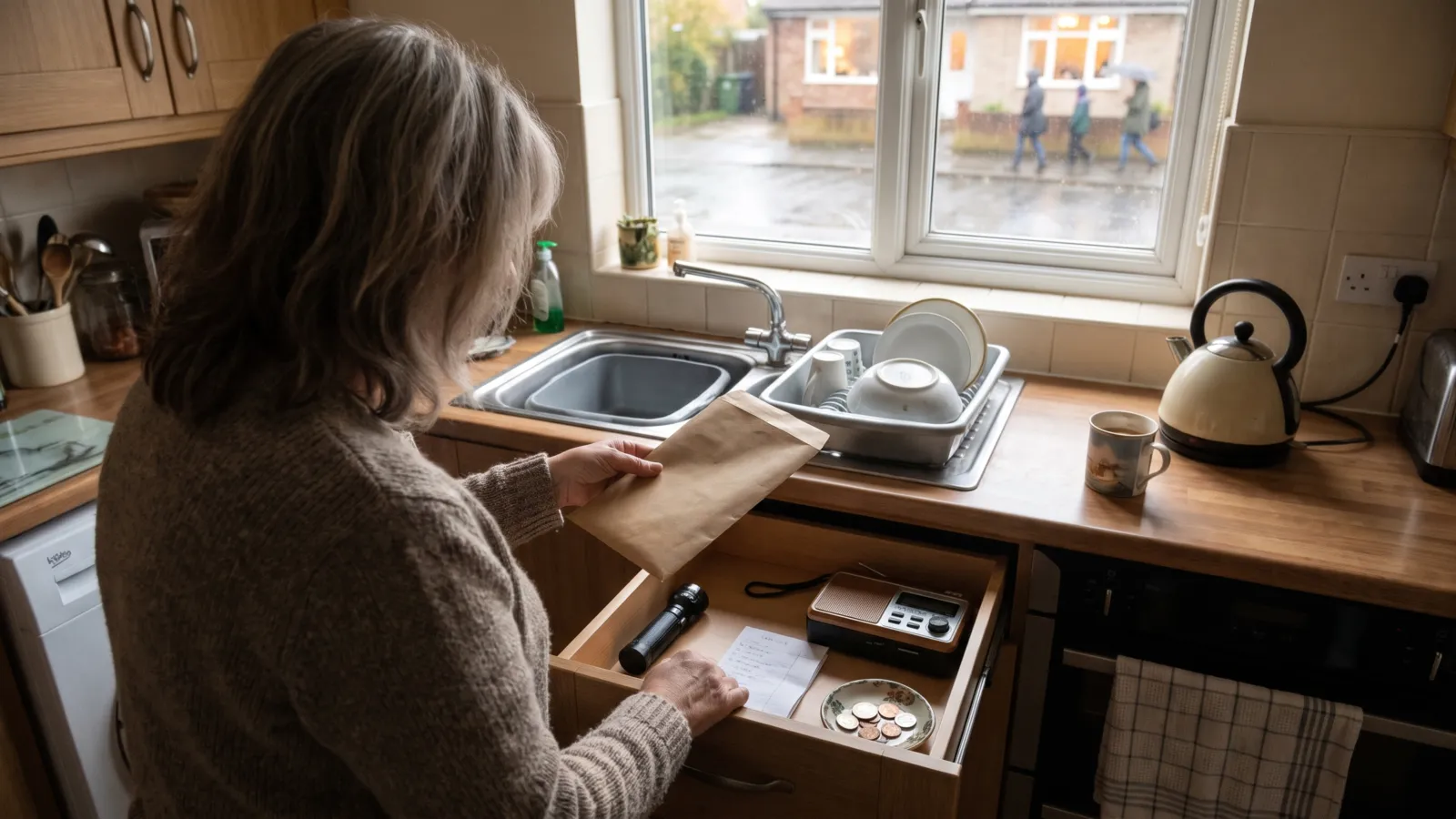
Keep it with the rest of your emergency kit, somewhere you can find in the dark, and tell the other adults in the house where it is. Our household emergency plan guide has room to note that down, and our power cut guide covers what else to have ready, such as the battery or wind-up radio and charged power bank that sit next to cash on the Be Ready checklist.
What LINK's survey found, and what it didn't
Some reports said 68% of people already kept cash at home. LINK's own release says something different. In its September survey, 68% of people said they already keep some supplies at home, when asked whether they would have enough to support their household's basic needs for 72 hours. A separate LINK survey in March 2026 found 17% have "a stash of cash at home".
LINK also says there are over 33,000 free-to-use cash machines across the country, that around £1.5 billion is withdrawn from its network every week, and that machines are "well stocked to ensure demand can be met".
Common questions
Are people really making record cash withdrawals?
Partly. LINK's figures, as reported on 4 November, show the weekly average withdrawal was above £100 for the first time outside Christmas. But figures reported on 8 November show the total withdrawn in the week to 2 November was only £16 million more than a year earlier, from fewer transactions. People are taking out more each time, not visiting cash machines more.
How much cash does the government say to keep at home?
It doesn't give a figure. The Be Ready checklist lists a mix of coins and notes, in case electronic payments or cash machines are disrupted, and says the amount depends on your family's specific needs for essentials.
Where does £50 per adult and £25 per child come from?
From LINK, the company that connects the UK's cash machine network. Its chief executive suggested it on 23 October, based on similar checklists from other European countries. It is not government advice.
How much money is in circulation in the UK?
The Bank of England's weekly report put the value of its notes in circulation at £100.13 billion on 4 November 2026, up about 5.2% on a year earlier, on our reading of its figures.
Will cash machines run out?
LINK says its network of over 33,000 free-to-use cash machines is well stocked to ensure demand can be met. Be Ready lists some cash at home in case electronic payments or cash machines are disrupted.
Sources (13)
- Bank of England, Weekly Report 4 November 2026notes in circulation £100,130m; published 5 November 2026
- Bank of England, Weekly Report 28 October 2026notes in circulation £99,928m and £99,598m
- Bank of England, Weekly Report 21 October 2026notes in circulation £99,598m and £99,492m
- Bank of England, Weekly Report 14 October 2026notes in circulation £99,492m and £99,425m
- Bank of England, Weekly Report 5 November 2025 (notes in circulation £95,213m)
- Bank of England, Weekly Report 22 October 2025 (notes in circulation £94,886m)
- Bank of England, Weekly Report 24 December 2025notes in circulation £97,714m and £96,944m
- Bank of England, Victoria Cleland speech, 15 October 2026 (cash 8% of transactions in 2025)
- Bank of England, Victoria Cleland fireside chat, 14 May 2026 (cash as a practical alternative)
- GOV.UK Be Ready, Be ready for emergencies (checklist: cash, a mix of coins and notes)
- LINK (cash machine network operator), Be Ready with Cash, 23 October 2026
- The Independent via Yahoo News UK, Banks see record cash withdrawals after government stockpiling advice4 November 2026; LINK's average withdrawal figures
- Brit Brief, Record cash withdrawals as Brits stockpile banknotes8 November 2026; the headline checked, LINK's weekly total
PreparedBritain is independent and not affiliated with HM Government.
See our checks first on Google. Add PreparedBritain as a preferred source and Google will show our stories to you more often in Top Stories.

Free alerts for your home
Home Alerts emails you when a power cut, a Met Office warning or a flood warning covers your postcode. Free for your own home. Sign up in a minute.
Start free →Latest from our live data
All stories → News · 7 NovWhat is a 'Black Sky event'? The UK warning, and the one thing every home should have
 News · 4 NovCould a cyber attack wipe out the UK's food supply and energy in two years? What the NCSC actually said
 News · 3 NovVampire devices: the '£200' is 13 gadgets added up; turning a home off standby saves about £45
Keep reading
All money & bills guides →Vampire devices: the '£200' is 13 gadgets added up; turning a home off standby saves about £45
This week's 'vampire devices' headlines add up one of each of 13 gadgets to reach over £200. The Energy Saving Trust…
Cold Weather Payment opens: £25 a freezing week; last winter 40 of 71 stations triggered none
The Cold Weather Payment season opened on 1 November: £25 for each freezing 7-day spell at your local weather…
Autumn Budget 2026: what it means for your household, from energy bills to pensions
Every change in the 28 October Budget that touches a household: a £100 energy payment, cheaper electricity until…