Fire safety in a block of flats: what your building must have, and what to do if there's a fire
What a block of flats should have to keep you safe from fire, and what each part does; the rules your building's Responsible Person has to follow in England; how to find your building's fire plan and see the fire risk assessment; and what to do if there's a fire in your flat or somewhere else in the block.
A block of flats is built so a fire in one flat can be held there long enough for the fire service to deal with it: London Fire Brigade says the walls, floors and doors of a purpose-built block will hold back flames and smoke for a minimum of 30 to 60 minutes. That only works if the fire doors close by themselves, the corridors are clear and the smoke vents work. In England, whoever runs your building (the Responsible Person) must tell you the building's fire plan when you move in and every year, and you can ask them for a copy of the fire risk assessment. Find out now whether your building's plan is to stay put or to leave, because the right thing to do in a fire depends on it.
By Tom Calder · Updated 4 November 2026 · Sourced to the Home Office, legislation.gov.uk, London Fire Brigade, the NFCC & the Building Safety Regulator
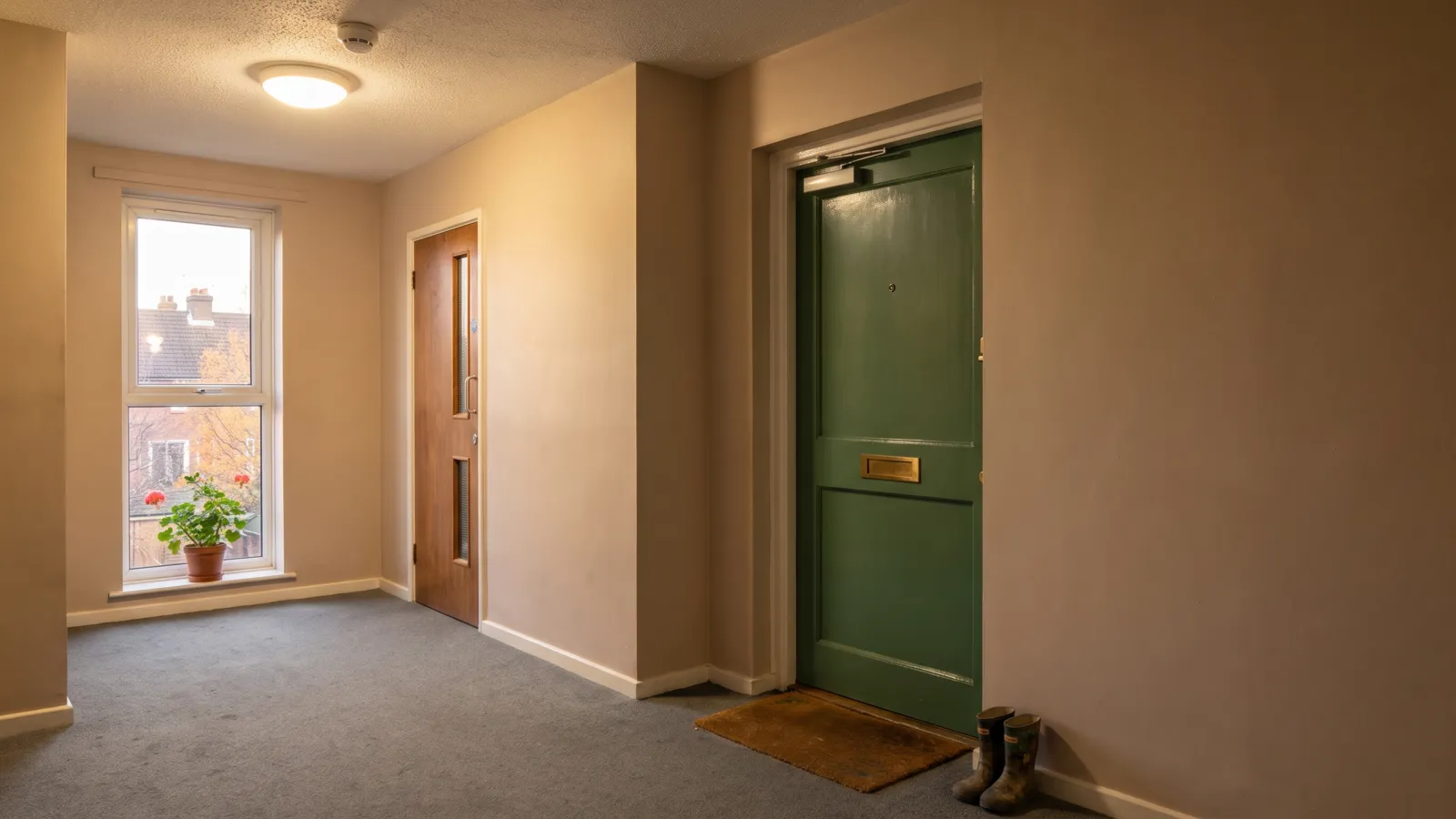
Fire doors: what the self-closer, smoke seals and intumescent strips do
Your flat's front door and the doors across the corridors and stairs are fire doors, and they are the main thing standing between a fire and the way out. London Fire Brigade says your front door and the doors on hallways and landings should be maintained as self-closing fire doors and must not be propped open, because an open door lets smoke and fire spread quickly. The Home Office's guide for small blocks says a modern fire door resists fire for at least 30 minutes; it is usually marked FD30S, the S meaning it has a smoke seal.
Three parts do the work. The self-closer is the arm or spring that pulls the door shut behind you: a fire door only protects anyone when it is closed. Intumescent strips, set into the edge of the door or the frame, swell up in the heat of a fire to seal the gap around the door. Smoke seals, usually a brush or rubber strip, help stop smoke getting through the gaps; the government's guide says the two are usually combined.
The gaps matter. The government's fire door guidance says a door should close fully into its frame when let go from any angle, the gap around the door should never be more than 4mm (the industry standard it quotes), the gap at the bottom should be as small as practicable, and the strips and seals should be undamaged, touching the door or frame, and not painted over. It also says a modern fire door should show a visible fire resistance rating. Fire door signs help too: the small-blocks guide asks for 'Fire door keep shut' signs on the self-closing fire doors in the common parts.
Smoke vents, emergency lighting, exit signs and assembly points
Smoke vents, often called AOVs (automatic opening vents), are vents or windows in the shared corridors and stairs that open to let smoke out of the escape routes. The small-blocks guide describes vents triggered by smoke detectors in the common parts, or windows and vents the fire service can open. The Northern Ireland Fire & Rescue Service notes that detectors fitted only to open the vents generally work silently, so a vent opening without an alarm sounding is normal.
Emergency lighting comes on by itself in a power cut so you can see the stairs. The small-blocks guide says it isn't needed in a two-floor block with enough daylight through windows, but must be provided where that borrowed light can't be relied on, with a test switch for monthly checks. Fire exit signs are not always required either: the same guide says a small block normally doesn't need them unless there is a second escape route that isn't in everyday use. In high-rise blocks in England, the law requires floor and flat numbers in the stairwells on signs that can be seen in low light or smoke, so firefighters can find each flat.
Many blocks have no fire assembly point, or muster point, and that is not a mistake. In a stay put building most residents are expected to stay in their flats, and the government's sample fire action notice tells anyone who has left to wait for the fire service in a safe place. Check the fire action notice in your entrance hall or lobby: the guide says it should show the route out of the building and how to report a fire.
Green emergency door releases, sprinklers and other equipment
Many entrance doors are held locked by a magnet and opened with a fob. The small-blocks guide says there should be a lever handle or similar on the inside, and that these locks should fail safe, releasing on their own if the power fails. Where a door is electrically locked on an escape route, you will often see a small green box next to it marked as an emergency door release. Breaking or pressing its glass panel breaks the lock's circuit so the door opens; the maker Videx says these units should only be used with fail-safe locks, and some are reset afterwards with a key rather than new glass. Use it only in an emergency, and report it to your managing agent or landlord if it is missing or damaged.
Sprinklers are not in most existing blocks. England's building guidance has called for them in new blocks of flats with a storey more than 11 metres up since November 2020, and the small-blocks guide says it is unusual to find one in a small block. Where a block has them, the small-blocks guide says they need at least annual maintenance by a competent contractor. Fire extinguishers are not normally provided in the corridors of a small block either; the small-blocks guide says they are not required in the common escape routes.
Taller buildings carry more. In England, the law says the equipment checked every month in a high-rise block includes firefighting and evacuation lifts, dry and wet rising mains, smoke control systems, sprinkler and other suppression systems, fire detection and alarm systems in the common parts, evacuation alert systems that let the fire service tell residents to leave, and automatic door release mechanisms linked to fire alarms. A fault that can't be fixed within 24 hours must be reported to the local fire service, and the records of those checks must be made available to residents.
NewSee this for your own homeHome Alerts: your postcode's power cuts, warnings and floods, on one screen. Free for your own home. Sign up in a minute.Start free →The law in plain words: what the Responsible Person must do
Every block of flats has a Responsible Person for fire safety in the shared parts. GOV.UK says it is usually the person or organisation that owns the building: a freeholder, landlord, housing association, council, residents' management company or Right to Manage company. A managing agent may do the day-to-day work for them, but the legal duty stays with the Responsible Person. The Fire Safety Act 2021, in force in England from 16 May 2022 (and in Wales from 1 October 2021), put beyond doubt that the building's structure, external walls and flat entrance doors are covered by fire safety law where a building has two or more homes.
The Fire Safety (England) Regulations 2022 came into force on 23 January 2023. In any block with two or more flats and shared parts, the Responsible Person must give you fire safety instructions (how to report a fire, the building's evacuation strategy and what to do once a fire has started) when you move in, display them in the communal areas, and give them to you again every year and whenever they change. They must also tell you why fire doors matter: keep them shut, don't tamper with the self-closers, and report any damage straight away.
Where a building has a storey more than 11 metres up, they must check the fire doors in the shared parts every three months and use their best endeavours to check each flat's front door once a year, so expect a request for access. In high-rise buildings, which the regulations define as at least 18 metres or at least seven storeys, they must also give the fire service electronic floor plans and details of the external walls, keep a secure information box on site holding the plans and their contact details, check lifts for firefighters and key fire equipment every month, and put up the floor and flat number signs.
High-rise buildings also come under the Building Safety Act 2022. A building of at least 18 metres or seven storeys with at least two homes must be registered with the Building Safety Regulator, and has one or more Accountable Persons and a Principal Accountable Person, who must run a complaints process for building safety risks such as missing or broken fire doors or smoke extraction. If they don't resolve your complaint, you can take it to the Building Safety Regulator.
The fire risk assessment for your block: who does it, how often, and how to see it
The Responsible Person must carry out a fire risk assessment of the shared parts, and since 1 October 2023 (under section 156 of the Building Safety Act 2022) must record it in full, including all the findings. They can bring in a fire risk assessor, but the duty stays with them, and the government recommends they make sure whoever does it is competent. GOV.UK says the assessment must be reviewed regularly and after significant events such as major building work or a fire. The law doesn't set a fixed interval, so ask the Responsible Person when yours was last done and when the next review is due.
You are entitled to the key findings. Residents must be told the risks the assessment found, the fire safety measures in place, the name and UK address of the Responsible Person, and who carried out or helped with the assessment. GOV.UK's guide for residents says you can ask your building owner, managing agent or landlord whether any fire safety risks have been found, for a copy of the fire risk assessment, and what is being done about the risks.
If you get no answer, or you are still worried, GOV.UK says to contact your local fire and rescue service or your council. Leaseholders can get free advice from the Leasehold Advisory Service, and anyone can ask Citizens Advice.
Stay put or leave: find out your building's evacuation strategy now
Most purpose-built blocks are designed for 'stay put'. London Fire Brigade explains that the walls, floors and doors will hold back flames and smoke for a minimum of 30 to 60 minutes, so if a fire starts somewhere else in the block and you are not affected by heat or smoke, you are usually safer staying in your flat with the windows and doors shut and calling 999. If fire, smoke or heat does reach you, alert everyone, leave and call 999.
Some buildings instead have a simultaneous evacuation strategy, where everyone leaves as soon as the alarm sounds; London Fire Brigade also calls it a full or temporary simultaneous evacuation. The National Fire Chiefs Council's guidance says this is used in buildings that can no longer support stay put, after a risk assessment by a competent person, and that in a building designed for stay put it should be temporary until the problem is fixed. Some of these buildings have a waking watch or a new communal fire alarm in the meantime.
Your building's strategy should be on the fire action notice in the entrance or lobby, and in the instructions the Responsible Person has to give you each year. If you can't find it, ask your landlord, housing provider or managing agent; London Fire Brigade says they need to tell you about the fire safety arrangements.
In case of fire: what to do if it's in your flat, or elsewhere in the block
If the fire is in your flat, get everyone out, close the doors behind you and call 999 once you are safe; the Northern Ireland Fire & Rescue Service says that if your own alarm sounds and you find a fire, leave immediately and call 999. Before opening a door, check it with the back of your hand, and if it is warm don't open it, London Fire Brigade advises. Use the stairs, never the lift, don't stop to investigate or pick up valuables, and don't assume someone else has called 999.
If you can't get out because the fire or smoke is between you and the door, London Fire Brigade says you may be safer to stay in your flat until the fire brigade arrives: go to a room as far as possible from the fire, with a window if possible, close the door and use soft materials to block any gaps to stop the smoke, go to the window, shout 'HELP, FIRE' and call 999. Tell the 999 operator where you are and the quickest way for firefighters to reach you, stay on the line and follow their advice.
If the fire is somewhere else in a stay put building and you are not affected, stay in your flat, close the windows and doors, call 999 and tell them where you are in the building. Be ready to follow the firefighters' instructions when they arrive, including if they tell you to leave. In a simultaneous evacuation building, leave as soon as the alarm sounds, closing the doors behind you and using the stairs.
If you would need help to get out: Residential PEEPs
Since 6 April 2026, the Fire Safety (Residential Evacuation Plans) (England) Regulations 2025 have applied to blocks of at least 18 metres or seven storeys, and to blocks over 11 metres that have a simultaneous evacuation strategy. If it is your only or main home and you could not get out without help because of a physical or cognitive impairment or condition, the Responsible Person must take reasonable steps to find you and offer you a person-centred fire risk assessment.
From that, they must put in place reasonable and proportionate measures to help you get out, subject to conditions on cost, try to agree a written evacuation statement and give you a copy, and review it within 12 months and then every year, or sooner if you reasonably ask. With your explicit agreement, they share your flat number, floor and the help you would need with the fire service. Taking part is your choice: the government's factsheet says residents cannot be compelled, and you can turn down measures you would have to pay for.
If you think you qualify and haven't been asked, contact your landlord, housing officer or managing agent and ask for a Residential PEEP. London Fire Brigade suggests the same.
How to report a faulty fire door, and keeping your own flat safe
Report a fire door that doesn't close by itself, has a broken self-closer, big gaps, damaged seals or strips, or is wedged open, to the Responsible Person straight away: the government's guidance asks residents to report any fault or damage immediately. Put it in writing (an email is fine) with the location and a photo, and keep a copy. Don't change or replace your flat's front door without the Responsible Person's knowledge and agreement; whether the door is your responsibility to repair depends on your lease or tenancy.
If nothing happens, in a high-rise building use the Principal Accountable Person's complaints process and then the Building Safety Regulator; in any building you can contact your local fire and rescue service or council. Keep corridors and stairs clear: London Fire Brigade says communal corridors and stairs must be kept free of clutter such as pushchairs and e-bikes, because it can block your escape route, add fuel to a fire and delay firefighting.
Inside your own flat, the same home safety basics apply as anywhere else, starting with working smoke alarms: as the Northern Ireland Fire & Rescue Service explains, purpose-built blocks are not normally given a communal fire alarm, and each flat has its own.
Scotland, Wales and Northern Ireland
The 2022 regulations and the 2025 evacuation plan rules above apply in England only. In Wales, the Fire Safety Order also covers the shared parts of blocks of flats, and the Welsh Government publishes its own guidance for them. Scotland has its own fire safety law: the Scottish Government's guidance for existing high-rise blocks says fire safety law doesn't generally apply inside individual flats, and that it is normally safe to stay in your flat if you are unaffected by fire or smoke. In Northern Ireland, the Fire & Rescue Service says a block's strategy will normally be either stay put or immediate evacuation, and that you can check with your building's manager which one applies.
Common questions
What does a smoke seal on a fire door do?
It helps stop smoke getting through the gap around the door. Intumescent strips, usually combined with the smoke seal, swell up in the heat of a fire to seal the gap. A door marked FD30S resists fire for at least 30 minutes and has a smoke seal.
What gap should there be around a fire door?
The government's fire door guidance quotes the industry standard: never more than 4mm around the door, with the gap at the bottom as small as practicable. The door should also close fully into its frame by itself from any angle.
What is the green box by the door marked emergency door release?
It is a break glass unit for an electrically locked door. Breaking or pressing its panel cuts the lock's circuit so the door opens, letting you get out if the normal release fails. It should only be used in an emergency.
Can I see the fire risk assessment for my block of flats?
You must be told the risks it found, the fire safety measures in place, the Responsible Person's name and UK address, and who carried out the assessment. GOV.UK says you can ask your building owner, managing agent or landlord for a copy. If they don't respond, contact your local fire and rescue service or council.
How often should a fire risk assessment for flats be done?
The law doesn't set a fixed interval. GOV.UK says it must be reviewed regularly and after significant events such as major building work or a fire, and since 1 October 2023 it must be recorded in full.
Should I stay put or leave if there's a fire in my block?
It depends on your building's strategy, which should be on the fire action notice and in the instructions you are given each year. In a stay put block, if the fire is elsewhere and you are not affected, stay in your flat and call 999. In a simultaneous evacuation block, leave when the alarm sounds. If the fire is in your own flat, get out and call 999.
Why is there no fire assembly point for my flats?
In a stay put building most residents stay in their flats, so many blocks have no assembly point. The government's sample fire action notice tells anyone who has left to wait for the fire service in a safe place.
Sources (22)
- GOV.UK (Home Office): Fire Safety (England) Regulations 2022, fact sheet overview, read 4 November 2026
- GOV.UK (Home Office): Fact sheet, information to residents (regulation 9), read 4 November 2026
- GOV.UK (Home Office): Fact sheet, fire doors (regulation 10), read 4 November 2026
- GOV.UK (Home Office): Fire Safety (England) Regulations 2022, fire door guidance, read 4 November 2026
- legislation.gov.uk: Fire Safety (England) Regulations 2022, regulation 6 (key fire-fighting equipment), read 4 November 2026
- legislation.gov.uk: Fire Safety (England) Regulations 2022, regulation 7 (lifts and essential fire-fighting equipment), read 4 November 2026
- GOV.UK (Home Office): A guide to making your small block of flats safe from fire, read 4 November 2026
- GOV.UK: Fire safety in flats in England, a guide for residents: check if your building has fire safety issues, read 4 November 2026
- GOV.UK: Fire safety responsibilities under section 156 of the Building Safety Act 2022, read 4 November 2026
- GOV.UK (Home Office): Fire Safety Act 2021 factsheet, commencement of sections 1 and 3, read 4 November 2026
- GOV.UK (Building Safety Regulator): Complain about a building safety risk in a high-rise building, read 4 November 2026
- GOV.UK: Building Safety Regulator becomes a standalone body (27 January 2026), read 4 November 2026
- legislation.gov.uk: Fire Safety Act 2021 (Commencement) (Wales) Regulations 2021, read 4 November 2026
- GOV.UK (Home Office): Residential PEEPs factsheet, Fire Safety (Residential Evacuation Plans) (England) Regulations 2025, read 4 November 2026
- legislation.gov.uk: Fire Safety (Residential Evacuation Plans) (England) Regulations 2025 (SI 2025/797), read 4 November 2026
- London Fire Brigade: Escape plan, blocks of flats, read 4 November 2026
- National Fire Chiefs Council: Simultaneous evacuation guidance, read 4 November 2026
- Northern Ireland Fire & Rescue Service: Advice note 007, fire safety advice for people living in flats (19 September 2024), read 4 November 2026
- GOV.UK: Approved Document B May 2020 amendment, circular letter (sprinklers in new blocks of flats over 11 metres), read 4 November 2026
- Videx (maker): Green break glass units, read 4 November 2026
- Welsh Government: A guide to making your small block of flats safe from fire, read 4 November 2026
- Scottish Government: Practical fire safety guidance for existing high-rise domestic buildings (updated March 2021), read 4 November 2026
PreparedBritain is independent and not affiliated with HM Government.
The Emergency Kit Checklist
The GOV.UK Prepare essentials on one printable page — tick them off as you go and keep it with the kit. Free, no catch.
Download it straight away. We'll also send the occasional briefing when something genuinely matters — severe weather, live incidents, real price drops. Nothing else.
Latest from our live data
All stories → News · 3 NovVampire devices: the '£200' is 13 gadgets added up; turning a home off standby saves about £45
 News · 2 NovCold Weather Payment opens: £25 a freezing week; last winter 40 of 71 stations triggered none
 News · 31 OctEarliest polar vortex breakdown on record forecast for November: what it means for the UK
Keep reading
All fire, gas & first aid guides →Basic first aid in the UK: the steps for the emergencies that matter most
Basic first aid for UK households, step by step from the official guidance: the primary survey, calling 999 or 111,…
Why is my smoke alarm beeping or chirping? How to stop it, and how to test it
What a smoke alarm’s chirp, beeps and full alarm each mean, how to stop the chirping safely, how to find which…
Where to put smoke alarms, and hardwired vs interlinked alarms: the UK rules
Where to fit smoke and heat alarms in a UK home, the difference between hardwired, battery and sealed 10-year…
