Best wind-up power banks UK (2026): hand-crank chargers that can top up a phone
A wind-up power bank is a small dynamo you turn by hand to put a little charge into a phone, almost always built into a crank radio with a torch. Every set on this page is sold in the UK and has a USB output that its maker, or for the ROCAM, Acta Berg, XHDATA and FosPower sets the Amazon listing, says will charge a phone, and most also take a charge from the mains or a solar panel beforehand. The useful question is what a minute of winding actually buys, and the makers that publish a figure measure it in minutes, not full charges: Duronic's Apex manual gives 4 to 15 minutes of phone talk time from 3 minutes of cranking, and Technaxx says filling the TX-414's 2,000mAh cell by crank takes up to 6 hours. Prices and stock are refreshed on a schedule. Every figure below is the maker's own unless we say it comes from an Amazon listing, and where there is none we say so.
By Tom Calder · Updated 3 November 2026 · 15 products, all price-tracked
Our picks
 Photo: Amazon
Technaxx TX-414
A DAB+ and FM wind-up radio from a maker that publishes its figures, for a household that wants DAB in a power cut and will keep it topped up by USB-C.
as of 3 Nov 2026, 10:07 GMT · Details
Product prices and availability are accurate as of the date/time indicated and are subject to change. Any price and availability information displayed on Amazon.co.uk at the time of purchase will apply to the purchase of this product. Photo: Amazon
FosPower A1
A cheap AM/FM backup with an AAA fallback and USB-C, for a grab bag or the car.
as of 3 Nov 2026, 10:07 GMT · Details
Product prices and availability are accurate as of the date/time indicated and are subject to change. Any price and availability information displayed on Amazon.co.uk at the time of purchase will apply to the purchase of this product.All 15 compared

A rugged home or shed radio: IP55, a user-replaceable battery Philips rates for up to 60 hours, a phone-charging port and four AAA cells as a fallback.
as of 3 Nov 2026, 10:07 GMT · Details
Product prices and availability are accurate as of the date/time indicated and are subject to change. Any price and availability information displayed on Amazon.co.uk at the time of purchase will apply to the purchase of this product.Our verdict
The most complete specification on this page from a brand that publishes its numbers. Philips states IP55, up to 60 hours of play from a user-replaceable lithium cell, a 3W speaker with a headphone socket and digital tuning with 40 presets, and it still runs on four AAA cells when that battery is flat. Two things hold it back. It's a new model with little owner feedback yet, and Philips' own page gives the battery as 5,200mAh in its spec table but calls it a 2,600mAh power bank elsewhere, so treat phone charging as a useful extra rather than a measured figure. At 670g it's a home radio, and there's no DAB.
Worth knowing: FM/AM only; no DAB+
Who shouldn't buy it: Don't buy it if you want DAB, or something light for a rucksack. For a grab bag the TAR1609 weighs 390g and the battery-only Roberts Sports 925 about 150g.
Read the full review →
A tough household radio that can top up a phone from its own cell and keep going from the crank or the sun, if FM and AM are enough.
as of 3 Nov 2026, 10:07 GMT · Details
Product prices and availability are accurate as of the date/time indicated and are subject to change. Any price and availability information displayed on Amazon.co.uk at the time of purchase will apply to the purchase of this product.Our verdict
Sangean's manual states the figures that matter: about 24 hours of play from a full 2,600mAh cell, about 3 hours to recharge by USB-C, and about 10 minutes of listening per minute of winding at 100 turns a minute. IP55 against dust and splashes is on the datasheet, and a 5V/1A USB-A port is a usable phone top-up. Against it: 900g, FM and AM only with no DAB+, and a built-in cell with no AA or AAA fallback, so when the cell is flat you depend on the crank or the sun.
Worth knowing: FM and AM only, with no DAB+ band
Who shouldn't buy it: Don't buy it if you want DAB+ or something light for a grab bag. The Sangean MMR-88 DAB+ is 377g with DAB+, and the Philips TAR1609 weighs 390g.
Read the full review →Photo: AmazonBest crank radio for charging a phoneA DAB+ and FM wind-up radio from a maker that publishes its figures, for a household that wants DAB in a power cut and will keep it topped up by USB-C.
as of 3 Nov 2026, 10:07 GMT · Details
Product prices and availability are accurate as of the date/time indicated and are subject to change. Any price and availability information displayed on Amazon.co.uk at the time of purchase will apply to the purchase of this product.Our verdict
One of the few DAB+ wind-up radios whose maker states real numbers. Technaxx gives up to 10 hours from the 2,000mAh cell, about 3 hours to recharge over USB-C, a 150 lux torch with an SOS mode and a USB-A port rated 5V/1A for a phone top-up. It is also honest about the backups: a full charge takes up to 6 hours of winding or 35 hours of sunlight, so the crank and the panel are last resorts. Its gap for a power cut is that it takes no AA or AAA cells and has no stated water rating, so once the cell and your power bank are flat the crank is all that's left. At 293g it suits a grab bag.
Worth knowing: No AA or AAA fallback: the 2,000mAh cell, the crank or the panel is all there is
Who shouldn't buy it: Don't buy it if you want a radio that runs on ordinary cells when its battery is flat. The Philips TAR3500 takes four AAA cells and the Acta Berg DAB+ crank radio three, and the Roberts Play 20 runs DAB+ on four AA cells with no crank at all.
Photo: AmazonBest cheap wind-up chargerA cheap AM/FM backup with an AAA fallback and USB-C, for a grab bag or the car.
as of 3 Nov 2026, 10:07 GMT · Details
Product prices and availability are accurate as of the date/time indicated and are subject to change. Any price and availability information displayed on Amazon.co.uk at the time of purchase will apply to the purchase of this product.Our verdict
Still a sensible budget pick because it gets the fundamentals right: AAA cells as a fallback, USB-C charging and a limited lifetime warranty. Be clear-eyed about the rest. The torch is a 20-lumen glow, the 2,000mAh cell gives a phone a top-up rather than a charge, the NOAA band is silent here, and the big review counts quoted for it in some UK blogs come from the US listing, not the UK one.
Worth knowing: The torch is 1W/20 lumens, which is dim, and the 2,000mAh cell is a phone top-up at best
Who shouldn't buy it: Don't buy it if you want useful light or a real power bank. Add a head torch and a separate power bank, or step up to the Philips TAR1609 for a longer-running radio with published figures.
Read the full review →
A wind-up and solar set that also gets DAB+, for a home kit where BBC national stations on digital matter.
as of 3 Nov 2026, 10:07 GMT · Details
Product prices and availability are accurate as of the date/time indicated and are subject to change. Any price and availability information displayed on Amazon.co.uk at the time of purchase will apply to the purchase of this product.Our verdict
One of the few crank and solar radios on Amazon UK with DAB+ as well as FM, plus a 5,000mAh battery, a torch, an SOS alarm and a charging port in one 19cm box. Acta Berg publishes almost nothing beyond the listing: no battery life, no output rating for the charger, no weight and no dust or water rating, and the brand has no working website. Treat it as a capable-looking budget set, not a rated one.
Worth knowing: No published battery life, charging output, weight or IP rating; the brand has no working website
Who shouldn't buy it: Don't buy it if you want published figures. The Philips TAR3500 states IP55 and up to 60 hours from its lithium cell, and the Roberts SolarDAB 99 is a DAB+ wind-up from a UK brand.

A cheap crank-and-solar AM/FM/SW radio for a kitchen drawer, if you accept that nothing about its performance is documented.
as of 3 Nov 2026, 10:07 GMT · Details
Product prices and availability are accurate as of the date/time indicated and are subject to change. Any price and availability information displayed on Amazon.co.uk at the time of purchase will apply to the purchase of this product.Our verdict
A generic crank-and-solar radio with a 5,000mAh cell, AM, FM and shortwave bands and a phone-charging role. The only maker website that could be found is an empty placeholder, so every figure here comes from the Amazon listing, and that gives no run time, no crank figure and no USB output rating. No AA or AAA fallback is listed, so when the cell is flat you depend on the handle or the sun. It may well do the job, but nothing published lets us say how well.
Worth knowing: No maker documentation: the listing gives no run time, crank output, USB rating or AA/AAA fallback
Who shouldn't buy it: Don't buy it if you want published numbers or a battery fallback. The Philips TAR3500 quotes up to 60 hours with AAA backup, and the Sangean MMR-99 quotes about 24 hours of play and about 10 minutes of listening per minute of winding.
Sold out right now (9)
The shop says these are sold out today. We check stock every hour, and each one moves back up the list when it returns.
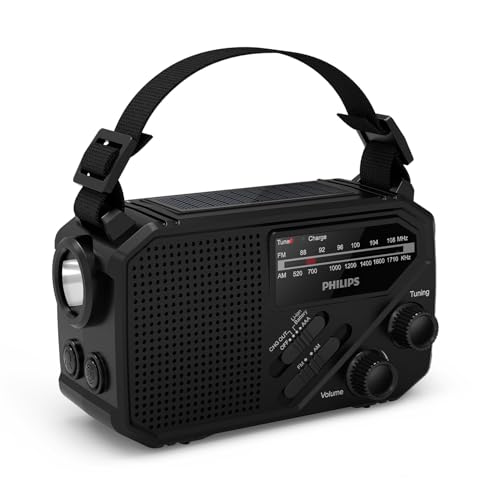
Most UK households: a mainstream-brand FM/AM set with its own rechargeable battery, three AAA cells as a fallback, and a crank and solar panel behind those.
Our verdict
The radio we'd put in a household kit first. Philips quotes up to 32 hours of listening from the built-in battery, it charges from the same USB-C lead as most modern phones, and it also runs on three ordinary AAA cells, so a flat internal battery doesn't leave you relying on the handle or the sun. There's no DAB, no headphone socket and no water-resistance rating, and Philips publishes no torch brightness or crank figure, but it does the one job GOV.UK asks of a radio, from a brand that publishes its specs, without an American weather band you can't use.
Worth knowing: FM/AM only, with analogue tuning: no DAB+, no presets and no headphone socket
Who shouldn't buy it: Don't buy it if you want DAB, or a radio that will properly charge a phone. Its USB-A port is an emergency top-up only, so keep a separate power bank.
Read the full review →
Mostly a power bank with a radio attached: a large internal cell for topping up phones through a long cut, with AM/FM and a Bluetooth speaker mode when you want sound.
Our verdict
Midland's manual gives a 10,000mAh cell, up to 100 hours of use (conditions not stated) and a USB-C port that outputs up to 3A, far more phone charging than most radios here offer. The catch is in the same manual: while it charges another device the radio drops to clock mode, so you can't charge and listen at once. For a cell this size the crank and solar panel are slow refills, with at best 10 minutes of recharge per hour of direct sun by Midland's figure. There's no DAB, no published IP rating and no AA fallback.
Worth knowing: The radio pauses while the unit charges another device, per the manual; AM/FM only, no DAB
Who shouldn't buy it: Don't buy it if you need DAB+, or want the radio to keep playing while it charges a phone. For DAB+ look at the Sangean MMR-88 DAB+ or the Nedis; the Philips TAR3500 adds an AAA fallback.
Read the full review →
Budget-minded DAB+ listeners who want a colour screen and Bluetooth, and who'll treat the battery figure as a claim.
Our verdict
A marketplace DAB+ crank radio that owners rate for its DAB reception, including in weak-signal areas, with a colour screen, Bluetooth and a 57mm speaker. We list the 12,000mAh battery as a claim because nobody has verified it, the AAA fallback is something owners report rather than the listing states, and there's no crank figure at all. Treated as a DAB+ radio you charge from the wall, it's a sensible buy; treated as a 12,000mAh power bank, it's unproven.
Worth knowing: The 12,000mAh capacity is the seller's unverified claim, and there's no published crank-to-play figure
Who shouldn't buy it: Don't buy it if you're buying it for the battery figure. Judge it on DAB+ reception and the screen, and check the AAA fallback works on day one.

A light DAB+ set for a kitchen shelf or a bag that can be topped up by crank, sun or USB-C, if you accept a short run time.
Our verdict
Sangean publishes more than most brands here: its manual gives about 10 hours of play from a full charge, about 5 to 7 minutes of listening per minute of winding at around 120 turns a minute, and about 15 hours in direct sun to refill the cell. That makes it a believable, modest set. It's DAB+ and FM at 377g with a swappable 18350 cell, but there's no AA or AAA backup, no IP rating and the phone port is a 5V/0.3A trickle. For a longer run the Roberts SolarDAB 99 quotes up to 20 hours, at more than twice the weight.
Worth knowing: About 10 hours per charge, no AA or AAA fallback, and a specialist 18350 cell to replace
Who shouldn't buy it: Don't buy it if you want a long run time, an IP-rated body or a quick phone top-up. The Philips TAR3500 quotes up to 60 hours, with AAA backup, and the Sangean MMR-99 has a rated 1A port and a dust and water rating, though it has no DAB+.
Read the full review →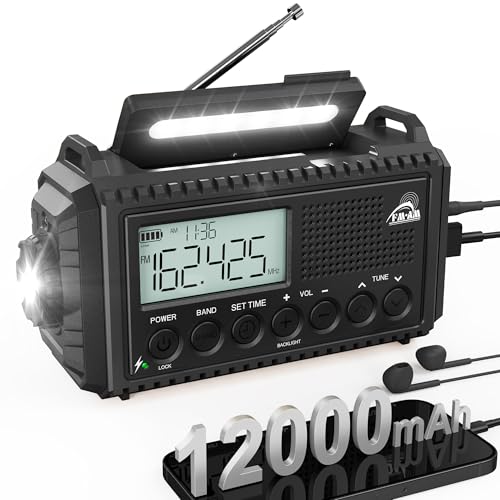
A power-cut standby for the hallway drawer: torch, loud siren, AM/FM and a battery that owners say will charge a phone, at a marketplace price.
Our verdict
A popular all-in-one that does the basics competently, with a brighter torch than most here. We've trimmed what we used to say about it: the 12,000mAh capacity is a seller's claim with no teardown behind it, the torch is 3W rather than 5W, and the siren is 116dB. It takes three AAA cells, which matters. One owner says a full day in the sun didn't move the battery level, so treat the solar panel as a slow extra, and shortwave is no help in a UK emergency.
Worth knowing: The 12,000mAh battery and '50+ hours' are unverified seller claims, and one owner says a day in the sun didn't move the battery level
Who shouldn't buy it: Don't buy it if you want DAB or a verified power bank. For DAB+ the CR1030DAB is the better ROCAM; for running times a manufacturer stands behind, look at the Philips sets.

A pocket-sized DAB+ radio with crank and solar backup and a swappable 18650 cell, from a European electronics brand that publishes a proper manual.
Our verdict
Nedis states 15 hours of play from the 2,500mAh cell and 3 to 5 minutes of radio per minute of cranking, a modest figure, and its manual shows how to swap the 18650 cell. It's DAB+ and FM at 288g, with a torch, reading light and siren. The loose ends are real: no headphone socket, a 1W mono speaker, no published rating for the USB-A output so phone charging is unproven, no IP rating (the manual says to keep it dry), and a manual whose crank line ('around 3 to 5 minutes to fully charge') doesn't match the product page's figure.
Worth knowing: No headphone socket, a 1W mono speaker and no rated phone-charging output
Who shouldn't buy it: Don't buy it if you want a water-resistant set or a rated phone-charging port. The Sangean MMR-99 has both, a dust and water rating and a 5V/1A USB-A port; the Philips TAR3500 is rated for dust and water but gives no USB output rating. Neither has DAB+.
Read the full review →
A cheap all-rounder for a power-cut box: crank, solar and USB-C charging, a torch and a phone port in one pocket-sized set.
Our verdict
XHDATA is an established radio maker, and this is its wind-up model: a 3,000mAh battery that charges over USB-C, a hand crank and solar panel as backups, a torch and reading lamp, an SOS alarm and a USB port for a phone. AM tunes in 9kHz steps for UK medium wave. It has no DAB, and the listing gives no battery life, charging output, weight or dust and water rating. The weather band in its name is a US service, so ignore it here.
Worth knowing: No DAB, and no published battery life, charging output or IP rating
Who shouldn't buy it: Don't buy it if you listen on DAB. The Acta Berg DAB+ crank radio adds digital stations, and the Philips TAR3500 publishes its run time and an IP55 rating.
Read the full review →
The cheapest way onto DAB+ with an AAA fallback, if you'll charge it from the wall and treat the crank and solar panel as extras.
Our verdict
On paper the budget DAB+ answer: DAB+, FM with RDS, 60 presets, a 5,000mAh cell and three AAA cells as backup, in a 410g IPX4 body. Owner reports pull it down. Two owners say the solar panel adds little or nothing, one says the promised automatic switch to AAA never happened and the radio just shut down, and one got under 10 seconds of radio from 15 minutes of winding, though their fresh AAA cells also ran flat within hours, which points to a faulty set. So charge it from the mains, keep AAA cells in it, and don't count on the handle.
Worth knowing: Two owners say the solar panel adds little or nothing, and one got under 10 seconds of radio from 15 minutes of winding, possibly from a faulty set
Who shouldn't buy it: Don't buy it if you expect the crank or the sun to run it. If you can't keep it charged from the mains, a battery-only set or the Philips TAR1609 is the safer buy.

A compact AM/FM set with a clock and a small torch for a drawer, glovebox or tent, from a UK company, if you accept a very small 300mAh cell.
Our verdict
A step up from the Duronic Hybrid on features: a three-LED torch and a clock with alarm, on a 300mAh cell Duronic rates for 7 to 9 hours of radio. Duronic says a minute's winding gives 18 to 27 minutes of radio and one owner says at least 20, so that roughly holds up. Its manual shows the limits: the torch is only 11 to 14 lumens, and phone charging works by winding, at 4 to 15 minutes of talk time per 3 minutes of cranking, enough for a call, not a recharge. AM/FM only, with no AA or AAA option listed, and one owner says the tuning needs tweaking quite often.
Worth knowing: A 300mAh cell with no AA or AAA option listed, and a 35 to 42 hour solar charge by Duronic's figure
Who shouldn't buy it: Don't buy it if you want DAB, a proper phone top-up or a battery fallback. The Philips TAR3500 has a USB-A port, AAA backup and a replaceable cell, and the Roberts Sports 925 runs on swappable AA cells, though neither has DAB.
Read the full review →ⓘ As an Amazon Associate, PreparedBritain earns from qualifying purchases. We may earn a commission when you buy, or a fee when you request a quote, through our links. When two products are close, commission can decide which one we pick. A clearly better product always wins. Amazon prices come from Amazon's own product data and show the date and time they were retrieved. Prices at other retailers are checked by us, less often. Prices and stock can change at any time, so always check the retailer's price before you buy.
Before you buy
Start with the crank figure, and be suspicious when there isn't one.
The makers on this page that publish a number put it in minutes of listening or light per minute of winding: Sangean's MMR-99 manual says about 10 minutes of radio per minute at around 100 turns a minute, the MMR-88 DAB+ manual 5 to 7 minutes, Nedis 3 to 5 minutes of radio or 5 to 10 of torch, and Duronic's Apex 18 to 27 minutes of radio. Only Duronic gives a phone figure, 4 to 15 minutes of talk time for 3 minutes of cranking. Midland's ER300 Pro manual quotes a crank 'charging current of about 600mAh' at about 120 turns a minute, a unit that makes no sense for a current, and Philips gives no crank figure, and the ROCAM, Acta Berg and XHDATA Amazon listings give none in minutes (the ROCAM CR1030DAB listing quotes only a '650mA' crank), so for those sets nobody can tell you what a minute of winding is worth.
Treat the built-in cell as the real power bank, and charge it from the mains before you need it.
What charges a phone in practice is the lithium cell inside the radio, filled by USB at home; the crank and the solar panel are the slow ways of refilling it once that charge is gone. Technaxx says the TX-414's 2,000mAh cell takes up to 3 hours by mains, up to 6 hours by crank and up to 35 hours by solar panel; Sangean puts the MMR-88's panel at about 15 hours of direct sun. The bigger the cell, the more useful the phone port: Midland's ER300 Pro carries 10,000mAh and a USB-C output of up to 3A, Philips lists the TAR3500 at 5,200mAh in its spec table (and 2,600mAh in its feature text, a conflict on Philips' own page), and the 12,000mAh claimed for the ROCAM CR1030DAB and ROCAM AM/FM/SW sets, the 5,000mAh for the ROCAM 1009Pro and both Acta Berg sets, the XHDATA's 3,000mAh and the FosPower's 2,000mAh are Amazon-listing figures with no maker page behind them.
Check the phone port's rating and whether the radio has to be off.
Look for a port rated 5V/1A or better; Sangean itself warns that a 0.3A port may not charge devices that need more current. The MMR-99 and TX-414 give 5V/1A, the ER300 Pro up to 5V/3A over USB-C, and the MMR-88 only 5V/0.3A. Sangean's manuals say the radio must be off to charge a phone, and Midland says AM/FM pauses while the ER300 Pro charges another device, so you cannot listen and top up at the same time on those sets. Several budget sets state no output rating at all. Also check the cable: most of these ports are USB-A, so you need an A-to-C lead for a modern phone, and the ER300 Pro's single USB-C port serves as both input and output.
Decide what happens when the cell is flat.
A crank is a backstop, not a battery, so the sets that also take ordinary cells are the ones that keep working through a long cut: the Philips TAR3500 and TAR1609 take AAA cells, and the FosPower A1, ROCAM 1009Pro and ROCAM AM/FM/SW listings say theirs do too. The Nedis and the Sangean MMR-88 use a swappable lithium cell (18650 and 18350) rather than shop batteries. The Technaxx, Sangean, Midland and Duronic sets have no AA or AAA option, and the Acta Berg and XHDATA listings mention none, so those rely on the handle or the sun once the cell is flat. Philips rates the TAR3500 at 60 hours of play from a full charge; Sangean puts the MMR-99 at about 24 hours and the MMR-88 at about 10; Technaxx says up to 10 hours. If the radio matters more than the phone port, our wind-up radios and battery radios pages compare the same sets on that basis.
Weigh it for the job.
A set for a kitchen drawer can be heavy: Midland's ER300 Pro is 609g (no IP rating published) and Sangean's MMR-99 900g (IP55), while the Technaxx TX-414 is 293g and the Sangean MMR-88 about 380g for a grab bag. Look for an IP rating if it may live in a shed or a car (Philips TAR3500 IP55, Sangean MMR-99 IP55; the TX-414, MMR-88 and ER300 Pro publish none). Keep the cell topped up every few months, and note that Duronic's manual asks owners to crank the Apex for at least a minute once a month to prolong the battery. Finally, none of these sets has a DAB tuner except the TX-414, MMR-88, Nedis, ROCAM 1009Pro, ROCAM CR1030DAB and Acta Berg DAB+ models: the rest are FM and AM (some add shortwave), which is fine for BBC local radio and Radio 4 on FM.
For longer power cuts
A radio, torches and a power bank cover a short cut. If you want the fridge, the router or medical kit to keep going for longer, these are the three ways to do it.
A silent battery you can use indoors. Enough for lights, the router and phones through an evening, or a fridge-freezer on a bigger one.
For cuts that run into days. Petrol or dual fuel, outdoors only, never in a garage or shed: the exhaust carries carbon monoxide.
2 to 4 kWh that stays in the house, often with solar panels to top it up, for a long cut or a home that relies on power for medical kit.
Not sure how big? What size power station do you need → · Power station or generator →
We haven't cranked, timed or measured the output of any of these sets ourselves, so nothing here is a hands-on result. Every crank figure, cell capacity and port rating on this page comes from the maker's own page, user guide or data sheet (Technaxx, Duronic, Midland, Sangean, Nedis and Philips), read between 4 October and 2 November 2026, except where the only source is an Amazon listing (ROCAM, Acta Berg, XHDATA, FosPower), which we label as such; each product's entry names its source. The arithmetic that turns Technaxx's 'up to 6 hours by hand crank' into hours per phone charge is ours and is labelled as such. Where a maker publishes no crank figure we say so rather than borrow a seller's number. No claim on this page rests on owners' reviews. Amazon prices and stock come from Amazon's API on a schedule, not from reading the page, and store prices we can't re-check automatically aren't quoted. When two products are close, commission can decide which one we pick. A clearly better product always wins. If we do crank and measure these sets, the entries will be labelled Used and reviewed by us and show the method. Read our full methodology →
Related kit comparisons
Guides that go with this
The free number to save today, what to have ready, food safety, staying warm safely, and the compensation you …
Long wave closed in June 2026, and half the wind-up radios on sale here advertise an American weather band tha…
A calm, sourced look at the 'national blackout' scenario: why it's a low-likelihood risk the grid is engineere…
The UK's old copper phone network is being switched off by January 2027. What the digital switchover means, wh…
The Government's recommended kit — with the best products for each item at every budget.
Common questions
How long do you have to crank a wind-up power bank to charge a phone?
Far longer than most people expect. The only maker on this page with a phone figure is Duronic, whose Apex manual gives 4 to 15 minutes of talk time for 3 minutes of cranking. Technaxx says filling the TX-414's 2,000mAh cell by crank takes up to 6 hours, and a phone battery is roughly 4,000 to 5,000mAh, so a full charge by hand alone is a working day or more at the handle. Use the crank for a short call or a text and charge the cell from the mains for anything bigger.
Is a wind-up power bank better than a normal power bank?
No. A mains-charged power bank holds far more and delivers it without effort: a 10,000mAh bank gives a phone of roughly 4,000 to 5,000mAh about one and a half to two full charges, and a 20,000mAh bank roughly twice that. A crank's advantage is that it can never be completely empty, which is why it belongs on a radio you would keep anyway. Buy the power bank first, and treat the crank as the last resort.
Do all crank radios charge a phone?
No, and the listing title is not a reliable guide. Duronic's own FAQ says its Hybrid radio cannot charge other devices although its Amazon title mentions a phone charger, and Roberts doesn't say whether the SolarDAB 99's USB port will charge a phone from its battery. Every set on this page has a USB output that its maker, or for the ROCAM, Acta Berg, XHDATA and FosPower sets the Amazon listing, says will charge a phone; check the port's rating as well, because the Sangean MMR-88's 5V/0.3A output may not charge a modern phone at all.
Why does the radio switch off when I charge my phone from it?
That is by design on several sets. Sangean's manuals say the radio must be off to use the USB output on the MMR-99 and MMR-88, and Midland's ER300 Pro manual says AM/FM is momentarily disabled while it charges another device. The makers don't give a reason, so if you want both, charge the phone first and then listen.
Does the solar panel on a crank radio help?
A little, slowly. Technaxx says the TX-414's panel takes up to 35 hours of full sun to fill its 2,000mAh cell, Sangean says about 15 hours of direct sun for the MMR-88's 850mAh cell and calls the panel a supplement, and Midland says an hour of direct sun gives the ER300 Pro about 10 minutes of recharge. Under a British sky in winter, expect much less. Our solar phone chargers page covers panels large enough to make a real difference.
What should I look for in a wind-up power bank for a power cut?
A published crank figure, a cell of at least 2,000mAh that you charge from the mains in advance, a phone port rated 5V/1A or better, a fallback of ordinary AA or AAA cells so the radio keeps working when the lithium cell is flat, and a weather rating if it will live in a car or shed. A torch with an SOS mode comes with nearly all of them. Keep it charged and, as Duronic advises for the Apex, crank it for at least a minute once a month.