Christmas tree and fairy light fire safety: what the fire services ask you to do
The fire services’ answer first: switch fairy lights off and unplug them before bed and when you go out. Then the detail: checking old sets, LED against filament bulbs, indoor and outdoor ratings, buying online, sockets and extension leads, real and artificial trees, candles, smoke alarms, cooking and button batteries.
Switch Christmas lights off and unplug them before you go to bed and whenever you go out. Electrical Safety First and the Scottish Fire and Rescue Service say to switch them off and unplug them; London Fire Brigade and the National Fire Chiefs Council say not to leave them on at night or when you are out. London Fire Brigade suggests a light timer as a back-up if you might forget. Check old sets for damaged cable, loose wires and blown bulbs, and buy new ones from a reputable retailer with a UK plug and a fuse. Never plug one extension lead into another. Keep a real tree watered and away from heat and flames, keep candles well away from the tree and decorations, and test your smoke alarms before the decorations go up.
By Tom Calder · Updated 12 November 2026 · Sourced to London Fire Brigade, the Scottish Fire and Rescue Service, the National Fire Chiefs Council, Electrical Safety First, GOV.UK Fire Kills, RoSPA and the Office for Product Safety and Standards
Can you leave Christmas lights on overnight? The fire services’ answer
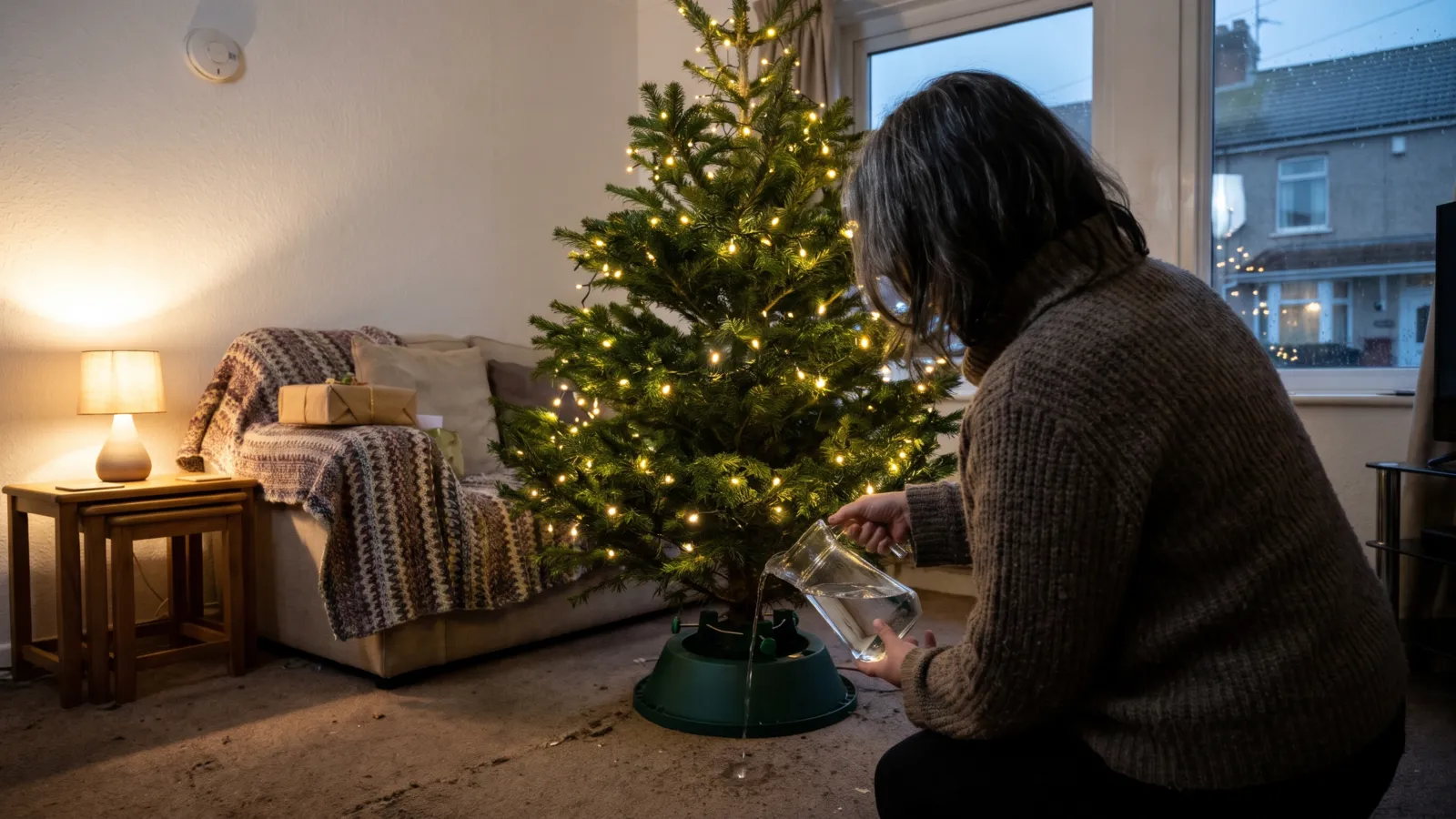
No. Electrical Safety First’s advice is to “Switch the lights off and unplug them before you go to bed or if you go out.” The Scottish Fire and Rescue Service says the same: “Unplug fairy lights and other electrical decorations when you leave the house or go to bed.” London Fire Brigade puts it as “Don’t leave fairy lights on when you go to sleep, or pop out”, and the National Fire Chiefs Council says festive lights “should always be switched off at night or whilst properties are empty”.
The Scottish Fire and Rescue Service says it attends house fires caused by fairy lights every year, and that lights are now wrapped around stair railings and draped across walls as well as on trees. The same advice applies wherever they hang.
If you think you might forget, London Fire Brigade suggests putting the lights on a light timer as a back-up. The rest of this guide is the detail: the lights themselves, the sockets they plug into, the tree, candles, smoke alarms and the kitchen.
Checking old fairy lights before they go up
Get the lights out of the box and look before you plug them in. Electrical Safety First says to check “they are not damaged or broken and make sure there are no loose wires”. London Fire Brigade says loose wires, blown bulbs or damaged cords are “a sign that it’s time to replace them”. Don’t use a set with damage to the wires or the plug.
Replace blown bulbs before you use the lights, so the set does not overheat, and only with the same type and rating as the ones supplied. If the bulbs can’t be replaced, Electrical Safety First says to buy a new set. Never take bulbs out or put them in while the lights are plugged in, and don’t connect different sets of lights together.
Mains-powered Christmas lights must have a UK 3-pin plug and a fuse, and the Scottish Fire and Rescue Service asks you to make sure the fuse is the correct rating. London Fire Brigade says new lights should carry a CE or UKCA safety mark. RoSPA says that if you have old lights, you should “seriously consider buying new ones which will meet much higher safety standards”, and not to buy second-hand lights unless they have been professionally checked first.
Unplug and stop using them if you notice burn marks on the plug or socket, a buzzing or crackling sound, or a plug that feels too hot to touch. Electrical Safety First lists all three as warning signs. When Christmas is over, store the lights in their packaging, somewhere that is not damp and not very hot or very cold.
LED or old filament bulbs?
London Fire Brigade recommends LED lights for your tree rather than the older incandescent (filament) bulbs: “LED bulbs use less energy and stay cooler.” Electrical Safety First adds that most LED Christmas lights work at extra-low voltage, which “significantly reduces the risk of electric shock, uses much less power, and generates less heat”. It says LED sets can use 80 to 90% less electricity than filament ones and typically last up to 60 times longer.
Electrical Safety First calls extra-low voltage lights (typically 12 to 24 volts) the safest option. They are often described as “low voltage” on the box, and the rated voltage should be marked on the product itself, and is normally also on the packaging or instructions.
Bulbs of any kind get warm. The Scottish Fire and Rescue Service says “Bulbs can get very hot” and not to let them touch paper or fabric. Keep the lights well away from flammable decorations, and don’t hang decorations on the lights themselves or on heaters.
NewSee this for your own homeHome Alerts: your postcode's power cuts, warnings and floods, on one screen. Free for your own home. Sign up in a minute.Start free →Indoor and outdoor lights: what the IP rating means
Indoor and outdoor lights are not interchangeable. London Fire Brigade says indoor lights won’t survive being used outdoors, and outdoor lights may pose a risk if used indoors: “Only use them as intended.” Check the instructions to see which yours are.
Lights made for outdoors should carry a water drop symbol or an IP code. IP stands for Ingress Protection, and the last digit tells you how well the lights keep water out: the higher the number, the better. Electrical Safety First says any lights used outdoors should have a last digit of three or higher.
Even with outdoor lights, the plug and any transformer stay indoors. Electrical Safety First says lights plugged in outdoors must be connected through a socket with 30mA RCD protection. An RCD (residual current device) is a switch that cuts the power if there is a fault. If your fuse box doesn’t have one, use an RCD plug at the socket.
Buying new lights safely, including online
Electrical Safety First’s advice is to buy from a reputable retailer “rather than a third-party seller online, as it may not have passed all the necessary safety checks”. The National Fire Chiefs Council makes the same point: products bought from third-party sellers on online marketplaces or auction sites “may not necessarily have the same level of regulation as trusted high street retailers”.
Before you pay, check the listing shows a UK 3-pin plug and, on the product, a CE or UKCA mark. Electrical Safety First advises buying a known and trusted brand. Once the lights arrive, register them with the manufacturer, so you will be told if they are ever recalled.
London Fire Brigade suggests a light timer as a back-up in case you forget. It is not a substitute for unplugging: Electrical Safety First and the Scottish Fire and Rescue Service ask you to unplug the lights at night and when you go out.
How many Christmas lights on one socket? Sockets and extension leads
There is no single number of light sets that is safe on one socket. It depends on what else is plugged in. The rule is to add up what you plug in and stay under the rating of the lead or adaptor. Electrical Safety First says most extension leads are rated at 13A, but some older ones are rated at 10A, and many cable reels at 10A or less. The rating is marked on the back or underside of an extension lead, and on the front of a cable reel. A cable reel must be fully unwound to give its full rating: Electrical Safety First says the rating can be as low as 3 or 4A while it is wound. Running a reel while it is still wound can make it overheat and catch fire (Electrical Safety First, London Fire Brigade), and Electrical Safety First says not to use a reel that has no thermal cut-out.
Plugging in appliances that together go over the lead’s rating can make the lead, or the plug in the wall socket, overheat and start a fire. Electrical Safety First’s socket overload calculator lets you add up the things you plan to plug in and tells you whether you are over the limit. Use it, rather than guessing from the number of plugs that fit.
Use one extension lead per wall socket. Never plug an extension lead into another one, which is known as daisy-chaining. Electrical Safety First says it “presents a serious risk that the wall socket could be overloaded”. Move the lights closer to the socket instead. London Fire Brigade advises a fused, inline extension lead rather than a plug-in cube adaptor, and says power-hungry appliances such as kettles, toasters and microwaves shouldn’t share an extension. The Scottish Fire and Rescue Service suggests a multi-socket adaptor with a fuse and surge protection when you plug several things into one socket.
Electrical Safety First says it is best not to rely on extension leads or adaptors if you can avoid it. If you need them all year round, the lasting fix is more wall sockets, fitted by a registered electrician.
Real Christmas trees: water, and where you put it
London Fire Brigade says a real tree can be more of a fire hazard than an artificial one, and “Dried out Christmas trees burn fast and fiercely.” The Scottish Fire and Rescue Service warns that a burning tree can rapidly fill a room with fire and deadly gases. Water is the main defence.
Keep the stand topped up. London Fire Brigade says a tree can drink up to two pints of water a day. Electrical Safety First says up to one litre. London Fire Brigade says to check the water level regularly; with a tree drinking that much, a daily look is sensible. The Scottish Fire and Rescue Service says keeping the stand filled stops the tree drying out quickly.
Choose a fresh tree. The Scottish Fire and Rescue Service says the needles should be green and hard to pull off, and the trunk should be sticky. If you bounce the trunk on the ground and lots of needles fall, the tree has probably dried out.
Put the tree away from heat sources such as fireplaces and heat vents, and away from open flames, candles and cigarettes. Stand it in a sturdy stand so children or pets can’t knock it over, somewhere that doesn’t block your way out. London Fire Brigade says a real tree stays relatively safe for only about two weeks. The Scottish Fire and Rescue Service advises not putting it up too early or leaving it up for longer than two weeks, and taking it down promptly once it is dry.
When it comes down, take it to a recycling centre or a council or community collection. Never put branches or needles in a fireplace, a wood-burning stove or on a bonfire. London Fire Brigade says the sap and resin can burn fiercely and unpredictably, some trees give off toxic smoke, and sap can build up creosote in a chimney and cause a chimney fire.
Artificial trees: check the fire-resistance label
London Fire Brigade says modern artificial trees are usually fire retardant or fire resistant, “but do look at the packaging to check”. If you have an older artificial tree, it says it might be time to think about replacing it. Electrical Safety First notes that a real tree can catch fire a lot quicker than a fire-retardant artificial one.
An artificial tree still needs the same care with lights, candles and heat: the label means it resists catching fire, not that it can’t burn.
Candles and tealights: the fire services’ rules
Never leave a lit candle unattended. Put candles out when you leave the room and make sure they are completely out before bed. This is the advice of London Fire Brigade and GOV.UK’s Fire Kills campaign.
Keep candles away from the tree, wrapped presents, decorations and anything else that can catch fire (Scottish Fire and Rescue Service). Keep cards and decorations away from fires and other heat sources, such as light fittings (RoSPA). Don’t put decorations directly above or around the fireplace (Scottish Fire and Rescue Service).
Stand candles in a heat-resistant holder on a stable surface, out of reach of children and pets, and keep matches and lighters out of reach too. London Fire Brigade warns that tealights get very hot and, without a proper holder, can melt through plastic surfaces such as a TV or a bath.
Flameless LED candles are the safer alternative that London Fire Brigade, the Scottish Fire and Rescue Service and Fire Kills all suggest: “If you doze off while a flameless candle is on, it’s not a problem.” RoSPA warns that most flameless candles don’t have lockable battery compartments, so keep any without a secure compartment away from children (see the button batteries section below).
If your clothes catch fire, London Fire Brigade’s rule is stop, drop and roll. Don’t run, because running makes the flames worse. Get down on the ground and roll, which makes it harder for the flames to spread.
Smoke alarms, and a clear way out
Test your smoke alarms before the decorations go up. Fire Kills says you are around 8 times more likely to die in a fire if you don’t have a working smoke alarm. Fit at least one on every level of your home, and test it by pressing the button until it sounds. Electrical Safety First says to test alarms at least once a month. RoSPA’s Christmas tip is to buy batteries for presents that need them, so nobody is tempted to take them out of a smoke alarm.
If an alarm chirps every so often, our guide to why a smoke alarm beeps explains what it means. If you need new alarms, our smoke alarms page compares sealed 10-year models.
Plan your way out and make sure everyone in the house knows it. Keep door and window keys where everyone can find them (Fire Kills). Don’t let the tree, presents or piles of boxes block the stairs, a hallway or the door. London Fire Brigade asks you to put the tree “somewhere that doesn’t block an escape route”.
Before the decorations come out, London Fire Brigade suggests its free online Home Fire Safety Checker. It takes a few minutes. If a fire does start, our guide on what to do in a house fire covers getting out and calling 999.
Cooking: where most home fires start
Decorations get the attention, but the kitchen is where most home fires start. London Fire Brigade says around 60% of home fires start in the kitchen. Fire Kills says around half are caused by cooking accidents. The Scottish Fire and Rescue Service says cooking is the biggest cause of house fires in Scotland, and that with an elaborate Christmas meal “even a short distraction can easily cause a fire to start”.
Never leave the hob or grill unattended. If you have to step away, turn the heat off. Keep tea towels and cloths away from the cooker and hob. Avoid cooking if you are tired or have been drinking. After a Christmas party, the Scottish Fire and Rescue Service suggests buying food on the way home or making something cold instead. London Fire Brigade recommends a heat alarm in the kitchen, where a smoke alarm would go off with cooking steam. Fire Kills says a fire blanket is best kept in the kitchen.
Our guides to chip pan and kitchen fires, a power cut on Christmas Day and what to do in a house fire cover the rest.
What, if anything, to buy
The most effective step costs nothing: unplug the lights at bedtime and when you go out. If your lights have no damage, carry a UK plug and work properly, you can keep using them indoors. If they are many years old, Electrical Safety First warns they may not meet current safety standards, and RoSPA suggests seriously considering a new set. If you are replacing a set, London Fire Brigade recommends LED.
GOV.UK’s Fire Kills campaign and the National Fire Chiefs Council recommend a working smoke alarm on every level of your home, and Fire Kills says a fire blanket is best kept in the kitchen, whatever the time of year. Our smoke alarms and fire blankets, extinguishers and alarms pages compare them with live UK prices. If you need more sockets near the tree, our surge-protected extension leads page covers fused leads with surge protection, the kind the Scottish Fire and Rescue Service suggests. Use one per wall socket and never chain them.
Common questions
Can you leave Christmas tree lights on overnight?
No. Electrical Safety First and the Scottish Fire and Rescue Service say to switch fairy lights off and unplug them before you go to bed and when you go out. London Fire Brigade says not to leave them on when you go to sleep or pop out, and suggests a light timer if you think you might forget.
How many Christmas lights can you plug into one socket?
There is no set number. Add up everything you plug into the extension lead and stay under its rating, which is usually 13A and sometimes 10A on older leads. Electrical Safety First’s socket overload calculator does the sums for you. Use one extension lead per wall socket and never plug one extension lead into another.
Are LED Christmas lights safer than old filament ones?
London Fire Brigade recommends LED lights over the older incandescent bulbs because they use less energy and stay cooler. Electrical Safety First says most LED sets work at extra-low voltage, which significantly reduces the risk of electric shock and generates less heat.
Can you use indoor Christmas lights outside?
No. London Fire Brigade says indoor lights won’t survive outdoors, and outdoor lights may pose a risk if used indoors. Electrical Safety First says outdoor lights should have a water drop symbol or an IP rating whose last digit is three or higher, with the plug kept indoors and connected through a 30mA RCD.
How long is a real Christmas tree safe?
London Fire Brigade says a real tree stays relatively safe for about two weeks, after which it is likely to become more flammable. The Scottish Fire and Rescue Service advises not putting it up too early or leaving it up longer than two weeks, and keeping the stand filled with water.
Are artificial Christmas trees fireproof?
Not fireproof. London Fire Brigade says modern artificial trees are usually fire retardant or resistant, but to check the packaging, and to think about replacing an older one. They still need the same care with lights, candles and heat.
Sources (15)
- Electrical Safety First — Christmas lights (read 12 November 2026)
- Electrical Safety First — Christmas tips (read 12 November 2026)
- Electrical Safety First — Overloading sockets and the socket overload calculator (read 12 November 2026)
- Electrical Safety First — Extension leads, cable reels and block adaptors (read 12 November 2026)
- London Fire Brigade — Christmas trees: avoid a festive fire hazard (read 12 November 2026)
- London Fire Brigade — Candles (read 12 November 2026)
- London Fire Brigade — Cables, fuses and leads (read 12 November 2026)
- London Fire Brigade — Cooking (read 12 November 2026)
- Scottish Fire and Rescue Service — Festive safety (read 12 November 2026)
- National Fire Chiefs Council — Councils and Fire Chiefs issue reminder on home fire safety ahead of festive season, 21 December 2024 (read 12 November 2026)
- GOV.UK Fire Kills — Fire safety in the home (read 12 November 2026)
- RoSPA — Christmas safety (read 12 November 2026)
- RoSPA — Christmas lights safety tips, PDF (read 12 November 2026)
- RoSPA — Button batteries (read 12 November 2026)
- Office for Product Safety and Standards (on GOV.UK) — New button battery safety campaign (read 12 November 2026)
PreparedBritain is independent and not affiliated with HM Government.
See our checks first on Google. Add PreparedBritain as a preferred source and Google will show our stories to you more often in Top Stories.

The Emergency Kit Checklist
The GOV.UK Prepare essentials on one printable page — tick them off as you go and keep it with the kit. Free, no catch.
Download it straight away. We'll also send the occasional briefing when something genuinely matters — severe weather, live incidents, real price drops. Nothing else.
Latest from our live data
All stories →
Keep reading
All fire, gas & first aid guides →Fire safety in a block of flats: what your building must have, and what to do if there's a fire
What a block of flats should have to keep you safe from fire, and what each part does; the rules your building's…
Basic first aid in the UK: the steps for the emergencies that matter most
Basic first aid for UK households, step by step from the official guidance: the primary survey, calling 999 or 111,…
Why is my smoke alarm beeping or chirping? How to stop it, and how to test it
What a smoke alarm’s chirp, beeps and full alarm each mean, how to stop the chirping safely, how to find which…