Best power banks to keep your phone alive (2026)
In a power cut, your phone is your lifeline — for news, for 999, and (increasingly) because your landline now needs mains power too. A power bank is the cheapest, simplest way to keep it alive for days, and for most households it's all the backup power you actually need. Here's how to pick one that holds its charge and delivers it fast.
In the US? Our sister site has the US version, with US gear and amazon.com links: PreparedStates.
By Tom Calder · Updated 5 November 2026 · 14 products, all price-tracked
Our picks
INIU B5 20000mAh Power Bank
Keeping phones and tablets topped up during a power cut or a long day away from the mains.
 Photo: Amazon
Anker 25,000mAh 165W
Keeping phones and a USB-C laptop going through a long power cut, with no cable to forget.
as of 5 Nov 2026, 01:07 GMT · Details
Product prices and availability are accurate as of the date/time indicated and are subject to change. Any price and availability information displayed on Amazon.co.uk at the time of purchase will apply to the purchase of this product. Photo: Amazon
UGREEN Nexode 140W 25K
Keeping a laptop as well as phones going through a long outage or a few days away from a socket.
as of 5 Nov 2026, 01:07 GMT · Details
Product prices and availability are accurate as of the date/time indicated and are subject to change. Any price and availability information displayed on Amazon.co.uk at the time of purchase will apply to the purchase of this product.All 14 compared
Keeping phones and tablets topped up during a power cut or a long day away from the mains.
Our verdict
A genuinely good-value 20,000mAh pack that delivers close to its rated capacity, with a clear battery display, USB-C in and out plus two USB-A outputs, and an unusually long three-year warranty. For most households wanting a reliable backup for phones and tablets, it is hard to beat at the price.
Worth knowing: 22.5W output is modest — fine for phones and tablets but slow to recharge the bank itself and not enough for most laptops
Who shouldn't buy it: You need to fast-charge or run a laptop, or want the quickest possible recharge — step up to INIU's 65W model (the B62) instead. If you only ever top up a single phone, a lighter 10,000mAh bank will cost less and weigh half as much.
Read the full review →Keeping a household's phones and a tablet topped up through a power cut, in a bank small enough to carry every day.
Our verdict
INIU's newer 20,000mAh bank keeps what made the B5 a good buy (near-full real capacity and a three-year warranty) and adds a built-in USB-C cable, so the lead can't go missing from the drawer. In techtest.org's test it delivered 93% to 98% of its rated capacity, which is excellent, at 114 × 72 × 29mm and 330g. The 45W figure is a peak, not a steady rate: the same test found it throttles as it warms, so treat it as a phone and tablet bank rather than a laptop one.
Worth knowing: Can't hold 45W for long: techtest.org found it throttles as it heats up, so it isn't a laptop bank
Who shouldn't buy it: You need to run a laptop from it: a bank rated for sustained laptop output, such as the higher-wattage Anker, UGREEN or EcoFlow models here, suits that better. If you only top up one phone, a 10,000mAh bank is lighter and cheaper.
Photo: AmazonRunner-upKeeping phones and a USB-C laptop going through a long power cut, with no cable to forget.
as of 5 Nov 2026, 01:07 GMT · Details
Product prices and availability are accurate as of the date/time indicated and are subject to change. Any price and availability information displayed on Amazon.co.uk at the time of purchase will apply to the purchase of this product.Our verdict
A big-capacity bank with 165W in total and up to 100W from each USB-C, enough to charge most USB-C laptops as well as phones. The two built-in cables mean nothing to lose from a grab bag. Like any power bank it charges USB devices only; mains appliances need a portable power station.
Worth knowing: Heavier and dearer than a phone-only 10,000mAh bank
Who shouldn't buy it: You only need to keep a phone topped up. A 10,000mAh bank costs less and weighs far less, and for mains appliances you need a power station instead.
Read the full review →Photo: AmazonAlso goodKeeping a laptop as well as phones going through a long outage or a few days away from a socket.
as of 5 Nov 2026, 01:07 GMT · Details
Product prices and availability are accurate as of the date/time indicated and are subject to change. Any price and availability information displayed on Amazon.co.uk at the time of purchase will apply to the purchase of this product.Our verdict
A large 25,000mAh (90Wh) bank whose first USB-C port is rated by UGREEN at up to 140W, enough for most USB-C laptops, with a second 65W USB-C port and a USB-A socket for phones. It adds a laptop-capable choice at a lower step than the Anker 165W and 300W models on this page, and UGREEN UK states a two-year warranty. It is a big, heavy unit, so it suits a bag or a kit box rather than a pocket.
Worth knowing: Stated weight of 513g and a 160 x 80 x 26mm body make it a bag item, not a pocket one
Who shouldn't buy it: You mainly charge phones and want something pocket-sized (a 10,000mAh bank fits better), or you need built-in cables.
Read the full review →
A big-capacity bank that recharges quickly, for laptops and phones on longer trips or outages.
Our verdict
EcoFlow states 25,000mAh (90Wh), up to 140W on a single USB-C port and 170W in total across two USB-C ports and a USB-A socket. It also accepts 140W input, which the maker says refills it in about an hour with a suitable charger. It overlaps the UGREEN 25K on this page, but EcoFlow states faster recharging (140W input against UGREEN's 65W) and 140W from either USB-C port; like the UGREEN, it has no built-in cable.
Worth knowing: Stated 565g and 157 x 53.8 x 48.8mm body is bulky for pockets
Who shouldn't buy it: You want an attached cable (the RAPID Pro or UGREEN built-in models fit better) or only need a phone top-up.
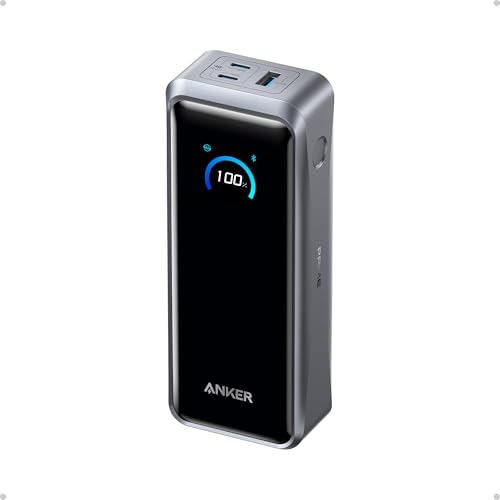
Keeping a laptop, phone and tablet running together through a long outage or a working trip.
as of 5 Nov 2026, 01:07 GMT · Details
Product prices and availability are accurate as of the date/time indicated and are subject to change. Any price and availability information displayed on Amazon.co.uk at the time of purchase will apply to the purchase of this product.Our verdict
Anker's high-end bank offers 300W total across two USB-C ports and one USB-A, with a 26,250mAh (99.75Wh) capacity that Anker describes as flight-approved. It is the strongest option here for laptops and several devices at once, and it recharges quickly with a suitable high-wattage charger. It is heavier and costs more than the 20,000mAh banks, so it is overkill if you only charge phones.
Worth knowing: About 600 g and 38 mm thick, noticeably bulkier than a phone-only bank
Who shouldn't buy it: You only need to charge phones and earbuds; a 10,000mAh or 20,000mAh bank is lighter and lower cost.
Read the full review →
Keeping phones and tablets topped up through a multi-day power cut.
as of 5 Nov 2026, 01:07 GMT · Details
Product prices and availability are accurate as of the date/time indicated and are subject to change. Any price and availability information displayed on Amazon.co.uk at the time of purchase will apply to the purchase of this product.Our verdict
A dependable mid-capacity bank that will recharge a typical phone three to four times, making it a sensible anchor for a home power-cut kit. USB-C Power Delivery means modern phones charge quickly and the bank itself refills far faster than the old micro-USB designs.
Worth knowing: Lower capacity than the old PowerCore 26800 it replaces, so fewer charges per fill
Who shouldn't buy it: You need to run a laptop or want the most charges per fill, in which case step up to Anker's 25K 165W laptop bank instead.
Read the full review →
Phones, tablets and a small laptop over a long outage or a few days away, with a cable that cannot be left behind.
as of 5 Nov 2026, 01:07 GMT · Details
Product prices and availability are accurate as of the date/time indicated and are subject to change. Any price and availability information displayed on Amazon.co.uk at the time of purchase will apply to the purchase of this product.Our verdict
A 20,000mAh bank from an established charger brand that carries its own attached USB-C lead, plus a second USB-C socket and a USB-A socket. Peak 45W is enough for phones, tablets and many lighter laptops over USB-C PD. It gives a non-Anker choice on a page where most picks are Anker, but the maker states that output drops sharply when more than one port is in use.
Worth knowing: UGREEN states total output is 15W when two or three ports are used together, so fast charging is a one-device feature
Who shouldn't buy it: You regularly charge a heavier laptop (the Anker 737 or Anker Prime 300W fit better) or want something pocket-slim (a 10,000mAh bank fits better).
Read the full review →
iPhone and Android owners who want cable-free snap-on charging with a USB-C port for a second device.
as of 5 Nov 2026, 01:07 GMT · Details
Product prices and availability are accurate as of the date/time indicated and are subject to change. Any price and availability information displayed on Amazon.co.uk at the time of purchase will apply to the purchase of this product.Our verdict
A 10,000mAh bank with a magnetic ring for wireless charging, which Belkin rates at up to 25W, and a USB-C port rated at up to 30W wired. Belkin supplies a 60cm USB-C lead and a two-year warranty. It sits above the Anker MagGo slim model on this page for wireless speed, and it is a better fit for a phone-only household than for anyone charging a laptop.
Worth knowing: The full 25W wireless rate needs a phone that supports Qi2 25W; other phones charge more slowly, and phones without magnets need a magnetic case
Who shouldn't buy it: Your phone does not support magnetic Qi2 charging, or you want to power a laptop (a higher-output bank fits better).
Read the full review →
Keeping a recent iPhone or other Qi2 phone topped up without a cable, in a pocket or grab bag.
as of 5 Nov 2026, 01:07 GMT · Details
Product prices and availability are accurate as of the date/time indicated and are subject to change. Any price and availability information displayed on Amazon.co.uk at the time of purchase will apply to the purchase of this product.Our verdict
A slim 10,000mAh bank that clips magnetically to the back of a compatible phone and charges wirelessly at up to 15W, with a USB-C port for everything else. It suits people who want a tidy, cable-free top-up through a power cut or a long day out. It gives you a single wired port, so it is less flexible than the multi-port banks on this page, and the wireless route is slower than a cable.
Worth knowing: Only one wired port, so a second device has to use the wireless pad
Who shouldn't buy it: You want to charge a laptop or several devices at once, or your phone is not Qi2 or magnetic-compatible; a multi-port wired bank such as the Ugreen or Anker 20K models fits better.
Read the full review →
A plain, sturdy 10,000mAh bank for a bag or glovebox with a long warranty.
as of 5 Nov 2026, 01:07 GMT · Details
Product prices and availability are accurate as of the date/time indicated and are subject to change. Any price and availability information displayed on Amazon.co.uk at the time of purchase will apply to the purchase of this product.Our verdict
A Danish accessory brand's aluminium 10,000mAh bank with a USB-C port rated at 20W, two USB-A sockets that Sandberg rates at up to 22.5W, and a micro-USB input as well as USB-C for recharging. Sandberg states a five-year warranty and includes a short USB-A to USB-C lead. It is not the fastest or slimmest option on this page, but it widens the choice with a non-Anker, non-UGREEN brand and a sensible spread of ports.
Worth knowing: Sandberg's datasheet lists a 250g unit, heavier than most slim 10,000mAh banks
Who shouldn't buy it: You want fast charging for tablets or laptops (a higher-wattage bank fits better) or need a built-in cable.

Keeping phones, tablets and earbuds topped up through a power cut or a long day out.
as of 5 Nov 2026, 01:07 GMT · Details
Product prices and availability are accurate as of the date/time indicated and are subject to change. Any price and availability information displayed on Amazon.co.uk at the time of purchase will apply to the purchase of this product.Our verdict
A dependable, no-drama 20,000mAh bank from a trusted brand that will recharge a typical phone three or four times. Just don't expect fast charging or enough grunt to run a laptop.
Worth knowing: Modest 15W maximum output is slow by 2026 standards, and that power is shared across ports when charging multiple devices
Who shouldn't buy it: You need to fast-charge a laptop or want rapid 45W+ USB-C PD top-ups — look at a higher-output bank instead.
Read the full review →Sold out right now (2)
The shop says these are sold out today. We check stock every hour, and each one moves back up the list when it returns.

Keeping a phone and small devices topped up during a short power cut or away from the mains.
Our verdict
A compact, well-made power bank from a brand with a strong safety record, and the built-in USB-C cable means there's one less thing to lose from a grab bag. The 10,000mAh capacity is enough for roughly one-and-a-half to two phone charges, so treat it as a sensible everyday-and-short-outage top-up rather than a way to ride out a long blackout.
Worth knowing: 10,000mAh only covers around one-and-a-half to two phone charges, not larger devices for long
Who shouldn't buy it: You want to keep devices running through a multi-day outage or power anything larger than phones and tablets. For that, size up to a higher-capacity bank or a proper portable power station rather than relying on this.
Read the full review →
Charging a laptop and phones together from one bank, with an attached lead that cannot be forgotten.
Our verdict
EcoFlow, better known for portable power stations, states 20,000mAh (72Wh), 230W total across four USB-C connections and a 60cm retractable 100W cable. It suits someone who wants one bank to run a laptop, tablet and phone through a power cut or a trip. It is far pricier than the 10,000mAh banks here, and it has no USB-A socket.
Worth knowing: At a stated 563.8g it is heavy for a phone-only user
Who shouldn't buy it: You only charge a phone or earbuds (a smaller, cheaper bank does the job) or rely on USB-A cables.
ⓘ As an Amazon Associate, PreparedBritain earns from qualifying purchases. We may earn a commission when you buy, or a fee when you request a quote, through our links. When two products are close, commission can decide which one we pick. A clearly better product always wins. Amazon prices come from Amazon's own product data and show the date and time they were retrieved. Prices at other retailers are checked by us, less often. Prices and stock can change at any time, so always check the retailer's price before you buy.
The Power Cut Action Card
One page for the kitchen drawer: what to do first, what to have ready, how long food keeps, and how to stay warm without risking carbon monoxide. Free, no catch.
Download it straight away. We'll also send the occasional briefing when something genuinely matters — severe weather, live incidents, real price drops. Nothing else.
Before you buy
Size it to your phone.
A modern phone battery is roughly 4,000–5,000mAh, so a 10,000mAh bank gives one and a half to two full charges and a 20,000–26,250mAh bank gives three to five — enough to keep a household's phones going through a multi-day outage. Remember the rated capacity isn't all usable: real-world output is typically 60–70% of the label after conversion losses.
Then charging speed and ports.
Look at the maximum output in watts and whether it supports your phone's fast-charging standard (USB-C Power Delivery for most modern phones); a higher-wattage bank like Anker's 25,000mAh 165W model can even top up a laptop. Multiple ports (at least one USB-C plus a USB-A) let you charge a phone and a second device at once — useful for a household. Magnetic Qi2 banks charge a compatible phone without a cable, though usually more slowly than a USB-C lead.
Two practical points reviews skip.
Keep it charged — a power bank left flat for months is no use in an outage, so top it up every few months. And if you want it to charge your phone and recharge itself at the same time (pass-through), check the spec, as not all support it. For grab bags, a compact 10,000mAh model that charges via USB-C is the easiest to keep topped up.
For longer power cuts
A radio, torches and a power bank cover a short cut. If you want the fridge, the router or medical kit to keep going for longer, these are the three ways to do it.
A silent battery you can use indoors. Enough for lights, the router and phones through an evening, or a fridge-freezer on a bigger one.
For cuts that run into days. Petrol or dual fuel, outdoors only, never in a garage or shed: the exhaust carries carbon monoxide.
2 to 4 kWh that stays in the house, often with solar panels to top it up, for a long cut or a home that relies on power for medical kit.
Not sure how big? What size power station do you need → · Power station or generator →
We verify every product's specifications against at least two independent sources, re-check its UK price and stock on a schedule where we can track it automatically, and cross-check safety-relevant claims against official guidance. Every review is labelled Researched or Used and reviewed by us: where we've bought a product, or been sent it free, and used it ourselves, its review says which; where we haven't, our verdict is a considered spec-and-evidence comparison, not a hands-on test. When two products are close, commission can decide which one we pick. A clearly better product always wins. Read our full methodology →
Related kit comparisons
Guides that go with this
In a long power cut the local mast can go quiet. What still works, how long masts last on Ofcom's own figures,…
The free number to save today, what to have ready, food safety, staying warm safely, and the compensation you …
The UK's old copper phone network is being switched off by January 2027. What the digital switchover means, wh…
A calm, sourced look at the 'national blackout' scenario: why it's a low-likelihood risk the grid is engineere…
Common questions
What size power bank do I need for a power cut?
For keeping phones going over a day or two, a 20,000–26,250mAh bank gives around three to five full phone charges. A compact 10,000mAh model (about one and a half to two charges) is fine for one person or a grab bag. Bear in mind only about 60–70% of the rated capacity is usable.
Is a power bank enough, or do I need a power station?
For phones, a tablet and a torch — the realistic power-cut need — a power bank is enough and far cheaper. You only need a power station if you want to run real appliances, medical equipment or charge many devices repeatedly over a long outage.
Why does my power bank deliver less than its rated capacity?
Conversion and voltage losses mean you typically get about 60–70% of the printed mAh figure as actual charge into your device. So a 20,000mAh bank delivers the equivalent of roughly 13,000–14,000mAh — normal, not a fault.
What charging features should I look for?
A high maximum output in watts, support for your phone's fast-charging standard (usually USB-C Power Delivery), and at least two ports so you can charge more than one device. A higher-wattage bank can also top up a tablet or laptop. Magnetic Qi2 banks charge a compatible phone without a cable, though usually more slowly than a USB-C lead.
How do I keep a power bank ready for an emergency?
Charge it fully and top it up every couple of months, because power banks slowly self-discharge and a flat one is useless when you need it. Store it somewhere you'll remember, ideally with the right cable attached.
Can a power bank charge my phone and itself at the same time?
Some support 'pass-through' charging, letting them recharge from the mains while charging your phone — but not all do, and it can generate heat. If that matters to you, check the specification before buying.
