Best wind-up and emergency radios UK (2026)
A radio is on the government's Be Ready checklist for a plain reason: when a power cut takes out the broadband and the TV, and eventually the mobile network too, a battery or wind-up radio can still pick up broadcast news. The ground has shifted since most buying guides were written. BBC Radio 4 left long wave on 27 June 2026, the government is reviewing FM's long-term future, and many crank radios sold here are American designs with a weather band that receives nothing in Britain. So this page judges each set on what matters in a UK cut: whether it takes ordinary batteries, how it does on FM, whether DAB is worth having, and how plainly its maker states its numbers. Prices and stock are refreshed on a schedule. We haven't cranked these ourselves yet, and we say where a figure is the maker's claim, an owner's report, or nobody's.
In the US? Our sister site has the US version, with US gear and amazon.com links: PreparedStates.
By Tom Calder · Updated 5 November 2026 · 44 products, all price-tracked
Our picks
 Photo: Amazon
Sangean MMR-99
A tough household radio that can top up a phone from its own cell and keep going from the crank or the sun, if FM and AM are enough.
as of 5 Nov 2026, 01:07 GMT · Details
Product prices and availability are accurate as of the date/time indicated and are subject to change. Any price and availability information displayed on Amazon.co.uk at the time of purchase will apply to the purchase of this product. Photo: Amazon
Roberts Play 20
A DAB+ and FM set that charges its own NiMH AA cells from the mains adaptor while it's switched off, so a charged set of cells is waiting when the power goes.
as of 5 Nov 2026, 01:07 GMT · Details
Product prices and availability are accurate as of the date/time indicated and are subject to change. Any price and availability information displayed on Amazon.co.uk at the time of purchase will apply to the purchase of this product. Photo: Amazon
Roberts Revival Petite 2
A household that already likes DAB and wants a rechargeable portable set for the kitchen that can also sit in the kit.
as of 5 Nov 2026, 01:07 GMT · Details
Product prices and availability are accurate as of the date/time indicated and are subject to change. Any price and availability information displayed on Amazon.co.uk at the time of purchase will apply to the purchase of this product.All 44 compared

A rugged home or shed radio: IP55, a user-replaceable battery Philips rates for up to 60 hours, a phone-charging port and four AAA cells as a fallback.
as of 5 Nov 2026, 01:07 GMT · Details
Product prices and availability are accurate as of the date/time indicated and are subject to change. Any price and availability information displayed on Amazon.co.uk at the time of purchase will apply to the purchase of this product.Our verdict
The most complete specification on this page from a brand that publishes its numbers. Philips states IP55, up to 60 hours of play from a user-replaceable lithium cell, a 3W speaker with a headphone socket and digital tuning with 40 presets, and it still runs on four AAA cells when that battery is flat. Two things hold it back. It's a new model with little owner feedback yet, and Philips' own page gives the battery as 5,200mAh in its spec table but calls it a 2,600mAh power bank elsewhere, so treat phone charging as a useful extra rather than a measured figure. At 670g it's a home radio, and there's no DAB.
Worth knowing: FM/AM only; no DAB+
Who shouldn't buy it: Don't buy it if you want DAB, or something light for a rucksack. For a grab bag the TAR1609 weighs 390g and the battery-only Roberts Sports 925 about 150g.
Read the full review →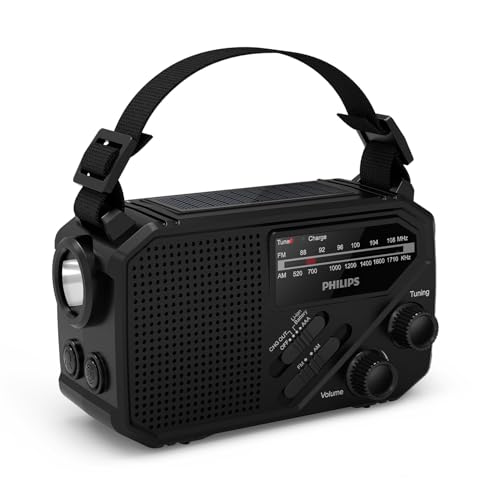
Most UK households: a mainstream-brand FM/AM set with its own rechargeable battery, three AAA cells as a fallback, and a crank and solar panel behind those.
as of 5 Nov 2026, 01:07 GMT · Details
Product prices and availability are accurate as of the date/time indicated and are subject to change. Any price and availability information displayed on Amazon.co.uk at the time of purchase will apply to the purchase of this product.Our verdict
The radio we'd put in a household kit first. Philips quotes up to 32 hours of listening from the built-in battery, it charges from the same USB-C lead as most modern phones, and it also runs on three ordinary AAA cells, so a flat internal battery doesn't leave you relying on the handle or the sun. There's no DAB, no headphone socket and no water-resistance rating, and Philips publishes no torch brightness or crank figure, but it does the one job GOV.UK asks of a radio, from a brand that publishes its specs, without an American weather band you can't use.
Worth knowing: FM/AM only, with analogue tuning: no DAB+, no presets and no headphone socket
Who shouldn't buy it: Don't buy it if you want DAB, or a radio that will properly charge a phone. Its USB-A port is an emergency top-up only, so keep a separate power bank.
Read the full review →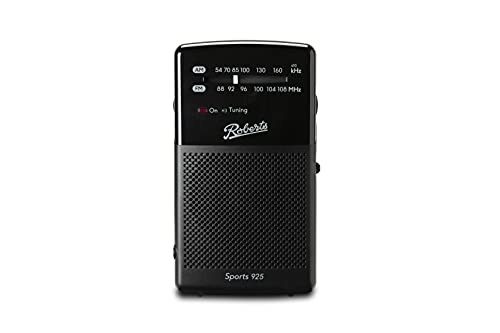
The plain 'battery radio' answer to the GOV.UK kit list: a pocket FM/AM set from a UK radio brand that runs for days on two AA cells and has little to go wrong.
as of 5 Nov 2026, 01:07 GMT · Details
Product prices and availability are accurate as of the date/time indicated and are subject to change. Any price and availability information displayed on Amazon.co.uk at the time of purchase will apply to the purchase of this product.Our verdict
GOV.UK Prepare asks for a battery or wind-up radio, and this is the battery one done simply. Roberts quotes up to 60 hours of playback, it runs on two AA cells, and there's no crank to seize, no solar panel to disappoint and no internal cell to go flat between emergencies. Its limits are plain: no torch, no phone charging, no DAB, and a small speaker that's quiet in a busy room, so keep headphones with it.
Worth knowing: No torch, no USB port and no DAB; it does one job only
Who shouldn't buy it: Don't buy it if you want one device for light and radio together, or DAB. Pair it with a head torch, or pick the Philips TAR1609 for a radio that also has a torch and a crank.
Read the full review →Photo: AmazonOur top pickA tough household radio that can top up a phone from its own cell and keep going from the crank or the sun, if FM and AM are enough.
as of 5 Nov 2026, 01:07 GMT · Details
Product prices and availability are accurate as of the date/time indicated and are subject to change. Any price and availability information displayed on Amazon.co.uk at the time of purchase will apply to the purchase of this product.Our verdict
Sangean's manual states the figures that matter: about 24 hours of play from a full 2,600mAh cell, about 3 hours to recharge by USB-C, and about 10 minutes of listening per minute of winding at 100 turns a minute. IP55 against dust and splashes is on the datasheet, and a 5V/1A USB-A port is a usable phone top-up. Against it: 900g, FM and AM only with no DAB+, and a built-in cell with no AA or AAA fallback, so when the cell is flat you depend on the crank or the sun.
Worth knowing: FM and AM only, with no DAB+ band
Who shouldn't buy it: Don't buy it if you want DAB+ or something light for a grab bag. The Sangean MMR-88 DAB+ is 377g with DAB+, and the Philips TAR1609 weighs 390g.
Read the full review →Photo: AmazonRunner-upA DAB+ and FM set that charges its own NiMH AA cells from the mains adaptor while it's switched off, so a charged set of cells is waiting when the power goes.
as of 5 Nov 2026, 01:07 GMT · Details
Product prices and availability are accurate as of the date/time indicated and are subject to change. Any price and availability information displayed on Amazon.co.uk at the time of purchase will apply to the purchase of this product.Our verdict
The more useful of the two Roberts Play sets for a power cut. Roberts' guide quotes up to 25 hours from four alkaline cells, and a switch in the battery bay lets the radio recharge NiMH cells from its own adaptor in about 7 hours, so spare AAs are a fallback you can keep topped up. It adds Bluetooth, 20 presets and rubber bumpers. It has no crank, solar panel, torch or phone port and no published IP rating, so it's a radio that needs cells in hand rather than a self-powered one.
Worth knowing: No crank, solar panel, torch or phone-charging port
Who shouldn't buy it: Don't buy it if you need light or phone charging from the same device, or a set that refills without a mains socket. The Philips TAR1609 has a crank, solar panel and torch; the Sangean MMR-88 DAB+ is the DAB+ alternative with a crank.
Read the full review →Photo: AmazonAlso goodA household that already likes DAB and wants a rechargeable portable set for the kitchen that can also sit in the kit.
as of 5 Nov 2026, 01:07 GMT · Details
Product prices and availability are accurate as of the date/time indicated and are subject to change. Any price and availability information displayed on Amazon.co.uk at the time of purchase will apply to the purchase of this product.Our verdict
Both Roberts and John Lewis describe a DAB, DAB+ and FM set with a rechargeable battery rated at up to 20 hours. In a long power cut that is the weak point: it has no spare-cell option, so once the battery is flat you need mains or a power bank on the USB-C lead, and Roberts does not say whether it plays while charging. It is a good everyday radio with a UK brand behind it, rather than a purpose-built kit radio. Top it up every few weeks and it can serve both roles.
Worth knowing: No replaceable cells, so a flat battery needs a USB-C source; Roberts does not say if it plays while charging
Who shouldn't buy it: Don't buy it if you want a set that runs on spare cells. The Roberts Sports 925 takes two AA cells and quotes up to 60 hours, and the Philips TAR1609 takes AAA cells as well as its own battery.
Read the full review →
A plain battery DAB+ and FM radio from a UK radio maker for a kitchen shelf or a power-cut drawer, with spare AA cells as the whole power plan.
as of 5 Nov 2026, 01:07 GMT · Details
Product prices and availability are accurate as of the date/time indicated and are subject to change. Any price and availability information displayed on Amazon.co.uk at the time of purchase will apply to the purchase of this product.Our verdict
Roberts' current guide (Issue 4, September 2024) gives up to 20 hours from four AA alkaline cells, down from 30 hours in an earlier edition, so check which figure a retailer repeats. It's the honest low-tech answer: DAB, DAB+ and FM with RDS, six presets with a mains adaptor in the box. It isn't self-sufficient: no crank, solar panel, torch or phone port, and it doesn't recharge cells, so what you keep in the drawer decides how long it lasts.
Worth knowing: No crank, solar panel, torch or phone port; once the cells run out you need more cells or the mains
Who shouldn't buy it: Don't buy it if you want a radio that charges itself or lights a room. The Philips TAR1609 has a crank, solar panel and torch; the Roberts Sports 925 quotes 60 hours on two AA cells, though without DAB.
Read the full review →
A full-size DAB+ and FM set for a kitchen or a power-cut shelf that Panasonic rates for about 40 hours of DAB on four alkaline C cells, if you can live with the weight.
as of 5 Nov 2026, 01:07 GMT · Details
Product prices and availability are accurate as of the date/time indicated and are subject to change. Any price and availability information displayed on Amazon.co.uk at the time of purchase will apply to the purchase of this product.Our verdict
Panasonic's spec page is the useful thing here: about 40 hours of DAB (30 on FM) from four alkaline C cells, but only about 12 hours (9 on FM) from manganese ones, and Panasonic says its figures assume its own batteries. That makes it one of the better-documented battery sets on this page, with a 10cm speaker, a backlit two-line display and a fold-down handle. The costs are about 1.3kg with the cells in, C cells that few homes keep spare, and no crank, solar panel, torch or phone port. It runs from the mains too, so the cells only matter when the power is off.
Worth knowing: About 1.3kg with cells in, and C cells are less likely to be in the house than AA
Who shouldn't buy it: Don't buy it if you want something light for a grab bag, or a phone top-up from the same device. The Roberts Sports 925 weighs about 150g on two AA cells, and the Philips TAR3500 has a USB-A port and AAA backup, though neither has DAB.
Read the full review →
A plain FM and AM radio from a big name that runs from the mains or three ordinary AA cells, for a shelf, a kitchen table or a power-cut drawer.
as of 5 Nov 2026, 01:07 GMT · Details
Product prices and availability are accurate as of the date/time indicated and are subject to change. Any price and availability information displayed on Amazon.co.uk at the time of purchase will apply to the purchase of this product.Our verdict
A straightforward analogue radio on three AA cells or the mains. Sony quotes about 35 hours on the speaker for both FM and AM, though it doesn't say which cells that assumes, and it has a 10cm speaker. For a power cut that's the whole job: ordinary cells, nothing to charge, a telescopic FM aerial and a built-in AM aerial. It has no DAB, torch or phone port, and tuning is by analogue dial, so stations take a little finding.
Worth knowing: FM and AM only, with no DAB, and analogue dial tuning
Who shouldn't buy it: Don't buy it if you want DAB or something pocket-sized. The Roberts Play 10 adds DAB on four AA cells, and the Roberts Sports 925 quotes 60 hours on two AA cells at about 150g.
Read the full review →
The simplest battery radio: a pocket FM and AM set that runs for days on two AA cells, for a grab bag or a coat pocket.
as of 5 Nov 2026, 01:07 GMT · Details
Product prices and availability are accurate as of the date/time indicated and are subject to change. Any price and availability information displayed on Amazon.co.uk at the time of purchase will apply to the purchase of this product.Our verdict
Panasonic's current pocket radio does one job: FM and AM on two AA cells, which Panasonic says last about 64 hours on FM and 68 on AM with alkaline batteries, in a 111g set. There's nothing to charge, crank or fail, and AA cells are the easiest batteries to keep in stock. It has no DAB, torch, phone port or mains option, so it's for news and updates in a cut rather than a radio that does everything.
Worth knowing: FM and AM only: no DAB, torch, phone port or mains option
Who shouldn't buy it: Don't buy it if you want DAB, a light or a phone top-up from the same radio; the Roberts Play 10 adds DAB, and the Philips TAR3500 adds a crank, solar panel and torch.
Read the full review →
A pocket-sized DAB+ radio with crank and solar backup and a swappable 18650 cell, from a European electronics brand that publishes a proper manual.
as of 5 Nov 2026, 01:07 GMT · Details
Product prices and availability are accurate as of the date/time indicated and are subject to change. Any price and availability information displayed on Amazon.co.uk at the time of purchase will apply to the purchase of this product.Our verdict
Nedis states 15 hours of play from the 2,500mAh cell and 3 to 5 minutes of radio per minute of cranking, a modest figure, and its manual shows how to swap the 18650 cell. It's DAB+ and FM at 288g, with a torch, reading light and siren. The loose ends are real: no headphone socket, a 1W mono speaker, no published rating for the USB-A output so phone charging is unproven, no IP rating (the manual says to keep it dry), and a manual whose crank line ('around 3 to 5 minutes to fully charge') doesn't match the product page's figure.
Worth knowing: No headphone socket, a 1W mono speaker and no rated phone-charging output
Who shouldn't buy it: Don't buy it if you want a water-resistant set or a rated phone-charging port. The Sangean MMR-99 has both, a dust and water rating and a 5V/1A USB-A port; the Philips TAR3500 is rated for dust and water but gives no USB output rating. Neither has DAB+.
Read the full review →
A good-looking DAB+ and Bluetooth radio for the kitchen that Roberts rates for up to 25 hours on four alkaline AA cells; an everyday radio first and an emergency set second.
as of 5 Nov 2026, 01:07 GMT · Details
Product prices and availability are accurate as of the date/time indicated and are subject to change. Any price and availability information displayed on Amazon.co.uk at the time of purchase will apply to the purchase of this product.Our verdict
Roberts' guide gives up to 25 hours from four alkaline AA cells, which is a useful run time, and the mains adaptor is in the box for the rest of the time. But it's a worktop radio first: the same guide recommends the adaptor 'whenever possible' with cells for occasional use, the display light only stays on for about 12 seconds on batteries. DAB, DAB+, FM with RDS, Bluetooth and an aux input are all there, but there's no crank, solar panel, torch or phone port, and it doesn't charge cells, so a power cut means spare AAs.
Worth knowing: Roberts itself recommends mains power with cells for occasional use, and the display light lasts about 12 seconds on batteries
Who shouldn't buy it: Don't buy it if you're buying for a power cut rather than the kitchen. The Roberts Play 20 also quotes up to 25 hours and charges NiMH cells inside the radio, and the Philips TAR1609 adds a hand crank, a solar panel and a torch.
Read the full review →
An affordable DAB+ and FM set for a kitchen or a power-cut drawer that runs on four ordinary AA cells, with Bluetooth as a bonus.
as of 5 Nov 2026, 01:07 GMT · Details
Product prices and availability are accurate as of the date/time indicated and are subject to change. Any price and availability information displayed on Amazon.co.uk at the time of purchase will apply to the purchase of this product.Our verdict
Majority quotes up to 15 hours on four AA cells, and ordinary cells are the right fallback for an emergency set. It's DAB+, FM and Bluetooth with a headphone socket and a USB-C mains adapter in the box. The caveats are practical: Majority's manual says to switch it off at the rear switch on cells, because standby drains them; the 15-hour figure doesn't say which cells it assumes; and there's no crank, solar panel, torch or phone port. Majority's page and manual also disagree on the preset count and Bluetooth version, so treat those details as approximate.
Worth knowing: On cells it must be switched off at the rear switch, as standby drains them (Majority's manual), and the 15 hours isn't tied to a cell type
Who shouldn't buy it: Don't buy it if you want a longer-running battery set or one that charges its own cells. The Roberts Play 20 quotes up to 25 hours and charges NiMH cells in the radio, and the Roberts Play 10 quotes up to 20 hours at 332g.
Read the full review →
A very small, plain FM/AM set from a mainstream brand for a grab bag or a drawer, running on two ordinary AAA cells.
as of 5 Nov 2026, 01:07 GMT · Details
Product prices and availability are accurate as of the date/time indicated and are subject to change. Any price and availability information displayed on Amazon.co.uk at the time of purchase will apply to the purchase of this product.Our verdict
Philips publishes a short but clear data sheet for this one: FM and AM, two AAA cells, a headphone socket and a wrist lanyard in a 96g body. That meets the government's Be Ready checklist, which asks for a battery or wind-up radio, at the simplest level. Philips gives no battery life, no frequency ranges and no AM step, so there is no run time to plan around, and the 100mW output means a small speaker. Keep a spare pair of AAA cells with it.
Worth knowing: Philips states no battery life and no AM tuning step
Who shouldn't buy it: Don't buy it if you want a published run time. The Roberts Sports 925 quotes up to 60 hours from two AA cells, and the Philips TAR1609 adds a rechargeable cell, torch and crank.
Read the full review →
A DAB+ and FM wind-up radio from a maker that publishes its figures, for a household that wants DAB in a power cut and will keep it topped up by USB-C.
as of 5 Nov 2026, 01:07 GMT · Details
Product prices and availability are accurate as of the date/time indicated and are subject to change. Any price and availability information displayed on Amazon.co.uk at the time of purchase will apply to the purchase of this product.Our verdict
One of the few DAB+ wind-up radios whose maker states real numbers. Technaxx gives up to 10 hours from the 2,000mAh cell, about 3 hours to recharge over USB-C, a 150 lux torch with an SOS mode and a USB-A port rated 5V/1A for a phone top-up. It is also honest about the backups: a full charge takes up to 6 hours of winding or 35 hours of sunlight, so the crank and the panel are last resorts. Its gap for a power cut is that it takes no AA or AAA cells and has no stated water rating, so once the cell and your power bank are flat the crank is all that's left. At 293g it suits a grab bag.
Worth knowing: No AA or AAA fallback: the 2,000mAh cell, the crank or the panel is all there is
Who shouldn't buy it: Don't buy it if you want a radio that runs on ordinary cells when its battery is flat. The Philips TAR3500 takes four AAA cells and the Acta Berg DAB+ crank radio three, and the Roberts Play 20 runs DAB+ on four AA cells with no crank at all.

A cheap AM/FM backup with an AAA fallback and USB-C, for a grab bag or the car.
as of 5 Nov 2026, 01:07 GMT · Details
Product prices and availability are accurate as of the date/time indicated and are subject to change. Any price and availability information displayed on Amazon.co.uk at the time of purchase will apply to the purchase of this product.Our verdict
Still a sensible budget pick because it gets the fundamentals right: AAA cells as a fallback, USB-C charging and a limited lifetime warranty. Be clear-eyed about the rest. The torch is a 20-lumen glow, the 2,000mAh cell gives a phone a top-up rather than a charge, the NOAA band is silent here, and the big review counts quoted for it in some UK blogs come from the US listing, not the UK one.
Worth knowing: The torch is 1W/20 lumens, which is dim, and the 2,000mAh cell is a phone top-up at best
Who shouldn't buy it: Don't buy it if you want useful light or a real power bank. Add a head torch and a separate power bank, or step up to the Philips TAR1609 for a longer-running radio with published figures.
Read the full review →
A good-looking DAB+ and FM radio for the kitchen that can keep NiMH AA cells topped up from the mains, so they're charged when a cut starts.
as of 5 Nov 2026, 01:07 GMT · Details
Product prices and availability are accurate as of the date/time indicated and are subject to change. Any price and availability information displayed on Amazon.co.uk at the time of purchase will apply to the purchase of this product.Our verdict
Roberts' quick-start guide gives between 8 and 10 hours from four alkaline AA cells, with the mains adaptor in the box. Its useful trick is a built-in charger: fit four NiMH cells, move the switch in the battery compartment, and they fill from the mains in about 7 hours, so they're charged when the power goes. The guide describes the USB socket as for service use only, so don't expect a phone top-up. At about 1.2kg with no crank, solar panel or torch it's a kitchen radio first, and DAB needs a signal like any radio.
Worth knowing: About 1.2kg and 18cm tall, with no crank, solar panel or torch
Who shouldn't buy it: Don't buy it if you want a long run time or a phone top-up from the same set. The Roberts Play 20 quotes up to 25 hours and charges NiMH cells in the radio at 390g, and the Philips TAR3500 has a USB-A phone port and an AAA fallback.
Read the full review →
A light everyday DAB+ set that runs on four AA cells in a power cut, from a UK brand.
as of 5 Nov 2026, 01:07 GMT · Details
Product prices and availability are accurate as of the date/time indicated and are subject to change. Any price and availability information displayed on Amazon.co.uk at the time of purchase will apply to the purchase of this product.Our verdict
A plain kitchen-and-garden DAB+ and FM radio from Majority that also earns its place in a power-cut box: Majority quotes up to 15 hours from four AA cells, with a mains cable for every other day. It has 20 presets and a headphone socket; Majority's page and manual disagree on its weight (0.25kg against 550g). There's no crank, solar panel, torch or phone port, so keep spare AAs with it.
Worth knowing: Needs AA cells in a power cut: no crank, solar, torch or phone port
Who shouldn't buy it: Don't buy it if you want a self-powered radio. The Acta Berg DAB+ crank radio charges by hand and sun, and the Roberts Play 20 recharges its own NiMH cells.
Read the full review →
A cheap, small FM radio for a grab bag or drawer that runs on its own rechargeable battery and switches to AA cells when that's flat.
as of 5 Nov 2026, 01:07 GMT · Details
Product prices and availability are accurate as of the date/time indicated and are subject to change. Any price and availability information displayed on Amazon.co.uk at the time of purchase will apply to the purchase of this product.Our verdict
A small FM, AM and shortwave set whose useful trick is a power switch: XHDATA says it runs from a built-in 1,200mAh battery charged by USB-C, or from AA cells (two, according to the SWLing Post's review; XHDATA doesn't say), so a packet of AAs takes over when the battery runs down. It has a torch and a headphone socket, and the AM step switches to the 9kHz used in Europe. XHDATA doesn't say how long either supply lasts, and for news in Britain FM is the band that matters; the shortwave is a hobby extra.
Worth knowing: No DAB, and XHDATA gives no running time or torch brightness
Who shouldn't buy it: Don't buy it if you want DAB or published battery figures. The Majority Histon runs DAB+ and FM on four AA cells for up to 15 hours, and for FM the Roberts Sports 925 quotes up to 60 hours on two AA cells.
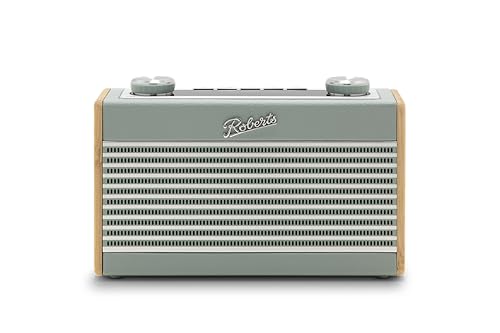
A good-looking DAB+ and Bluetooth radio for the kitchen that also runs on four AA cells; an everyday radio first and an emergency set second.
as of 5 Nov 2026, 01:07 GMT · Details
Product prices and availability are accurate as of the date/time indicated and are subject to change. Any price and availability information displayed on Amazon.co.uk at the time of purchase will apply to the purchase of this product.Our verdict
It does run without mains: four AA cells, alkaline or NiMH, and the radio charges NiMH cells itself in about 7 hours. Roberts' guide says 8 to 10 hours on alkaline, shorter than the other Roberts AA sets here. On paper it's a well-specified radio (DAB, DAB+ and FM with RDS, 20 presets, a 50mm speaker with a passive radiator, Bluetooth), but it's built for the worktop. With no crank, solar panel, torch or phone port, a power cut means spare cells.
Worth knowing: 8 to 10 hours on alkaline is short; the Play 10 and Play 20 quote 20 and 25 hours
Who shouldn't buy it: Don't buy it if you're buying for a power cut. The Play 20 quotes up to 25 hours on four AA cells, and the Philips TAR1609 can recharge itself.
Read the full review →
A light DAB+, FM and Bluetooth set that runs from the mains adaptor in the box, and in a cut from four alkaline AA cells, rated at about 8 hours at full volume.
as of 5 Nov 2026, 01:07 GMT · Details
Product prices and availability are accurate as of the date/time indicated and are subject to change. Any price and availability information displayed on Amazon.co.uk at the time of purchase will apply to the purchase of this product.Our verdict
Panasonic's manual quotes about 8 hours of DAB, FM or Bluetooth from four alkaline AA cells, measured at maximum volume, and gives no figure for quieter listening. That's a demanding test, but without a normal-volume figure you'd plan a long cut around spare cells. The same manual says not to use rechargeable cells, so there's no NiMH route. In its favour: DAB+ and FM, a 2.4-inch colour display, four preset keys and about 0.6kg with cells, with the mains adaptor in the box. There's no crank, solar panel, torch or phone port, and DAB needs a signal like any radio.
Worth knowing: Panasonic's manual says not to use rechargeable cells, so spares have to be disposable alkaline or manganese AAs
Who shouldn't buy it: Don't buy it if you want a long rated run time on batteries or a rechargeable option. The Roberts Play 20 quotes up to 25 hours on alkaline AA cells and charges NiMH cells inside the radio, and the Panasonic RF-D10EB quotes about 40 hours of DAB on four alkaline C cells, though neither figure is measured at full volume as this one's is.

A simple analogue-dial FM, AM and shortwave pocket set on two AA cells, for a grab bag or a shed.
as of 5 Nov 2026, 01:07 GMT · Details
Product prices and availability are accurate as of the date/time indicated and are subject to change. Any price and availability information displayed on Amazon.co.uk at the time of purchase will apply to the purchase of this product.Our verdict
XHDATA's own page is short but specific: two AA cells or a 5V DC input, manual analogue tuning, FM, AM and nine shortwave bands, 159g without cells and an English manual in the box. It publishes no battery life, and no mains adaptor is in its package list. The Amazon listing gives AM as 522-1620kHz, the 9kHz-step version that suits UK medium wave; XHDATA says its US warehouse stocks a 10kHz version instead. It's a cheap, simple set, not a rated one: no IP rating, torch or phone port.
Worth knowing: XHDATA states no battery life, and its package list names only the radio and a manual
Who shouldn't buy it: Don't buy it if you want a published run time or a rated build. The Roberts Sports 925 quotes up to 60 hours from two AA cells at about 150g, and the Philips TAR3500 has a published dust and water rating and quotes up to 60 hours from its lithium cell.
Read the full review →
A wind-up and solar set that also gets DAB+, for a home kit where BBC national stations on digital matter.
as of 5 Nov 2026, 01:07 GMT · Details
Product prices and availability are accurate as of the date/time indicated and are subject to change. Any price and availability information displayed on Amazon.co.uk at the time of purchase will apply to the purchase of this product.Our verdict
One of the few crank and solar radios on Amazon UK with DAB+ as well as FM, plus a 5,000mAh battery, a torch, an SOS alarm and a charging port in one 19cm box. Acta Berg publishes almost nothing beyond the listing: no battery life, no output rating for the charger, no weight and no dust or water rating, and the brand has no working website. Treat it as a capable-looking budget set, not a rated one.
Worth knowing: No published battery life, charging output, weight or IP rating; the brand has no working website
Who shouldn't buy it: Don't buy it if you want published figures. The Philips TAR3500 states IP55 and up to 60 hours from its lithium cell, and the Roberts SolarDAB 99 is a DAB+ wind-up from a UK brand.

A splash-resistant DAB+ and FM radio for the kitchen or garden that will run for an evening in a power cut and recharge from a power bank.
as of 5 Nov 2026, 01:07 GMT · Details
Product prices and availability are accurate as of the date/time indicated and are subject to change. Any price and availability information displayed on Amazon.co.uk at the time of purchase will apply to the purchase of this product.Our verdict
A well-documented DAB+ and FM radio from Philips: 10 hours from its 2,600mAh battery by Philips' own figure, USB-C charging that a power bank can feed, IPX4 splash resistance and 20 presets on each band. Philips says the battery is replaceable, which matters on a radio you might keep for years. As an emergency radio it has one real weakness: it takes no ordinary cells, so once the battery and your power bank are flat, it's silent. At 887g it's a household radio, not a grab-bag one.
Worth knowing: No AA or AAA option, crank or solar panel: it relies on its battery or a power bank
Who shouldn't buy it: Don't buy it if you want a radio that keeps going on ordinary cells. The Sony XDR-S40DBP runs DAB+ on four AA cells, and the Philips TAR1609 adds AAA cells, a crank and solar.
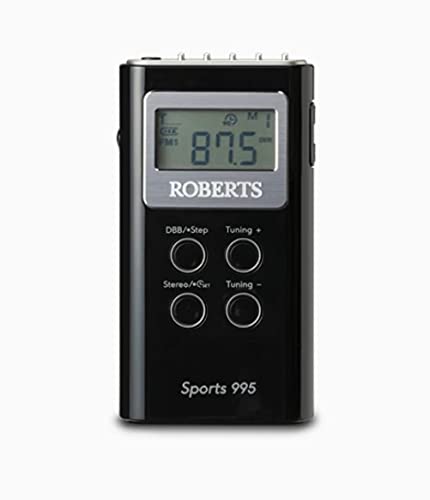
The cheapest way to keep FM news coming for one person: a pocket radio on two AAA cells with Roberts' own 30-hour figure, for a grab bag or a coat pocket.
as of 5 Nov 2026, 01:07 GMT · Details
Product prices and availability are accurate as of the date/time indicated and are subject to change. Any price and availability information displayed on Amazon.co.uk at the time of purchase will apply to the purchase of this product.Our verdict
A pocket FM and AM set from a UK radio brand, with digital tuning, 15 presets and a lock switch, that Roberts rates at about 30 hours from two alkaline AAA cells. It is a personal radio in the strict sense: the sound goes to the included earphones, there is no loudspeaker, and the earphone lead doubles as the aerial. That makes it a fine grab-bag radio for one listener and a poor kitchen radio for a household waiting for news together. The 90-minute auto power-off saves cells but needs cancelling if you want to leave it on.
Worth knowing: Earphones only: no loudspeaker, so only one person hears it
Who shouldn't buy it: Don't buy it if you want a speaker so the household can listen together. The Roberts Sports 925 and the Panasonic RF-P50D are the same idea with a loudspeaker on two AA cells, and the Philips TAR1509 is a speaker set on two AAA cells.

A compact AM/FM set with a clock and a small torch for a drawer, glovebox or tent, from a UK company, if you accept a very small 300mAh cell.
as of 5 Nov 2026, 01:07 GMT · Details
Product prices and availability are accurate as of the date/time indicated and are subject to change. Any price and availability information displayed on Amazon.co.uk at the time of purchase will apply to the purchase of this product.Our verdict
A step up from the Duronic Hybrid on features: a three-LED torch and a clock with alarm, on a 300mAh cell Duronic rates for 7 to 9 hours of radio. Duronic says a minute's winding gives 18 to 27 minutes of radio and one owner says at least 20, so that roughly holds up. Its manual shows the limits: the torch is only 11 to 14 lumens, and phone charging works by winding, at 4 to 15 minutes of talk time per 3 minutes of cranking, enough for a call, not a recharge. AM/FM only, with no AA or AAA option listed, and one owner says the tuning needs tweaking quite often.
Worth knowing: A 300mAh cell with no AA or AAA option listed, and a 35 to 42 hour solar charge by Duronic's figure
Who shouldn't buy it: Don't buy it if you want DAB, a proper phone top-up or a battery fallback. The Philips TAR3500 has a USB-A port, AAA backup and a replaceable cell, and the Roberts Sports 925 runs on swappable AA cells, though neither has DAB.
Read the full review →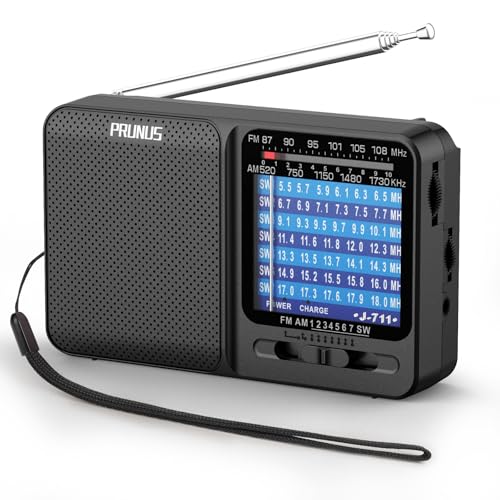
A cheap pocket set with a built-in rechargeable cell and an AA backup, if you accept that no run time is published.
as of 5 Nov 2026, 01:07 GMT · Details
Product prices and availability are accurate as of the date/time indicated and are subject to change. Any price and availability information displayed on Amazon.co.uk at the time of purchase will apply to the purchase of this product.Our verdict
The Amazon listing gives a built-in 1,200mAh cell charged over USB-C, two AA cells as a backup (not included) and a 42cm telescopic aerial, but no run time and no charge time. It's a light set at about 150g, with knob controls, a headphone socket and a wrist strap. The listing gives AM as 520-1730kHz but doesn't say whether it tunes the 9kHz steps UK medium wave uses, and shortwave is a hobby extra here. There's no torch or phone port. Treat it as a low-cost backup to an FM set you already trust.
Worth knowing: No run time or charge time is published, so the 1,200mAh figure can't be turned into hours
Who shouldn't buy it: Don't buy it if you want a published run time. The Panasonic RF-P50D quotes about 64 hours on FM from two alkaline AA cells at 111g, and the Roberts Sports 925 quotes up to 60 hours on two AA cells.

A neat DAB+ and FM set for the house that gives up to 15 hours a charge, if you'll keep it topped up rather than rely on spare cells.
as of 5 Nov 2026, 01:07 GMT · Details
Product prices and availability are accurate as of the date/time indicated and are subject to change. Any price and availability information displayed on Amazon.co.uk at the time of purchase will apply to the purchase of this product.Our verdict
Pure quotes up to 15 hours from a built-in 4,000mAh cell, lists 40 DAB+ and 40 FM presets, and publishes a proper datasheet, so it's a capable everyday portable. For a power cut its limits matter more: the cell isn't user-replaceable, there's no AA or AAA fallback, the box has a USB cable but no mains adapter, and Pure's safety sheet says to use it only in moderate indoor climates. It can't charge a phone or light a room. Charged, it gives up to 15 hours of listening; once the cell is flat it needs a USB power source again.
Worth knowing: The cell isn't user-replaceable and there's no AA or AAA option, so a flat set needs a USB charger or a power bank
Who shouldn't buy it: Don't buy it if you want spare cells as a fallback, or a set for a shed or a tent. The Roberts Play 20 takes four AA cells (up to 25 hours), and the Philips TAR1609 has a crank, solar panel and torch.
Read the full review →
A cheap crank-and-solar AM/FM/SW radio for a kitchen drawer, if you accept that nothing about its performance is documented.
as of 5 Nov 2026, 01:07 GMT · Details
Product prices and availability are accurate as of the date/time indicated and are subject to change. Any price and availability information displayed on Amazon.co.uk at the time of purchase will apply to the purchase of this product.Our verdict
A generic crank-and-solar radio with a 5,000mAh cell, AM, FM and shortwave bands and a phone-charging role. The only maker website that could be found is an empty placeholder, so every figure here comes from the Amazon listing, and that gives no run time, no crank figure and no USB output rating. No AA or AAA fallback is listed, so when the cell is flat you depend on the handle or the sun. It may well do the job, but nothing published lets us say how well.
Worth knowing: No maker documentation: the listing gives no run time, crank output, USB rating or AA/AAA fallback
Who shouldn't buy it: Don't buy it if you want published numbers or a battery fallback. The Philips TAR3500 quotes up to 60 hours with AAA backup, and the Sangean MMR-99 quotes about 24 hours of play and about 10 minutes of listening per minute of winding.

A small, cheap FM radio for a grab bag that also pulls in medium wave, long wave, shortwave and the airband, on a replaceable BL-5C cell.
as of 5 Nov 2026, 01:07 GMT · Details
Product prices and availability are accurate as of the date/time indicated and are subject to change. Any price and availability information displayed on Amazon.co.uk at the time of purchase will apply to the purchase of this product.Our verdict
A pocket world-band set from the maker of the D-219 and D-220, with digital tuning, 500 presets and a 5W speaker in a 190g body. For a British power cut the band that matters is FM, and the R-108 covers it; long wave is listed, but BBC Radio 4 left 198kHz on 27 June 2026, so that band, shortwave and airband are hobby extras rather than reasons to buy. The drawback for the emergency box is power: a BL-5C cell charged over USB, with no AA option and no running time published by XHDATA, so it needs topping up before it's needed, though the cell is a standard pattern and cheap to replace.
Worth knowing: No AA or AAA option, no torch, and XHDATA publishes no running or charging time
Who shouldn't buy it: Don't buy it if you want cells from the supermarket. The XHDATA D-219 and D-220 run on two AA cells, and the D-226 switches between a built-in cell and AA.

A small DAB+ and FM radio for the kitchen or a bedside that will run through an evening of a power cut and recharge from a power bank by USB-C.
as of 5 Nov 2026, 01:07 GMT · Details
Product prices and availability are accurate as of the date/time indicated and are subject to change. Any price and availability information displayed on Amazon.co.uk at the time of purchase will apply to the purchase of this product.Our verdict
A tidy DAB+ and FM set with Bluetooth, 30 presets on each band and a colour screen, charged by USB-C so a power bank can feed it. Lenco's own figure is up to 7 hours per charge, and its page gives the battery as 2,000mAh in one place and 2,500mAh in another, so treat the capacity as unconfirmed. As an emergency radio it has the usual weakness of a rechargeable-only set: no ordinary cells, no crank and no solar panel, so once the battery and your power bank are flat it's silent, and Lenco says it isn't water resistant. At 427g it's a shelf radio rather than a grab-bag one.
Worth knowing: No AA or AAA option, crank or solar panel: 7 hours on a charge, then it needs a socket or a power bank
Who shouldn't buy it: Don't buy it if you want a DAB set that keeps going on ordinary cells. The Majority Histon and the Roberts Play 20 run DAB+ on four AA cells, and the Technaxx TX-414 adds a crank and solar panel to DAB+.

A big, simple kitchen radio with a 3.5in speaker and number keys that runs on three D cells when the mains goes, for a home that will keep a pack of D cells beside it.
as of 5 Nov 2026, 01:07 GMT · Details
Product prices and availability are accurate as of the date/time indicated and are subject to change. Any price and availability information displayed on Amazon.co.uk at the time of purchase will apply to the purchase of this product.Our verdict
A plain mains radio that also takes three D cells, with FM, AM and shortwave, digital tuning with number keys, a 3.5in speaker and a carry handle. D cells hold far more charge than AA, but they're not what most homes keep in the drawer, and Retekess publishes no running time, so you're buying the capacity on trust. It has no DAB, no crank, no torch, and the USB socket is for a memory stick rather than a phone. At 852g before cells it is a shelf radio, best suited to a household that wants big buttons and a big speaker on the mains every day with a cell-powered fallback in the same box.
Worth knowing: Three D cells, not AA, and Retekess gives no running time on them
Who shouldn't buy it: Don't buy it if you keep AA cells rather than D. The Roberts Play 20 and the Majority Histon run DAB+ and FM on four AA cells, and the Panasonic RF-D10EB is the C-cell set with a published running time.

A very cheap pocket FM and AM radio with a torch for a drawer or glovebox, as long as you remember to charge it.
as of 5 Nov 2026, 01:07 GMT · Details
Product prices and availability are accurate as of the date/time indicated and are subject to change. Any price and availability information displayed on Amazon.co.uk at the time of purchase will apply to the purchase of this product.Our verdict
A pocket radio with a speaker, a torch and a rechargeable cell of the old Nokia BL-5C pattern, which is cheap to replace. Retekess gives 4 hours at full volume or 8 at a lower one, and about 2 hours to charge over USB. For a power cut the drawbacks are plain: it takes no ordinary cells, so a radio left in a drawer for a year arrives flat, and the torch's brightness isn't published. It earns a place as a spare for a car or a shed rather than as the household's main set.
Worth knowing: No AA or AAA option, so it needs charging before a cut rather than a fresh pack of cells
Who shouldn't buy it: Don't buy it if you want a radio that runs on cells you can keep in a drawer. The XHDATA D-226 is the same idea with an AA switch and a torch, and the Roberts Sports 925 runs on two AA cells with no battery to go flat.
Sold out right now (11)
The shop says these are sold out today. We check stock every hour, and each one moves back up the list when it returns.
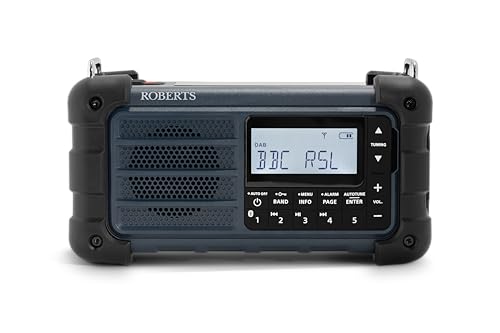
Someone who wants proper DAB+ from a UK radio brand with solar and crank backup, and will keep it on a kitchen shelf rather than in a rucksack.
Our verdict
The only DAB+ set here from a UK radio maker that also has a crank and solar panel: its product description promises up to 7 minutes of listening per minute of winding, which is modest and believable. IP55, up to 20 hours of playback by Roberts' figure and 40 presets make it a good everyday radio that keeps going in a cut. Against it: 830g, no AA or AAA fallback, a USB port owners can't agree works off the mains, and a premium price.
Worth knowing: No AA or AAA fallback, so once the internal battery is flat you're down to the sun and the handle
Who shouldn't buy it: Don't buy it if you want something for a grab bag, or you're paying extra for phone charging. Buy it as a resilient household DAB radio and keep a power bank for the phone.
Read the full review →
Mostly a power bank with a radio attached: a large internal cell for topping up phones through a long cut, with AM/FM and a Bluetooth speaker mode when you want sound.
Our verdict
Midland's manual gives a 10,000mAh cell, up to 100 hours of use (conditions not stated) and a USB-C port that outputs up to 3A, far more phone charging than most radios here offer. The catch is in the same manual: while it charges another device the radio drops to clock mode, so you can't charge and listen at once. For a cell this size the crank and solar panel are slow refills, with at best 10 minutes of recharge per hour of direct sun by Midland's figure. There's no DAB, no published IP rating and no AA fallback.
Worth knowing: The radio pauses while the unit charges another device, per the manual; AM/FM only, no DAB
Who shouldn't buy it: Don't buy it if you need DAB+, or want the radio to keep playing while it charges a phone. For DAB+ look at the Sangean MMR-88 DAB+ or the Nedis; the Philips TAR3500 adds an AAA fallback.
Read the full review →
Budget-minded DAB+ listeners who want a colour screen and Bluetooth, and who'll treat the battery figure as a claim.
Our verdict
A marketplace DAB+ crank radio that owners rate for its DAB reception, including in weak-signal areas, with a colour screen, Bluetooth and a 57mm speaker. We list the 12,000mAh battery as a claim because nobody has verified it, the AAA fallback is something owners report rather than the listing states, and there's no crank figure at all. Treated as a DAB+ radio you charge from the wall, it's a sensible buy; treated as a 12,000mAh power bank, it's unproven.
Worth knowing: The 12,000mAh capacity is the seller's unverified claim, and there's no published crank-to-play figure
Who shouldn't buy it: Don't buy it if you're buying it for the battery figure. Judge it on DAB+ reception and the screen, and check the AAA fallback works on day one.

A light DAB+ set for a kitchen shelf or a bag that can be topped up by crank, sun or USB-C, if you accept a short run time.
Our verdict
Sangean publishes more than most brands here: its manual gives about 10 hours of play from a full charge, about 5 to 7 minutes of listening per minute of winding at around 120 turns a minute, and about 15 hours in direct sun to refill the cell. That makes it a believable, modest set. It's DAB+ and FM at 377g with a swappable 18350 cell, but there's no AA or AAA backup, no IP rating and the phone port is a 5V/0.3A trickle. For a longer run the Roberts SolarDAB 99 quotes up to 20 hours, at more than twice the weight.
Worth knowing: About 10 hours per charge, no AA or AAA fallback, and a specialist 18350 cell to replace
Who shouldn't buy it: Don't buy it if you want a long run time, an IP-rated body or a quick phone top-up. The Philips TAR3500 quotes up to 60 hours, with AAA backup, and the Sangean MMR-99 has a rated 1A port and a dust and water rating, though it has no DAB+.
Read the full review →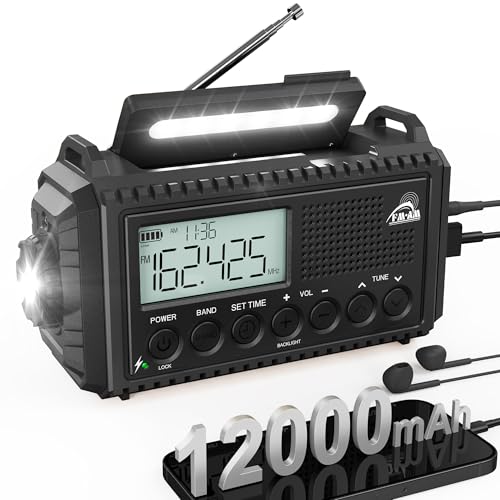
A power-cut standby for the hallway drawer: torch, loud siren, AM/FM and a battery that owners say will charge a phone, at a marketplace price.
Our verdict
A popular all-in-one that does the basics competently, with a brighter torch than most here. We've trimmed what we used to say about it: the 12,000mAh capacity is a seller's claim with no teardown behind it, the torch is 3W rather than 5W, and the siren is 116dB. It takes three AAA cells, which matters. One owner says a full day in the sun didn't move the battery level, so treat the solar panel as a slow extra, and shortwave is no help in a UK emergency.
Worth knowing: The 12,000mAh battery and '50+ hours' are unverified seller claims, and one owner says a day in the sun didn't move the battery level
Who shouldn't buy it: Don't buy it if you want DAB or a verified power bank. For DAB+ the CR1030DAB is the better ROCAM; for running times a manufacturer stands behind, look at the Philips sets.

A plain DAB+ and FM radio from a big name that runs on four ordinary AA cells in a power cut and from the mains the rest of the time.
Our verdict
A simple digital radio that does the power-cut job the boring, reliable way: four AA alkaline cells, which Sony rates for up to 13 hours (up to 10 on FM), or the mains. It has DAB+ and FM with ten presets for each, station names on the screen and a 445g body that sits on a shelf or in a drawer. It's a 2013 design with no crank, solar panel, torch or phone port, and it may be the last of its stock, so check the seller before you buy.
Worth knowing: An older 2013 model that may be discontinued, sold by a third-party seller rather than Amazon
Who shouldn't buy it: Don't buy it if you want a radio that can recharge itself. The Acta Berg DAB+ crank radio charges by hand and sun, and the Roberts Play 20 recharges its own cells on the mains.

A cheap all-rounder for a power-cut box: crank, solar and USB-C charging, a torch and a phone port in one pocket-sized set.
Our verdict
XHDATA is an established radio maker, and this is its wind-up model: a 3,000mAh battery that charges over USB-C, a hand crank and solar panel as backups, a torch and reading lamp, an SOS alarm and a USB port for a phone. AM tunes in 9kHz steps for UK medium wave. It has no DAB, and the listing gives no battery life, charging output, weight or dust and water rating. The weather band in its name is a US service, so ignore it here.
Worth knowing: No DAB, and no published battery life, charging output or IP rating
Who shouldn't buy it: Don't buy it if you listen on DAB. The Acta Berg DAB+ crank radio adds digital stations, and the Philips TAR3500 publishes its run time and an IP55 rating.
Read the full review →
The cheapest way onto DAB+ with an AAA fallback, if you'll charge it from the wall and treat the crank and solar panel as extras.
Our verdict
On paper the budget DAB+ answer: DAB+, FM with RDS, 60 presets, a 5,000mAh cell and three AAA cells as backup, in a 410g IPX4 body. Owner reports pull it down. Two owners say the solar panel adds little or nothing, one says the promised automatic switch to AAA never happened and the radio just shut down, and one got under 10 seconds of radio from 15 minutes of winding, though their fresh AAA cells also ran flat within hours, which points to a faulty set. So charge it from the mains, keep AAA cells in it, and don't count on the handle.
Worth knowing: Two owners say the solar panel adds little or nothing, and one got under 10 seconds of radio from 15 minutes of winding, possibly from a faulty set
Who shouldn't buy it: Don't buy it if you expect the crank or the sun to run it. If you can't keep it charged from the mains, a battery-only set or the Philips TAR1609 is the safer buy.

A cheap pocket FM, AM and shortwave set on two AA cells for a grab bag, if you accept thin published specs.
Our verdict
XHDATA's page confirms the essentials: two AA cells, medium wave from 522kHz, shortwave and a headphone jack. It does not publish a battery life, an AM step or an FM range on the page read, and the Amazon title wrongly suggests a wind-up. As a spare-cells set it does the basic job, but the older D-219 on this page has a fuller spec sheet. Treat it as a budget extra, not a primary kit radio.
Worth knowing: XHDATA's page states no battery life, no AM step and no FM range
Who shouldn't buy it: Don't buy it if you want a published run time or a rated build. The Roberts Sports 925 quotes up to 60 hours from two AA cells, and the Philips TAR3500 has a published dust and water rating.

A light rechargeable DAB+ and FM radio from a UK brand, for a kitchen or bedside, that a power bank can top up in a cut.
Our verdict
A compact 320g DAB+ and FM set from Cambridge brand Majority with 40 presets, Bluetooth and USB-C charging, plus a three-year warranty if you register it within 30 days. For a power cut it's a middling choice: Majority doesn't publish a running time for the 2,000mAh battery, and there's no slot for ordinary cells, crank or solar panel, so its staying power is your power bank's.
Worth knowing: Majority publishes no battery running time
Who shouldn't buy it: Don't buy it if you want a radio that runs on ordinary cells. Majority's own Little Shelford and Histon take four AA cells, as does the Sony XDR-S40DBP.

The cheapest, simplest pocket AM/FM set for a kitchen drawer, shed or greenhouse, from a UK company.
Our verdict
A tiny, long-selling wind-up radio that does one thing: AM/FM from a crank, a solar panel or a USB lead. Duronic claims 20 minutes of play per minute of winding and one owner gets about 15, so the figure roughly holds up. There's no torch, no AA option and a 300mAh cell good for about 7 hours, and, despite the listing title, Duronic's own FAQ says it won't charge a phone. We've corrected our entry to say so.
Worth knowing: No torch, no AA/AAA fallback and a 300mAh cell: about 7 hours of listening, then it's sun or handle
Who shouldn't buy it: Don't buy it if you want light, DAB, a battery fallback or any phone charging. It's a backup radio in the strictest sense.
Read the full review →ⓘ As an Amazon Associate, PreparedBritain earns from qualifying purchases. We may earn a commission when you buy, or a fee when you request a quote, through our links. When two products are close, commission can decide which one we pick. A clearly better product always wins. Amazon prices come from Amazon's own product data and show the date and time they were retrieved. Prices at other retailers are checked by us, less often. Prices and stock can change at any time, so always check the retailer's price before you buy.
The Power Cut Action Card
One page for the kitchen drawer: what to do first, what to have ready, how long food keeps, and how to stay warm without risking carbon monoxide. Free, no catch.
Download it straight away. We'll also send the occasional briefing when something genuinely matters — severe weather, live incidents, real price drops. Nothing else.
Before you buy
Start with how it takes power, in this order: ordinary batteries, then a rechargeable cell, then the crank, then solar.
Alkaline AA and AAA cells keep their charge for years in a drawer; a radio's internal lithium cell slowly loses charge between emergencies and needs topping up, and a radio that only recharges by USB is no better placed than your phone when the sockets are dead. By their makers' or listings' own account, the Philips TAR1609 and TAR3500, the FosPower A1, the RunningSnail MD-090, the ROCAM 1009Pro and the AM/FM/SW ROCAM all take AAA cells as well as their built-in battery, owners report the ROCAM CR1030DAB does too, and the PRUNUS J-711 keeps two AA cells as a backup. The Technaxx TX-414, the Lenco PDR-045, the Retekess PR11 and the XHDATA R-108 take no cells at all, by their makers' pages. Sets without a crank are simpler still: the Roberts Sports 925, Panasonic RF-P50D and XHDATA D-219 run on two AA cells, the Sony ICF-506 on three, the Roberts Sports 995 on two AAA cells to earphones only, the Retekess TR629 on three D cells or the mains, and the Roberts Play 10, Play 20, Rambler Uno, Revival Uno BT and Revival Mini 2, the Majority Little Shelford and the Panasonic RF-D15 on four AA or the mains, with the Panasonic RF-D10EB on four C cells. Roberts and Duronic list no AA or AAA option for the SolarDAB 99 and the Hybrid. Treat the crank as a fallback: the SolarDAB 99's product description promises up to seven minutes of listening per minute of winding, Duronic claims twenty on the Hybrid and one owner gets about fifteen, while Philips, FosPower and ROCAM publish no crank figure. The small solar panels trickle-charge over hours of real daylight and do nothing on the first evening.
FM is the band that matters, and long wave no longer counts.
The BBC switched Radio 4 off 198 kHz long wave at 01:00 on 27 June 2026 and closed the Droitwich, Westerglen and Burghead transmitters, so a radio bought for its long wave or shortwave bands has lost its UK selling point. FM still carries BBC Radio 1 to 4 and, more usefully in a local emergency, BBC local radio. FM's own future is under review: on 12 February 2026 the government launched a Radio Review that asks whether there should be a managed transition away from FM in the 2030s, due to report to government in autumn 2026. The previous review, in 2021, concluded FM should continue until at least 2030, and nearly 75% of UK radio listening now happens on digital or online platforms. The practical rule is simple. FM is the safe core today, DAB+ is a worthwhile bonus, and if you're spending more than the minimum, a set with both is the safer buy for the next decade. Few wind-up radios have DAB: most cheap crank designs are built for the American AM/FM market, and a DAB+ tuner adds cost. On many sets it also draws more current than FM, though the evidence is mixed and varies by radio, which is one of the things we want to measure. The wind-up sets here with DAB+ are the Roberts SolarDAB 99, the Sangean MMR-88 v2, the Nedis RDDBCR2000GN, the ROCAM CR1030DAB and the ROCAM 1009Pro, and most of the battery and mains sets from Roberts, Panasonic, Pure and Majority carry DAB+ as well.
Read battery figures as claims unless a manufacturer stands behind them.
Marketplace sets advertise 12,000mAh and more, and we found no independent teardown that confirms any of those figures, so this page labels them unverified. The more useful number is hours of listening from the manufacturer: Philips states up to 60 hours for the TAR3500 and up to 32 hours for the TAR1609; Roberts states up to 60 hours for the AA-powered Sports 925 and up to 20 hours for the SolarDAB 99; Duronic states about 7 hours from the Hybrid's 300mAh cell. The ROCAM listings' '50+ hours' and '25 hours at 50% volume' are the sellers' figures. Even big brands slip: Philips' TAR3500 page gives the battery as 5,200mAh in its spec table and calls it a 2,600mAh power bank elsewhere. A maker that publishes a modest, specific number is usually a better bet than a listing that prints a big round one.
Decide whether it lives on a shelf or in a bag, then weigh it.
The Duronic Hybrid is 230g by Duronic's figure and pocketable (Roberts gives no weight for the Sports 925); the FosPower A1 is 310g, the Philips TAR1609 390g and the ROCAM 1009Pro 410g, all fine in a rucksack; the AM/FM/SW ROCAM is 522g, the Philips TAR3500 670g and the Roberts SolarDAB 99 830g, which are household radios. Water resistance is patchy: the TAR3500 and SolarDAB 99 are IP55 by their makers, the 1009Pro IPX4 and the FosPower IPX-3 by their listings, the TAR1609 has no rating stated, and the AM/FM/SW ROCAM's 'IPX6/IPX4' wording is ambiguous, so assume splash-resistant at best. Torches are an afterthought on most of these: the FosPower's is a stated 20 lumens, the AM/FM/SW ROCAM's a stated 3W (about 150 lumens), and Philips and Roberts don't publish brightness. If you need light in a power cut, a head torch is a better tool than any radio's torch.
Set the presets tonight, not during the cut.
The standard advice from councils and local resilience forums is 'go in, stay in, tune in', and the government's Be Ready checklist asks you to write down the frequencies of the stations you'd use for news. Tune in your BBC local station on FM first, since that's where practical local information goes out when something happens in your area, then BBC Radio 4 on FM and a local commercial station. If you don't know the frequencies, scan the band at home and note where each station sits on the dial or display. On a DAB+ set, store the same stations on the digital side too, because a weak DAB signal drops out where FM would just hiss. Then do the test that matters: put the radio where you'd actually use it, on the kitchen table or by the bed, and check it holds the station there. Owners of more than one set here report reception that's fine in town and weaker outside it.
On phone charging, read the small print rather than the title.
Duronic's own FAQ says the Hybrid 'does not include functionality to charge other devices', even though its listing title says 'USB Phone Charger'. Owners of the Roberts SolarDAB 99 report its USB output only works when the radio is on mains, or once power-save is switched off, so we treat it as unproven off-grid. An owner of the Philips TAR1659, the TAR1609's twin, says its USB port gives 0.5A at 5V, which is a slow emergency top-up. The FosPower's 2,000mAh cell is a top-up rather than a full charge, the bigger figures on the ROCAM listings are sellers' claims, and Philips states the TAR3500's capacity two different ways. Winding a handle to charge a phone is not a realistic plan on any of these. If keeping a phone alive is the goal, our power banks page is where that money should go.
Know where to buy, and how to read the reviews.
Most sets on this page are Amazon marketplace listings. Beyond Amazon, John Lewis sells the Roberts SolarDAB 99 and Roberts sells the Sports 925 on its own website; we don't quote those shops' prices because we can't re-check them on a schedule. On Amazon, three things can mislead. Star ratings are often pooled across colours, or even different models in the same listing family. Review counts quoted in UK blogs sometimes belong to the US listing. And some listings are sold from abroad, with a note that products 'may differ from UK products' or that the manufacturer's warranty may not apply, so check who is selling before you buy. Finally, treat a cheap lithium radio like any other lithium device: charge it on a hard surface, not on bedding, with working smoke alarms, and follow the charging advice in our lithium battery fire-safety guide.
For longer power cuts
A radio, torches and a power bank cover a short cut. If you want the fridge, the router or medical kit to keep going for longer, these are the three ways to do it.
A silent battery you can use indoors. Enough for lights, the router and phones through an evening, or a fridge-freezer on a bigger one.
For cuts that run into days. Petrol or dual fuel, outdoors only, never in a garage or shed: the exhaust carries carbon monoxide.
2 to 4 kWh that stays in the house, often with solar panels to top it up, for a long cut or a home that relies on power for medical kit.
Not sure how big? What size power station do you need → · Power station or generator →
We haven't cranked, timed or run down any of these radios ourselves yet, so nothing here is a hands-on result. Every specification in the table and the verdicts was checked on 4 October 2026 against the manufacturer's own page where one exists (Philips, Roberts, and Duronic's FAQ on its listing), with the sets added on 2 November 2026 (Technaxx, Lenco, the Roberts Sports 995, Retekess and the XHDATA R-108) read against their makers' pages or user guides on that date, against a major retailer's listing for figures the maker's page leaves out (John Lewis for the SolarDAB 99's weight and crank figure), and, for marketplace brands, against the Amazon UK listing's bullets and spec fields; we say which. Battery capacities and crank figures that come from a seller rather than a maker are labelled as claims, and where a maker states a figure two different ways we say so. Where owners' reviews supply a figure or contradict a listing, we say 'owners report' and never present it as fact. Amazon prices and stock come from Amazon's API on a schedule, not from reading the page, and store prices we can't re-check automatically aren't quoted. When two products are close, commission can decide which one we pick. A clearly better product always wins. When we do measure crank-to-play, FM against DAB battery life and real USB output, the entries will be labelled Used and reviewed by us and show the method. Read our full methodology →
Related kit comparisons
Guides that go with this
In a long power cut the local mast can go quiet. What still works, how long masts last on Ofcom's own figures,…
Long wave closed in June 2026, and half the wind-up radios on sale here advertise an American weather band tha…
A minister, a former national security adviser and a former defence secretary have all warned about cyber atta…
The free number to save today, what to have ready, food safety, staying warm safely, and the compensation you …
A simple, practical household emergency plan — following the government's Be Ready advice: contacts, meeting p…
What the loud siren means, when the government sends Emergency Alerts, what a real one looks like, and how — a…
A calm, sourced look at the 'national blackout' scenario: why it's a low-likelihood risk the grid is engineere…
Why lithium batteries fail, the charging rules that prevent fires, warning signs of a failing pack, and how to…
Common questions
What is the best wind-up radio in the UK?
For most households, the Philips TAR1609 when it's in stock: an FM/AM set from a mainstream brand that runs on three AAA cells as well as its rechargeable battery, charges by USB-C, and is rated by Philips for up to 32 hours of listening on a full charge, with the crank and solar panel as backups. Amazon sold out of it in late October 2026, and while it's away the Sangean MMR-99 is the crank radio to buy: AM/FM with RDS, solar and crank, IP55 and a 5V/1A phone port, from a maker that publishes its figures, though it takes no ordinary cells. If you want DAB+ with a crank, the Technaxx TX-414 publishes its numbers, and the Roberts SolarDAB 99 is the UK-brand choice when it's stocked; if you want IP55 and the most complete published specification, the Philips TAR3500, which Amazon listed as ships-later through October and early November 2026. We rank on verified specs and owner evidence, not hands-on tests, and we say so on every entry. Stock of wind-up radios comes and goes; the picks at the top of the page only ever show sets you can buy now.
Is a hand-crank radio the same as a wind-up radio?
Yes. Wind-up, windup, hand-crank and crank radio are names for the same thing: a radio with a built-in rechargeable battery that you can top up by turning a handle. Most add a small solar panel and USB charging, many have an LED torch, and some have a USB socket to top up a phone. The radios on this page without a crank, which run on ordinary cells or the mains, are compared with each maker's running time on our battery radios page.
Can I get a wind-up DAB radio?
Yes, but the choice is small. On this page seven wind-up sets receive DAB+ as well as FM, with solar and crank backup: the Roberts SolarDAB 99, the Sangean MMR-88 v2, the Nedis RDDBCR2000GN, the ROCAM CR1030DAB, the ROCAM 1009Pro, the Acta Berg DAB+ crank radio and the Technaxx TX-414, the last two the ones still on sale when most of the others sold out in autumn 2026. Most crank radios are American AM/FM designs, and a DAB+ tuner adds cost and, on many sets, draws more power than FM, which is why DAB versions are rarer and dearer. Make sure any DAB set also has FM: a weak DAB signal drops out where FM would still be audible.
Does Radio 4 still broadcast on long wave?
No. The BBC switched Radio 4 off 198 kHz long wave at 01:00 on 27 June 2026, and the long wave transmitting stations at Droitwich, Westerglen and Burghead closed with it. A long wave radio no longer receives BBC programming, and buying guides that still call long wave the national fallback are out of date. Use FM, and DAB where you have it.
Is FM being switched off in the UK?
Not yet. The 2021 review concluded FM should continue until at least 2030. On 12 February 2026 the government launched a new Radio Review, which asks whether there should be a managed transition away from FM in the 2030s and, if so, over what timescale; it is due to report in autumn 2026. Nearly 75% of UK radio listening already happens on digital or online platforms. For a radio you'll keep for ten years, a set with both FM and DAB+ is the safer buy, but FM alone is fine today.
How much listening does a minute of winding give?
Less than the marketing suggests, and most makers don't say. The Roberts SolarDAB 99's product description promises up to 7 minutes of listening from 1 minute of cranking. Duronic claims 20 minutes on its Hybrid, and one owner gets about 15 with the sound fading after 8. Philips, FosPower and ROCAM publish no figure we could verify. Treat the crank as a last resort for catching the news on the hour, and keep spare batteries for everything else.
Can a wind-up radio charge my phone?
Rarely in any useful way. Duronic's own FAQ says the Hybrid can't charge other devices at all, despite its listing title. Owners of the Roberts SolarDAB 99 report its USB output only works on mains unless power-save is switched off. An owner of the Philips TAR1659, the TAR1609's twin, says its port gives 0.5A at 5V, a slow top-up. The Philips TAR3500 is built to double as a power bank, though Philips states its capacity two different ways. Cranking a handle to charge a phone is not realistic on any of them. A separate power bank is the right tool, and our wind-up power banks page compares the ones that carry a crank of their own.
Should I buy a battery radio or a wind-up radio?
The government's Be Ready checklist asks for a battery or wind-up FM radio, so either does the job. Alkaline AA or AAA cells keep their charge for years, so a battery set with a spare pack beside it is a perfectly good emergency radio: the Roberts Sports 925 and the Panasonic RF-P50D are pocket FM/AM sets on two AA cells, and the Panasonic RF-D10EB runs DAB+ and FM on four C cells. The best of both is a crank set that also takes AAA cells, such as the Philips TAR1609 or TAR3500, where the handle and solar panel only matter once the cells are spent. The weakest option is a set that recharges by USB only.
Can I get a wind-up radio with a torch built in?
Yes. Most hand-crank emergency radios have an LED torch built in, and many add a power bank for a phone. One unit saves space in a grab bag, but a separate torch is still worth having: you can light a room without running the radio's battery down, and two lights are better than one in a long cut. Our wind-up torches comparison covers the stand-alone ones.
Which stations should I preset for an emergency?
Your BBC local station on FM first, because practical local information in an incident goes out there; then BBC Radio 4 on FM and a local commercial station. On a DAB+ set, store the same stations digitally as well. The government's Be Ready checklist asks you to write down the frequencies of your news stations, and the standard council advice is 'go in, stay in, tune in'. If you don't know the frequencies, scan the band at home and note where each station sits. Test the radio where you'll actually use it, not just at the window.
Where can I buy a wind-up radio on the high street in the UK?
Of the sets on this page, John Lewis sells the Roberts SolarDAB 99 and Roberts sells the battery-only Sports 925 on its own website; the others we've checked only on Amazon. Shops' radio ranges change, so check stock online before you travel. We don't quote other shops' prices because we can't re-check them automatically.
Are the 12,000mAh batteries on cheap crank radios real?
Treat them as unverified. Marketplace sets advertise 12,000mAh and more, and we found no independent teardown that confirms any of them. The figures we trust more are running times that manufacturers publish and stand behind: Philips states up to 60 hours for the TAR3500 and up to 32 hours for the TAR1609; Roberts states up to 20 hours for the SolarDAB 99 and up to 60 hours for the AA-powered Sports 925. Where a listing's capacity appears on this page we label it a claim, and where a maker contradicts itself, as Philips does on the TAR3500's capacity, we say so.